
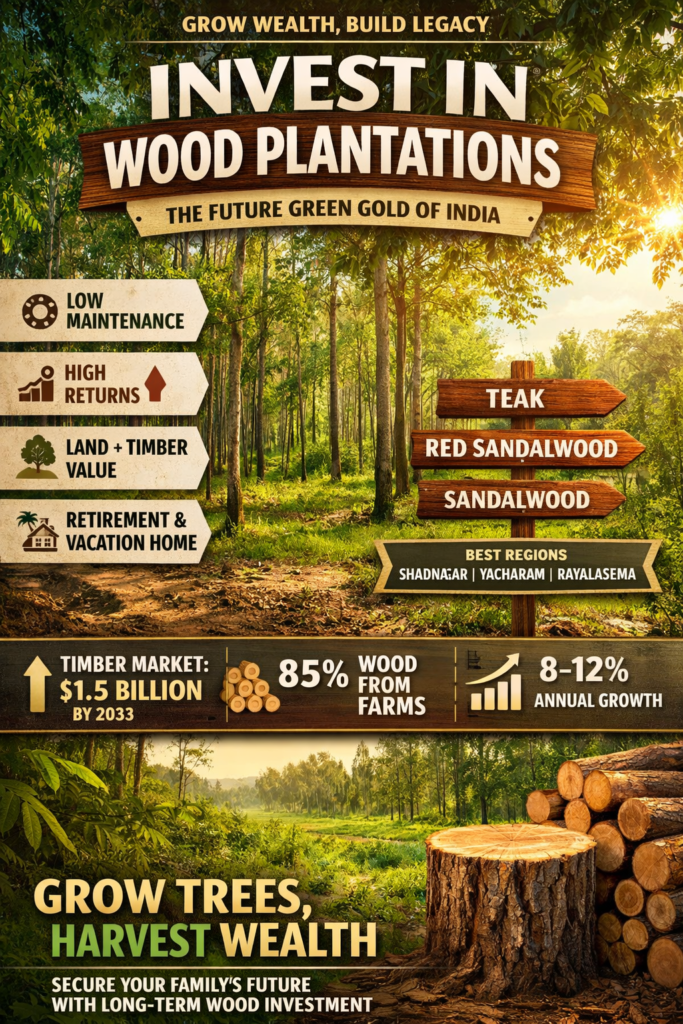
In today’s fast-changing investment landscape, smart investors are moving beyond traditional assets and exploring commercial agricultural land with wood plantations. With rising demand, limited supply, and long-term value creation, timber farming is emerging as a powerful wealth-building strategy—especially near growing urban corridors like Hyderabad.
🌱 Why Wood Plantation Farming is Gaining Momentum
Unlike seasonal farming (vegetables, fruits, pulses), timber plantations offer:
- ✅ Low maintenance after initial years
- ✅ Minimal labor requirements
- ✅ No seasonal stress or continuous monitoring
- ✅ Long-term high-value returns
- ✅ Dual appreciation: Land + Trees
👉 While traditional crops demand constant effort and capital every season, wood plantations grow silently—compounding value over time.
🌍 Right Tree in the Right Soil = Maximum Returns
One of the most critical factors in timber success is geographical suitability.
Every wood species grows best in specific soil and climatic conditions.
🌳 Popular Timber Species in India:
- Teak – thrives in well-drained loamy soils
- Red Sandalwood – best in dry, mineral-rich regions
- Sandalwood – prefers alkaline soils with host plants
- Melia Dubia – fast-growing, suits fertile lands
👉 Golden Rule:
Always buy land based on the tree you want to grow—not the other way around.
This ensures:
- Higher survival rates 🌱
- Faster growth 📈
- Premium timber quality 💰
📍 Best Regions for Wood Plantation (Hyderabad Growth Belt)
Strategically located farmlands near Hyderabad offer both agriculture + real estate appreciation.
Top emerging zones:
- Shadnagar
- Yacharam
- Ibrahimpatnam
👉 These regions are ideal for:
- Farm investments
- Weekend homes
- Future villa developments
- Long-term appreciation
🏡 More Than Farming: A Lifestyle + Legacy Asset
Wood plantation land is not just an investment—it’s a multi-dimensional asset:
- 🌿 Vacation / Weekend Retreat
- 🏡 Retirement Planning Tool
- 🌳 Eco-living Experience
- 👨👩👧👦 Generational Wealth for Family
You’re not just buying land… you’re building a legacy that grows every year.
📊 India Wood Industry: Market Size & Growth
India’s timber and wood-based industry is expanding rapidly, driven by real estate, furniture demand, and exports.
🇮🇳 Key Market Insights:
- Timber construction market:
- $649 million (2024) → $1.56 billion by 2033
- ~10.4% CAGR growth
- Softwood lumber market:
- Expected to reach $1.06 billion by 2032
- ~11% CAGR growth
- Plywood industry:
- Growing at 6–7% annually
- Furniture exports:
- Increasing at ~10% yearly
👉 This shows consistent and strong demand growth across all wood segments.
🌳 India’s Supply Gap = Huge Opportunity
- 85% of industrial wood comes from farm-grown trees
- Agroforestry area: 12.8 million hectares
- Production: 91.5 million cubic meters
👉 Despite this, India still imports timber, especially high-quality wood.
Conclusion:
Demand is rising faster than supply → Future price appreciation is highly likely
📍 Telangana & Andhra Pradesh: Timber Hotspots
🌲 Telangana
- ~2,700 wood-based industries
- ~1,500 timber depots
- 98% raw material from agroforestry
👉 Strong local demand ensures easy market access for farmers
🌳 Andhra Pradesh
- Global hub for Red Sandalwood
- High-value export species
- Strict government regulations (important to follow)
👉 Regions like Rayalaseema are ideal for premium plantations
⚠️ Important Note on High-Value Woods
Species like Red Sandalwood and Sandalwood:
- Require government permissions
- Have strict harvesting and transport laws
- Carry theft risks
👉 Always ensure legal compliance before investing
⏳ Investment Timeline & Returns
| Tree Type | Growth Period | Return Type |
|---|---|---|
| Teak | 12–20 years | High-value timber |
| Sandalwood | 12–15 years | Premium luxury wood |
| Red Sandalwood | 15–20 years | Ultra high-value |
| Melia Dubia | 6–8 years | Fast income |
👉 A well-managed acre can generate significant wealth over time, depending on survival rate and market prices.
⚖️ Wood Plantation vs Traditional Farming
| Factor | Wood Plantation 🌳 | Seasonal Farming 🌾 |
|---|---|---|
| Maintenance | Low | High |
| Income | Long-term | Short-term |
| Risk | Market-based | Weather & pests |
| Labor | Low | High |
| Effort | Minimal | Continuous |
👉 Smart investors follow a hybrid model:
- Short-term crops for cash flow
- Timber for long-term wealth
🔮 Future Forecast: Why Wood is the Next “Gold”
🚀 Growth Drivers:
- Real estate expansion 🏗️
- Luxury interior demand 🪵
- Export growth 📦
- Sustainability trends 🌍
- Agroforestry policies 🌱
📈 Industry Outlook:
- Wood demand growing at 8–12% CAGR
- Premium timber demand rising faster
- Supply shortage likely to continue
“In the coming decades, wood will evolve from a raw material into a premium asset class.”
💰 Final Investment Perspective
Buy land where the tree naturally grows—and let nature multiply your wealth.
Commercial wood plantations offer:
- Long-term stability
- Tangible asset security
- High appreciation potential
- Lifestyle + financial benefits
🧠 Final Insight
- ✔ Not a quick-profit model
- ✔ Requires patience (10–15 years)
- ✔ Best suited for long-term investors
- ✔ Ideal for building generational wealth
🔑 Conclusion
If planned correctly, commercial wood plantation farming in India can outperform many traditional investments. With rising demand, limited supply, and strong market fundamentals, timber farming is becoming a future-ready investment strategy.
👉 Whether you’re planning for:
- Financial growth
- Retirement security
- Family legacy
Wood plantation is where land meets long-term wealth. 🌳💰