
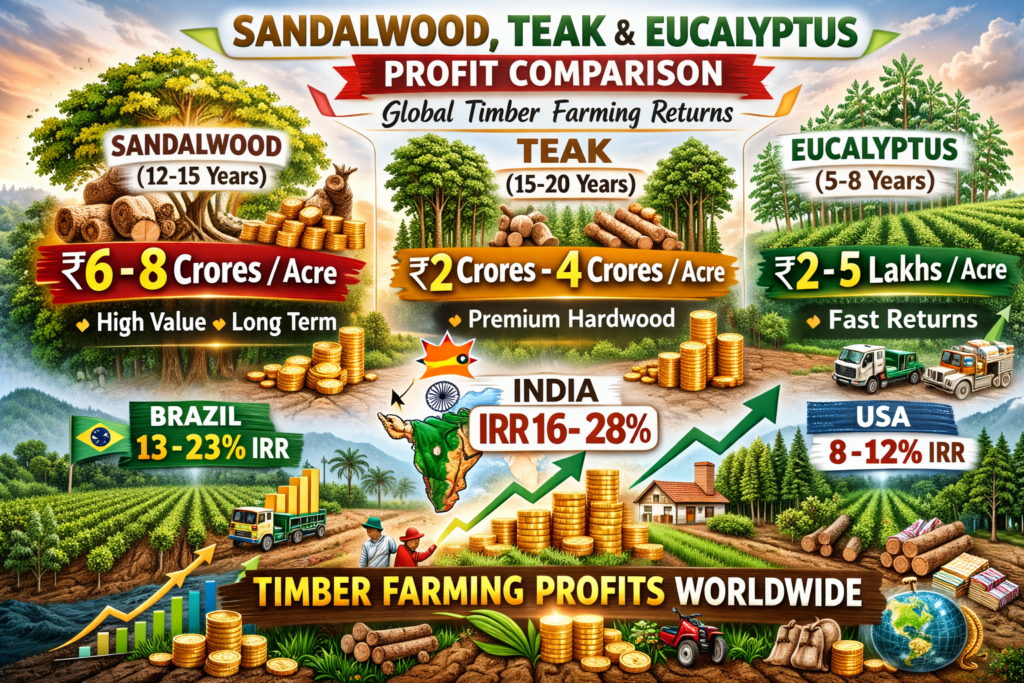
As agricultural margins shrink and land prices rise, farmers and landowners worldwide are turning toward timber cultivation and agroforestry as long-term wealth strategies. From eucalyptus plantations in Brazil to sandalwood farms in India, tree-based farming is increasingly viewed not just as agriculture — but as a strategic asset class.
This article combines global case studies, Indian field data, and species-wise profit projections to evaluate the real profitability of timber cultivation.
🌍 Global Timber Cultivation: Real Returns from Different Countries
🇧🇷 Brazil – Commercial Eucalyptus Success
Brazil
Brazil is one of the world’s largest eucalyptus producers. Commercial plantation models report:
- Rotation period: 6–7 years
- IRR range: 13%–23%
- Strong export pulpwood demand
- Mechanised large-scale farming
In several rural municipalities, expansion of timber plantations has been linked to poverty reduction and improved rural income levels.
Lesson: Fast-growing species with strong export markets generate consistent mid-term returns.
🇺🇸 United States – Pine as Institutional Asset
United States
Loblolly Pine
In the southern United States:
- Rotation: 20–25 years
- IRR: 8%–12%
- Low-risk, stable returns
- Popular among pension funds & institutional investors
Forestry here is treated as a long-term inflation hedge and diversification tool.
Lesson: Even moderate IRRs become powerful when stability and scale are strong.
🇮🇳 Timber Cultivation in India: Real Profit Comparisons
India’s agroforestry reforms have improved farmer freedom to grow and market timber. Here’s how major species compare.
🌿 Eucalyptus (Fast Rotation Model)
Eucalyptus
Rotation: 5–8 years
Investment per acre: ₹60,000 – ₹1 lakh
Net returns per cycle: ₹2 – ₹5 lakh
IRR: 20%–35% (in some regional studies)
Best suited for farmers seeking quicker returns with manageable risk.
🌲 Teak – Premium Hardwood Model
Teak
Rotation: 15–20 years
Trees per acre: 400–500
Total investment: ₹8–12 lakh over lifecycle
Revenue potential:
₹1 – ₹3 crore gross per acre (depending on quality & maturity)
Estimated net profit: ₹2 lakh – ₹4 crore
Teak is a long-term capital appreciation crop.
💎 Sandalwood – High Value, High Reward Timber
Indian Sandalwood
Among all timber species, sandalwood offers one of the highest per-acre value potentials.
Financial Snapshot (12–15 Years)
- Trees per acre: 250–450
- Total investment: ₹4 – ₹8 lakh
- Heartwood yield: 15–20 kg per mature tree
- Heartwood price range: ₹8,000 – ₹15,000/kg
Conservative Example:
250 surviving trees × 15 kg = 3,750 kg
At ₹10,000/kg average = ₹3.75 crore gross
Even under moderate pricing:
₹6 – ₹8 crore net potential per acre
Estimated IRR: 25%–35%
🌏 Australia’s Commercial Sandalwood Model
Australia
Australian Sandalwood
Australia developed structured sandalwood export systems:
- Rotation: 15–20 years
- IRR: 12%–18%
- Organized supply chains
However, Indian sandalwood commands higher global pricing due to superior oil quality.
📊 Timber vs Traditional Farming Income
| Farming Type | Income Pattern | Risk | Wealth Creation Potential |
|---|---|---|---|
| Annual crops | Yearly income | High (weather/market) | Moderate |
| Dairy/Livestock | Regular cash flow | Operational risk | Moderate |
| Eucalyptus | 5–8 year cycle | Medium | Medium-High |
| Teak | 15–20 year cycle | Medium | High |
| Sandalwood | 12–15 year cycle | Higher | Very High |
🌱 Agroforestry: The Smart Hybrid Model
Globally, the most successful farmer models integrate:
- Timber trees
- Intercrops (pulses, vegetables, grains)
- Fruit crops
- Livestock
This reduces waiting risk and improves annual cash flow while building long-term timber wealth.
⚠️ Risks to Consider
Timber farming is not risk-free:
- Long gestation period
- Price volatility
- Mortality rates (15–30% possible)
- Theft risk (especially sandalwood)
- Regulatory compliance requirements
Professional management and market linkage planning are critical.
💡 Strategic Wealth Planning Model (For Indian Landowners)
A diversified timber strategy could include:
✔ 30–40% fast rotation species (eucalyptus/poplar)
✔ 20–30% premium hardwood (teak/sandalwood)
✔ Remaining under fruit or seasonal crops
✔ Explore carbon credit markets
This approach balances cash flow + capital appreciation + land value growth.
🎯 Final Conclusion
Timber cultivation — especially premium species like teak and sandalwood — can generate multi-crore per acre returns over long cycles when executed professionally.
Globally, forestry is increasingly viewed as a stable, appreciating green asset class, and India is gradually moving in that direction through agroforestry reforms.
For farmers and farmland investors willing to think long term, timber cultivation represents:
- Inflation protection
- Asset appreciation
- Diversified income
- Generational wealth creation