
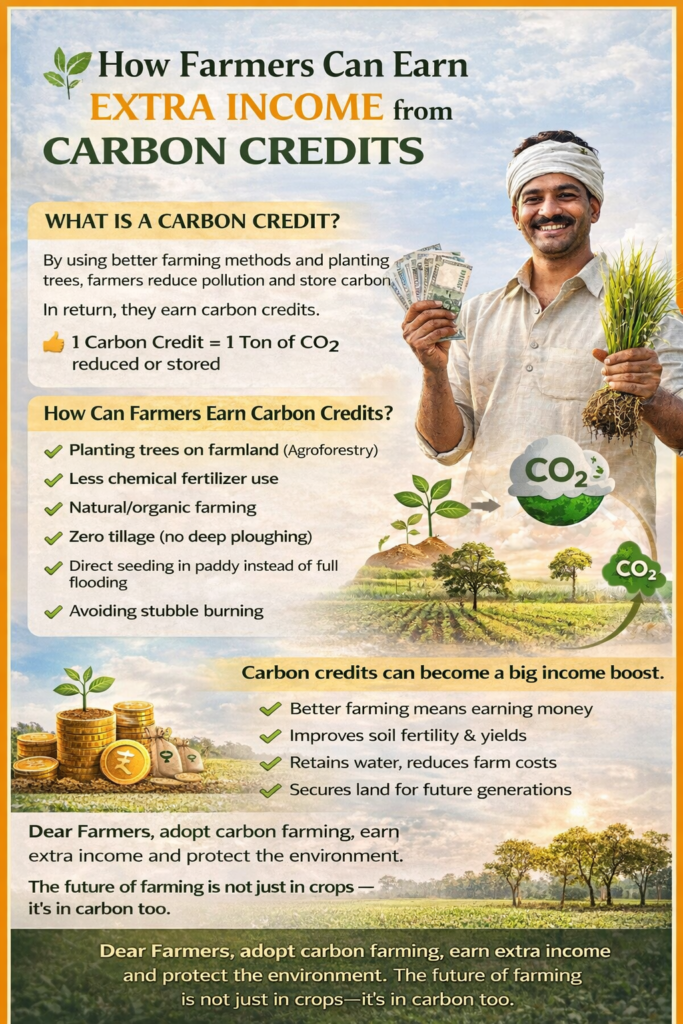
🌾 How Indian Farmers & the Agriculture Sector Can Benefit from the Voluntary Carbon Market (VCM)
Discover how Indian farmers can generate income through the Voluntary Carbon Market (VCM), how multinational companies buy agricultural carbon credits, and how government frameworks are enabling farmer participation.
Introduction: Agriculture at the Center of India’s Carbon Opportunity
India’s agriculture sector plays a dual role in the climate economy. While it contributes to greenhouse gas emissions, it also holds enormous potential to remove and store carbon through improved farming practices, soil management, and agroforestry systems.
The Voluntary Carbon Market (VCM) allows companies to purchase carbon credits generated from projects that reduce or remove carbon emissions. For Indian farmers, this represents a potential new income stream beyond traditional crop revenues.
With new policy frameworks, pilot programs, and institutional support emerging, agriculture is increasingly being integrated into India’s carbon economy.
What is the Voluntary Carbon Market (VCM)?
The Voluntary Carbon Market enables businesses, institutions, and multinational corporations to voluntarily purchase carbon credits to offset emissions and meet net-zero commitments.
Each carbon credit typically represents one metric tonne of CO₂ equivalent reduced or removed from the atmosphere.
In agriculture, carbon credits are generated through:
- Soil carbon sequestration
- Reduced tillage practices
- Direct seeded rice instead of flooded paddy
- Improved nutrient management
- Biochar application
- Agroforestry and tree plantation
- Methane emission reduction techniques
These activities are measured, reported, and verified (MRV) before credits are issued under recognized carbon standards.
Government Framework for Agriculture in the VCM (2024 Onwards)
In 2024, the Government of India introduced a formal framework for integrating agriculture into the Voluntary Carbon Market, including accreditation protocols for agroforestry nurseries.
The framework aims to:
- Enable small and medium farmers to participate in carbon markets
- Promote sustainable agricultural practices
- Create institutional support structures
- Build transparent benefit-sharing systems
Agricultural research institutions have been tasked with developing methodologies for carbon measurement, farmer training modules, and aggregation models.
This marks a significant shift from pilot experimentation to structured participation.
How Farmers Can Earn from Carbon Credits
Farmers adopting regenerative and climate-smart practices can generate measurable carbon sequestration.
Estimated Carbon Potential
Depending on crop type, soil, and region:
- 4–12 carbon credits per hectare per year may be generated
- Credits are issued after verification
- Projects typically run for 10–30 years
Income Model
Farmers can benefit through:
- Direct carbon credit payments
- Revenue-sharing agreements with aggregators
- Long-term carbon farming contracts
- Tree-based agroforestry carbon income
- Improved crop yields due to better soil health
In addition to direct carbon revenue, improved soil fertility and water retention enhance farm productivity and reduce input costs.
Role of Aggregators & Carbon Project Developers
Since smallholder farmers often lack direct access to global carbon buyers, project developers and aggregators play a key role by:
- Grouping farmers into carbon projects
- Handling MRV processes
- Managing certification and registration
- Selling credits to corporate buyers
- Sharing revenue with participating farmers
Technology platforms using satellite monitoring and digital measurement systems are increasingly simplifying participation.
Multinational Companies Buying Agricultural Carbon Credits
Global corporations with net-zero commitments are actively purchasing nature-based and agricultural carbon credits.
These companies seek:
- Soil carbon projects
- Regenerative agriculture credits
- Agroforestry carbon assets
- Methane reduction credits
- Long-term offtake agreements
Many multinational companies now prefer high-integrity, farmer-linked carbon credits that deliver both climate and social impact.
Increasingly, corporations are exploring:
- Direct investment in carbon farming projects
- Forward carbon purchase agreements
- Equity participation in agroforestry ventures
- Long-term carbon supply contracts
This demand is driving structured agricultural carbon programs in India.
Registered Agricultural & Agroforestry Carbon Projects in India
India has several registered and pipeline projects in:
- Agroforestry (tree-based farming systems)
- Improved rice cultivation
- Soil organic carbon enhancement
- Afforestation and reforestation on private lands
- Community-based landscape restoration
States actively participating include:
- Telangana
- Andhra Pradesh
- Karnataka
- Maharashtra
- Madhya Pradesh
- Odisha
- Uttar Pradesh
Pilot projects are increasingly integrating smallholder farmers through cooperative and self-help group models.
Institutional & Research Support for Agriculture VCM
Agricultural research institutions are developing:
- Carbon quantification methodologies
- Soil carbon baselines
- Standardized measurement protocols
- Digital monitoring systems
- Farmer training programs
Workshops and policy consultations are being conducted to align agriculture with India’s broader carbon trading mechanisms.
The long-term objective is to integrate agriculture into both voluntary and potential compliance carbon markets.
Ground Reality: Challenges in Farmer Participation
While the opportunity is promising, several challenges remain:
1. Limited Direct Benefit Realization
Some early pilot studies indicate that farmers did not always receive expected financial benefits due to project structure inefficiencies.
2. Complex MRV Requirements
Carbon measurement can be technically demanding and costly.
3. Long Commitment Periods
Carbon projects may require multi-year commitments.
4. Information Gaps
Many farmers lack awareness about how carbon markets function.
5. Revenue Distribution Transparency
Clear benefit-sharing mechanisms are essential to maintain trust.
To ensure inclusive growth, farmer-centric models must prioritize transparent payments and simplified participation processes.
The Future of Agriculture in India’s Carbon Economy
Despite early challenges, the agriculture VCM segment is expected to grow significantly due to:
- Rising global demand for nature-based carbon credits
- Strengthening Indian policy frameworks
- Corporate ESG pressure
- Climate finance flows into developing markets
- Technology-driven monitoring systems
India’s vast agricultural land base positions it as a major future supplier of agricultural carbon credits.
If structured correctly, carbon markets can:
- Diversify farmer income
- Improve soil health
- Increase climate resilience
- Attract private climate capital into rural India
Strategic Outlook for Farmers & Investors
For Farmers:
Carbon farming can become a supplementary income stream if:
- Projects are transparent
- Payments are timely
- Aggregation models are fair
- Technical support is accessible
For Multinational Companies:
Partnering directly with farmer groups or agroforestry ventures provides:
- High-integrity carbon credits
- Long-term supply security
- ESG credibility
- Community-linked sustainability impact
Conclusion: Can the VCM Transform Indian Agriculture?
The Voluntary Carbon Market has the potential to create a new economic layer for Indian agriculture — but only if farmer inclusion remains central to policy and project design.
With government frameworks now in place, institutional research support expanding, and multinational demand rising, agriculture is gradually becoming a legitimate carbon asset class.
The next phase will determine whether carbon markets become:
• A true income diversification tool for farmers
• A structured investment opportunity for corporations
• A scalable climate solution rooted in rural India
If implemented responsibly, agriculture can shift from being a climate vulnerability sector to becoming a climate solution provider.