
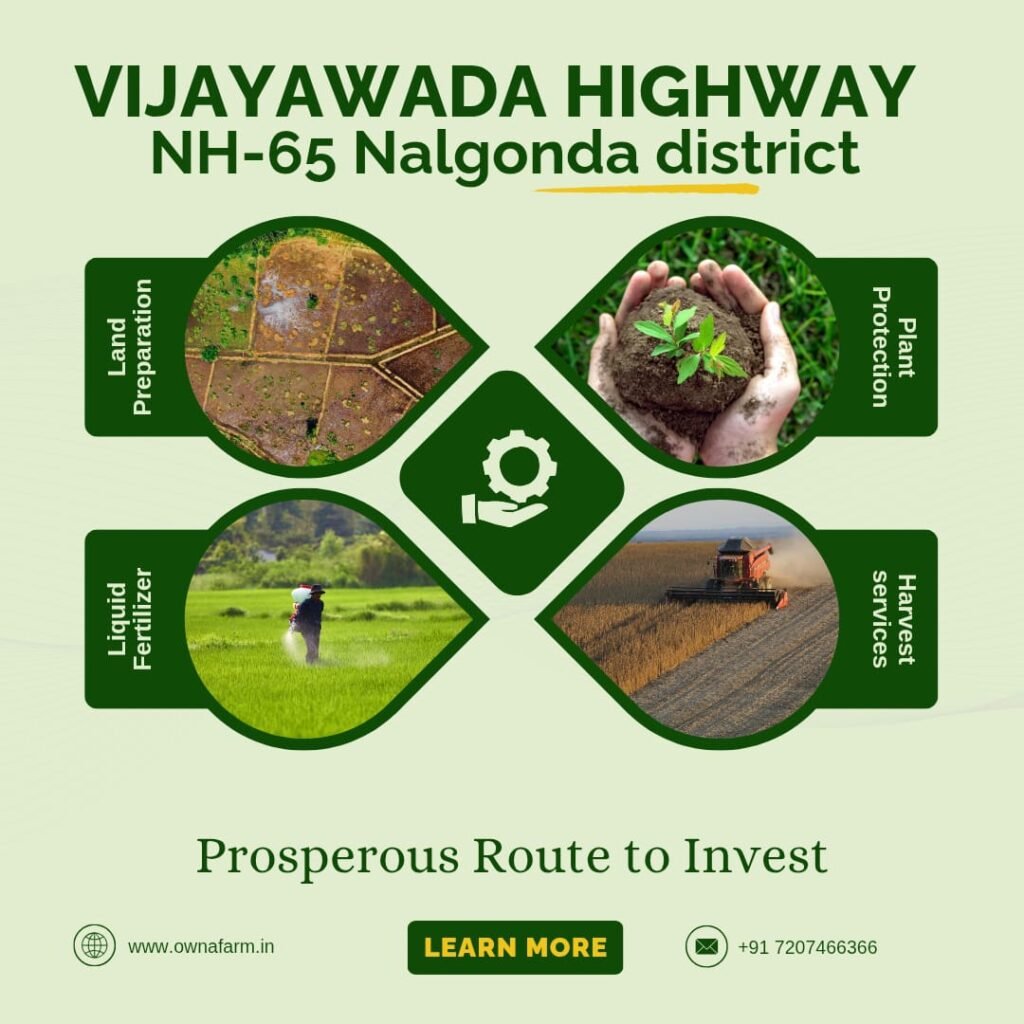
The National Highway 65 (Hyderabad–Vijayawada) corridor is one of Telangana’s fastest-developing agricultural belts. The stretch passing through Nalgonda district is particularly sought-after by farmland investors, agri-entrepreneurs, and progressive farmers because it combines excellent road access with diverse soil types, dependable cropping systems, and pockets of good irrigation resources.
This article provides a complete, easy-to-understand guide to soil types, mandal-wise soil characteristics, water availability, rivers, crop patterns, and temperature conditions—helping you make informed decisions before buying or cultivating farmland along NH-65.
1. Why Nalgonda District Near NH-65 Is Emerging as an Agricultural Hotspot
Nalgonda’s location along NH-65 offers a unique blend of:
- Fast access to Hyderabad and Vijayawada markets
- Transport convenience for vegetables, fruits, paddy, cotton, and agri-inputs
- Diverse land parcels—rainfed, irrigated, and river-belt soils
- Increasing demand for farmhouses, organic farming, and horticulture ventures
The region’s long agricultural tradition, combined with better connectivity, is creating new opportunities for commercial farming, natural farming, dairy, and integrated agri-projects.
2. Types of Soils in Nalgonda District (Mandal-Wise Summary)
Nalgonda district displays rich soil diversity, each supporting specific crops and water requirements. Below is a practical summary:
a) Red Sandy & Red Loamy Soils
Found in many upland and midland mandals around the NH-65 belt.
Characteristics:
- Good drainage
- Low to moderate organic matter
- Responds well to fertilizers and organic inputs
Best For: Millets, pulses, cotton, vegetables, orchards, flowers
b) Black Cotton Soils (Clayey/Vertisols)
Occur in pockets across several mandals.
Characteristics:
- High moisture retention
- Cracks during summer but excellent for rainfed crops
Best For: Cotton, red gram, bengal gram, oilseeds
c) Alluvial / Riverine Soils
Found along river courses and tank-fed areas.
Characteristics:
- High natural fertility
- Suitable for intensive cultivation
Best For: Paddy, sugarcane, vegetables, bananas, leafy crops
Mandal Examples (Generalized Patterns):
- Red Soil Dominant Mandals: Kattangur, Chityal, Narketpally, Munugode, Marriguda, Chandur
- Black Soil Pockets: Nalgonda Rural, Kethepally, Nidamanoor, Anumula
- Alluvial Soil Zones: Along Musi basin, near tanks, canals, and minor irrigation sources
(For plot-specific accuracy, soil testing is always recommended.)
3. Soil Fertility Levels in Nalgonda
Most farmland soils in Nalgonda are:
- High in Potassium (K) – naturally available
- Moderate to Low in Nitrogen (N) – needs supplementation
- Moderate in Phosphorus (P) – improves with balanced fertilization
- Low in Organic Carbon in many red soil areas
Adding FYM, green manure, and crop residue greatly improves yields, especially in horticulture and vegetable farming.
4. Water Resources & Irrigation Potential
a) Rivers Flowing Through Nalgonda
- Musi River (major river system of the district)
- Seasonal streams and tributaries feeding into Krishna basin
- Local nalas and irrigation channels supporting agricultural belts
b) Tank & Canal Irrigation
Nalgonda has a strong traditional tank network, providing water for:
- Paddy
- Vegetables
- Fodder crops
- Horticulture
Many villages rely on tanks supplemented by lift irrigation or canal-based schemes.
c) Groundwater Availability
Groundwater is variable across mandals:
- Good recharge areas: Near river belts, tanks, and low-lying plains
- Semi-critical areas: Some upland mandals with high borewell density
Before purchasing farmland, buyers should check:
- Borewell depth in surrounding farms
- Water quality (TDS levels)
- Local groundwater reports
5. Crops Grown Across Nalgonda District
Kharif Season (Monsoon)
- Cotton
- Maize
- Red gram
- Green gram
- Millets (jowar, bajra)
Rabi Season (Winter)
- Paddy
- Bengal gram
- Wheat (in pockets)
- Groundnut
Horticulture
Ideal for NH-65 belt due to quick market access:
- Mango
- Sweet lime & citrus
- Guava
- Banana (in irrigated belts)
- Vegetables (tomato, brinjal, leafy greens)
- Flowers (marigold, jasmine)
Horticulture and organic vegetable farming are rapidly gaining popularity near the highway, driven by demand from Hyderabad urban markets.
6. Temperature & Climate Conditions
Nalgonda falls under a hot semi-arid climatic zone, making it suitable for a wide range of crops with proper water management.
- Summer: 38°C to 45°C
- Monsoon: June to September
- Winter: 15°C to 25°C
This temperature profile supports both tropical fruit orchards and seasonal field crops.
7. Why Farmland Near NH-65 Is a Smart Investment
Investing in farmland near NH-65 in Nalgonda offers:
- Quick access to major cities and markets
- Better resale value compared to interior rural lands
- Suitable soil for diverse crops and farm models
- Strong potential for farmhouses, goat farms, dairy, and organic ventures
- Easier logistics for input supply and crop transportation
Whether you plan for farming, long-term investment, or a farmhouse project, the NH-65 belt offers excellent natural resources and growth potential.
Final Thoughts Agricultural lands around NH-65 in Nalgonda combine soil diversity, irrigation access, fertile belts, and favorable weather, making the region one of Telangana’s most promising zones for sustainable agriculture and land investment.