
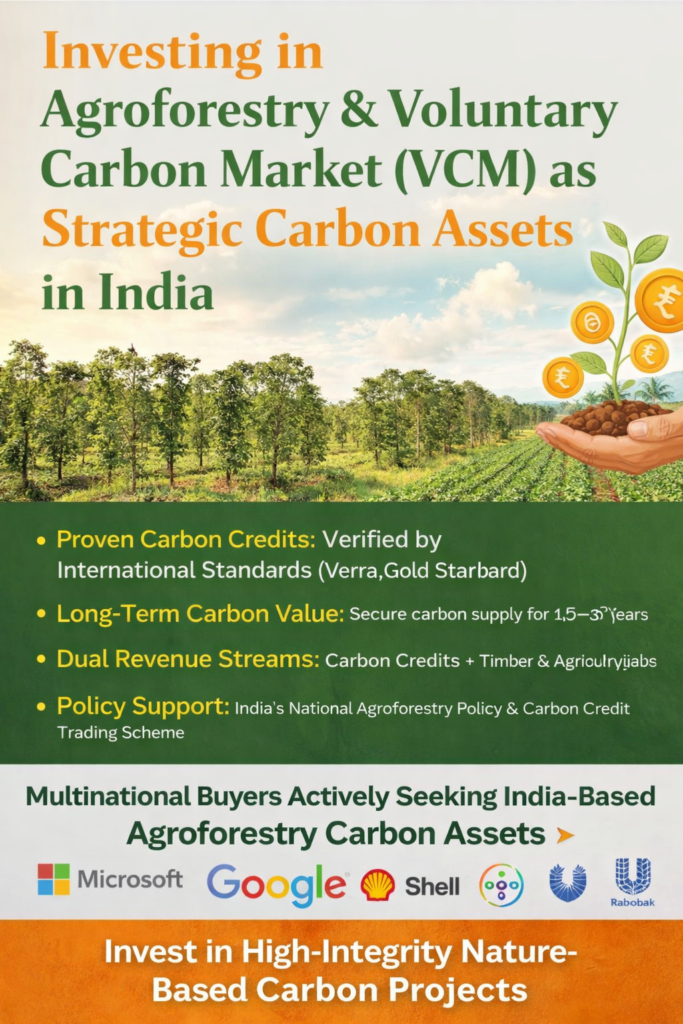
The Strategic Carbon Asset Opportunity for Multinational Investors in India
Agroforestry Carbon Credits in India: A Strategic VCM Investment for Multinational Companies
Discover how agroforestry projects in India are generating high-integrity carbon credits under the Voluntary Carbon Market (VCM). Learn why multinational companies are investing in Indian agroforestry farms to secure long-term carbon assets.
Introduction: The Rise of Agroforestry in the Global Carbon Economy
As global corporations accelerate toward net-zero commitments, the demand for high-quality carbon credits has surged. The Voluntary Carbon Market (VCM) has emerged as a critical mechanism allowing companies to offset unavoidable emissions while supporting climate-positive projects.
Among all nature-based solutions, agroforestry — the integration of trees with crops or livestock — is becoming one of the most credible, scalable, and investable carbon asset classes globally.
India, with its vast agricultural base and favorable climatic zones, is uniquely positioned to become a global leader in agroforestry-based carbon credits.
For multinational corporations (MNCs), investing directly in agroforestry farms in India is no longer just ESG positioning — it is a strategic long-term carbon security decision.
Understanding the Voluntary Carbon Market (VCM)
The Voluntary Carbon Market enables companies to purchase carbon credits generated by verified climate projects. Each credit typically represents one metric ton of CO₂ equivalent removed or avoided.
Leading international standards and registries include:
- Verra (Verified Carbon Standard – VCS)
- Gold Standard
- American Carbon Registry
- Climate Action Reserve
Agroforestry projects registered under these standards generate high-integrity, nature-based carbon credits that are highly sought after by global buyers.
Why Agroforestry is a Premium Carbon Asset Class
Agroforestry projects generate carbon credits through:
- Tree biomass carbon sequestration
- Soil organic carbon improvement
- Reduced land degradation
- Long-term carbon permanence
Key Investor Advantages:
1. High Additionality & Permanence
Tree-based systems sequester carbon for 20–50 years, offering long-duration carbon assets.
2. Dual Revenue Model
- Carbon credit income
- Agricultural produce (timber, fruits, commercial crops)
3. ESG & SDG Alignment
Agroforestry projects align with global sustainability goals including biodiversity conservation and rural livelihood enhancement.
4. Lower Reversal Risk
Compared to pure forestry projects, diversified agroforestry systems reduce fire and monoculture risks.
India’s Competitive Advantage in Agroforestry Carbon Projects
India holds a strategic advantage due to:
- Over 140+ million hectares of agricultural land
- Established agroforestry practices (teak, sandalwood, bamboo, fruit orchards)
- Favorable tropical growth cycles
- Government-backed frameworks
Policy & Regulatory Support
India launched its domestic carbon framework under the Carbon Credit Trading Scheme (CCTS) backed by:
- Bureau of Energy Efficiency
- Ministry of Environment, Forest and Climate Change
This aligns India with global carbon markets while allowing voluntary market participation.
Additionally, India’s National Agroforestry Policy supports tree-based farming expansion, strengthening long-term project viability.
Indian Agroforestry Projects Registered in Global Carbon Registries
Several Indian agroforestry and Afforestation/Reforestation (ARR) projects are registered under:
- Verra
- Gold Standard
Project models include:
- Smallholder farmer aggregation models
- Corporate-backed plantation projects
- NGO-led sustainable landscape programs
- Timber-based long-rotation plantations
Indian states such as Telangana, Andhra Pradesh, Maharashtra, Karnataka, and Madhya Pradesh are emerging as agroforestry carbon hubs.
Multinational Corporations Actively Buying Nature-Based Carbon Credits
Global corporations with net-zero targets are increasingly purchasing agroforestry and nature-based credits.
Some major international buyers include:
- Microsoft
- Amazon
- Shell
- BP
- Unilever
- Nestlé
Indian corporations participating in voluntary carbon initiatives include:
- Tata Group
- ITC Limited
- Mahindra Group
- Reliance Industries
These corporations are increasingly seeking:
- Direct farm acquisition models
- Long-term carbon offtake agreements
- Forward carbon purchase contracts
- Equity participation in agroforestry ventures
Why MNCs Are Now Acquiring Agroforestry Farms Instead of Just Buying Credits
Forward-thinking multinational companies are shifting from spot carbon purchases to owning or co-owning carbon-generating land assets.
Strategic Benefits:
1. Carbon Supply Security
Lock in predictable carbon credit supply for 15–30 years.
2. Price Hedging
Avoid future carbon credit price volatility.
3. ESG Authenticity
Direct project ownership improves sustainability disclosures and audit transparency.
4. Brand Positioning
Demonstrates tangible climate action rather than financial offsetting alone.
Revenue Potential for Agroforestry Carbon Projects in India
Typical agroforestry carbon projects can generate:
- 5–12 tCO₂ per hectare annually (depending on species and density)
- Crediting period: 20–30 years
- Carbon price range: Varies by quality and certification
Combined with agricultural revenue, IRR can become highly attractive for institutional investors.
Present & Future Outlook of Agroforestry in India’s VCM
Present Scenario:
- Growing demand for high-integrity credits
- Increasing scrutiny on quality and additionality
- Expansion of smallholder aggregation models
Future Projections:
- Stronger integration with India’s domestic carbon market
- Higher premium pricing for biodiversity-linked credits
- Increased participation from institutional capital and climate funds
India is expected to become one of the largest suppliers of nature-based carbon credits globally within the next decade.
Conclusion: Agroforestry as a Strategic Climate Infrastructure Investment
Agroforestry is no longer just a sustainable agriculture model — it is emerging as a long-term climate infrastructure asset class.
For multinational corporations aiming to:
- Achieve net-zero commitments
- Secure long-term carbon credit supply
- Strengthen ESG disclosures
- Build community-linked climate assets
Investing in Indian agroforestry farms presents a compelling opportunity.
The Voluntary Carbon Market is evolving rapidly — and those who secure land-based carbon assets today will lead tomorrow’s climate economy.