
Introduction: Why Eco-Conscious Investing Is the Next Big Opportunity
In today’s evolving investment landscape, eco-conscious investing and sustainable real estate are rapidly gaining traction among forward-thinking investors. With increasing awareness around climate change, soil degradation, and environmental responsibility, investors are actively seeking green investment opportunities that deliver both financial returns and long-term ecological value.
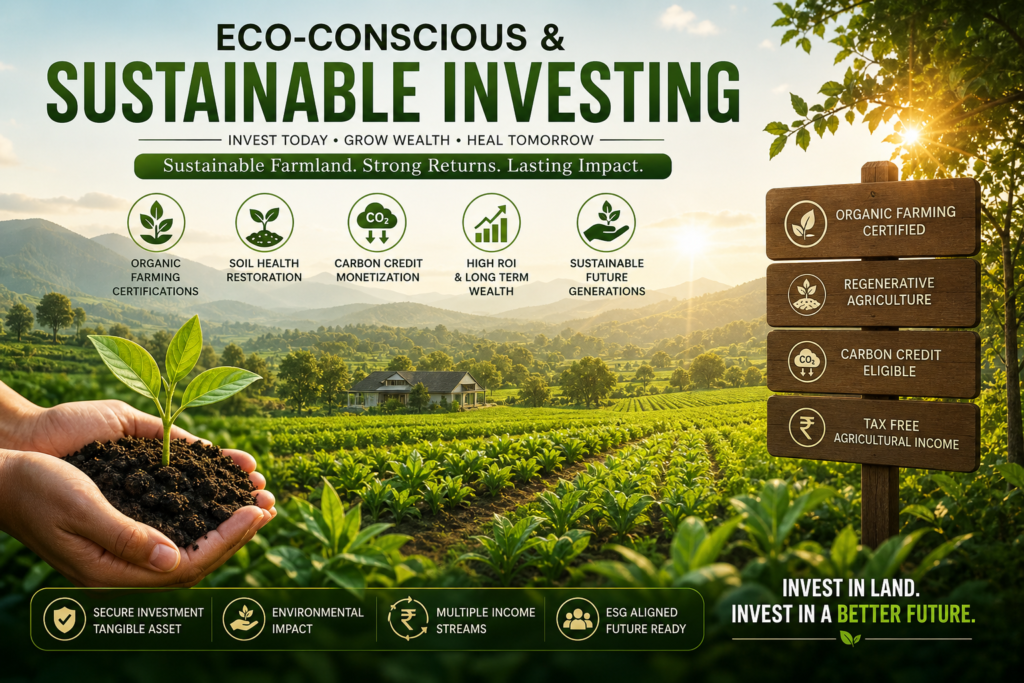
One of the most promising segments in this space is sustainable farmland investing, where land ownership is aligned with organic farming, soil restoration, and carbon credit monetization—creating a powerful combination of profitability and purpose.
What Is Eco-Conscious & Sustainable Investing?
Eco-conscious investing focuses on deploying capital into assets that promote environmental sustainability, biodiversity, and resource conservation. In the real estate sector, this translates into:
- Organic farmland investments
- Agri-land with sustainable farming models
- Green-certified agricultural projects
- Carbon-neutral land development
These investments are not just about land ownership—they represent a future-proof asset class designed to thrive in a sustainability-driven economy.
Organic Farming Certifications: Unlocking Premium Value
A key driver of value in eco-conscious farmland is organic certification, which ensures that agricultural practices are free from synthetic fertilizers, pesticides, and GMOs.
Key Benefits of Organic Certification:
- Higher market demand for organic produce
- Premium pricing and export potential
- Increased land valuation over time
- Eligibility for global organic markets
In India, certifications like:
- NPOP (National Programme for Organic Production)
- PGS-India (Participatory Guarantee System)
play a crucial role in establishing credibility and enhancing investment-grade farmland value.
Investors who enter early into certified organic farmland projects position themselves to benefit from both capital appreciation and recurring agricultural income.
Soil Health Restoration: The Foundation of Sustainable Wealth
One of the most overlooked yet powerful aspects of sustainable investing is soil health restoration. Healthy soil is a long-term asset that directly impacts productivity, crop quality, and environmental sustainability.
Sustainable Practices That Enhance Soil Value:
- Natural composting and vermiculture
- Crop rotation and multi-cropping
- Agroforestry and permaculture techniques
- Water conservation and drip irrigation
These practices not only improve soil fertility and yield, but also:
- Increase land lifespan and productivity
- Reduce dependency on chemical inputs
- Improve resilience against climate risks
From an investor’s perspective, regenerative agriculture transforms ordinary farmland into a high-performance ecological asset.
Carbon Credit Monetization: The Hidden Income Stream
One of the most exciting developments in eco-conscious investing is the potential to generate income through carbon credits.
What Are Carbon Credits?
Carbon credits are tradable certificates that represent the reduction or removal of one ton of carbon dioxide from the atmosphere. Sustainable agricultural practices such as:
- Agroforestry
- Organic farming
- Soil carbon sequestration
can generate these credits.
Why This Matters for Investors:
- Creates an additional passive income stream
- Increases overall ROI on farmland investments
- Aligns with global ESG (Environmental, Social, Governance) trends
- Attracts institutional and international buyers
With global corporations aiming for net-zero emissions, the demand for carbon credits is expected to surge—making carbon credit-enabled farmland a high-growth investment opportunity.
Why Sustainable Farmland Is a High-Growth Asset Class
Eco-conscious farmland investments combine multiple wealth drivers:
1. Capital Appreciation
Strategically located farmland near growth corridors appreciates significantly over time.
2. Tax-Free Agricultural Income
In India, agricultural income is tax-exempt, enhancing net returns.
3. Recurring Farm Revenue
Income from crops, plantations, and agri-products ensures steady cash flow.
4. Future Carbon Income
Carbon credit monetization adds a futuristic revenue layer.
5. ESG-Driven Demand
Growing global focus on sustainability increases asset demand and liquidity.
The Rise of Green Real Estate Investment in India
India is witnessing a shift toward sustainable land investments, especially among:
- Urban professionals seeking eco-friendly assets
- NRIs looking for long-term wealth preservation
- Investors diversifying into climate-resilient portfolios
Regions with strong infrastructure growth and agricultural potential—such as emerging districts in Andhra Pradesh and Telangana—are becoming hotspots for eco-conscious real estate investment.
How to Choose the Right Sustainable Investment Project
Before investing in eco-conscious farmland, ensure the project offers:
- Verified organic certification roadmap
- Professional farm management (Farm-as-a-Service model)
- Soil testing and restoration plans
- Water resource sustainability
- Carbon credit eligibility and long-term strategy
- Clear land titles and legal compliance
A well-structured project transforms land into a managed, income-generating green asset.
Conclusion: Invest in the Future, Sustainably
Eco-conscious and sustainable investing is no longer a niche concept—it is the future of wealth creation. By combining organic farming, soil regeneration, and carbon credit monetization, investors can unlock multiple income streams while contributing to environmental sustainability.
As the world moves toward greener economies, those who invest early in sustainable farmland and green real estate will not only benefit financially but also play a vital role in shaping a more sustainable planet.