
Introduction
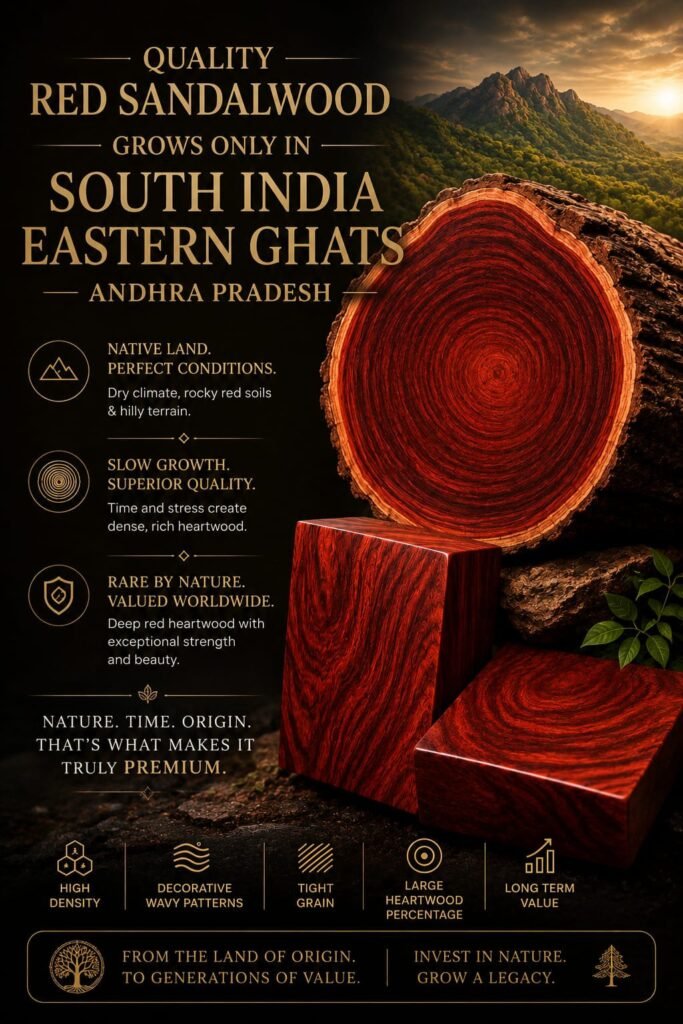
Red Sanders (Pterocarpus santalinus), also known as Red Sandalwood, is one of the world’s rarest and most valuable tree species. It is endemic to India, meaning it occurs naturally only in a limited geographical region. Its natural habitat is the southern Eastern Ghats of South India, with the largest and most significant populations found in Andhra Pradesh. The species is globally renowned for its richly colored heartwood, exceptional durability, medicinal value, and cultural importance.
Does Red Sanders Grow Naturally Anywhere Else in the World?
Scientific research confirms that Red Sanders does not occur naturally anywhere outside the southern Eastern Ghats of India. It is an endemic species whose native distribution is restricted mainly to the hill ranges of:
- Seshachalam Hills
- Veligonda Hills
- Lankamala Hills
- Palakonda Hills
These forests lie primarily in the districts of Kadapa, Chittoor, Nellore, Prakasam, and Kurnool in Andhra Pradesh. Small natural populations also extend into adjoining parts of Tamil Nadu and Karnataka, but the species remains confined to the southern Eastern Ghats.
Although Red Sanders has been planted experimentally in several countries and Indian states, these plantations are not part of its natural geographical range.
Why Only the Eastern Ghats?
Red Sanders has evolved over thousands of years under the unique environmental conditions of the southern Eastern Ghats. It thrives in:
- Rocky and well-drained soils
- Dry deciduous forests
- Hot semi-arid climate
- Elevations of approximately 150–900 metres
- Annual rainfall of about 700–1,100 mm
These specialized ecological conditions are difficult to replicate naturally elsewhere, making the Eastern Ghats its exclusive native habitat.
A Globally Significant Endemic Species
Because of its extremely restricted distribution, Red Sanders is considered one of India’s most important endemic tree species. It has been listed under:
- IUCN Red List as an Endangered species.
- CITES Appendix II, regulating international trade to prevent over-exploitation.
Strict conservation measures have been introduced by Indian authorities to protect the remaining natural forests and ensure sustainable management.
Andhra Pradesh: The Global Stronghold
Andhra Pradesh possesses the world’s largest natural reserves of Red Sanders. The forests of the state serve as the primary source for legal conservation programs, scientific research, seed collection, and regulated auctions conducted by the Andhra Pradesh Forest Department.
The species has become an important part of the state’s biodiversity and forest conservation efforts because nowhere else in the world supports such extensive natural populations.
Scientific Importance
Researchers continue to study Red Sanders because of its:
- Unique genetic diversity
- Slow growth and long lifespan
- High-value heartwood
- Adaptation to dry tropical ecosystems
- Conservation biology
Its restricted distribution makes it an important species for ecological and evolutionary research in the Eastern Ghats.
Conclusion
Red Sanders is one of the world’s most exclusive tree species. Its natural occurrence is confined to the southern Eastern Ghats of South India, with Andhra Pradesh serving as its principal habitat. While the tree can be cultivated under suitable conditions elsewhere, its wild, naturally evolved populations exist only in this unique landscape. This exceptional geographical exclusivity makes Red Sanders not only an ecological treasure of India but also a globally significant species deserving continued conservation and sustainable management.