
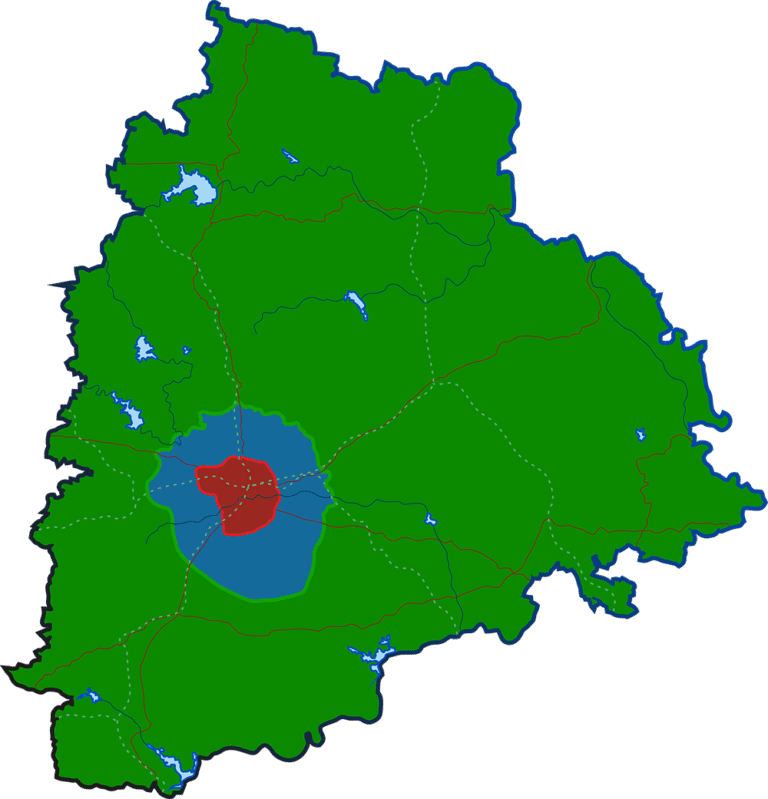
Introduction: Telangana’s Journey Towards a $3 Trillion Economy
Telangana has emerged as one of India’s fastest-growing economies, driven by progressive governance, infrastructure expansion, technology adoption, and inclusive development. As the state sets its ambitious target of becoming a $3 trillion economy by 2047, agriculture and rural development are positioned as strategic economic pillars, not just support sectors.
At the core of this rural transformation lies the RARE (Rural Agriculture Region Economy) categorization, a policy-driven framework designed to strengthen agriculture, enhance rural livelihoods, and integrate farmlands into Telangana’s long-term economic growth story.
RARE Categorization: Redefining Rural Telangana
The RARE framework focuses on identifying and developing rural zones with strong agricultural potential, ecological balance, and connectivity advantages. Unlike traditional rural planning, RARE is designed to:
- Preserve fertile agricultural land
- Enable sustainable farming and allied activities
- Support agri-based entrepreneurship
- Attract organized farmland development
- Integrate rural areas into modern infrastructure networks
This strategic classification ensures that agriculture remains productive while rural regions evolve into economically vibrant, future-ready zones.
Agriculture as a Growth Engine in the $3 Trillion Vision
Agriculture in Telangana is no longer limited to subsistence farming. It is rapidly transforming into a high-value, technology-enabled sector contributing significantly to Gross State Domestic Product (GSDP).
Key contributors include:
- Precision farming and smart irrigation
- Horticulture, floriculture, and plantation crops
- Organic and natural farming clusters
- Food processing and agro-logistics
- Export-oriented agri produce
As RARE regions expand agricultural productivity and value addition, agriculture’s contribution to the $3 trillion economy becomes both direct and multiplier-driven, impacting manufacturing, services, logistics, and rural employment.
Rising Agricultural Land Values Across Telangana
One of the most visible outcomes of RARE implementation is the steady appreciation of agricultural land values. Several factors are driving this upward trend:
- Improved road, power, and digital infrastructure
- Proximity to logistics corridors and regional growth hubs
- Increasing demand for managed farmlands
- Entry of institutional and lifestyle investors
- Growing interest in long-term land assets
Unlike speculative urban real estate, farmland appreciation under RARE is fundamentally driven, backed by productivity, utility, and policy support.
Agri Tourism: Unlocking New Revenue Streams for Farmlands
RARE regions are emerging as hotspots for agri tourism, blending agriculture with experiential rural living. This model generates diversified income for landowners while promoting sustainable practices.
Agri tourism opportunities include:
- Farm stays and eco-retreats
- Organic food experiences
- Cultural and seasonal farming activities
- Educational agriculture tours
- Wellness and nature-based tourism
With increasing urban demand for authentic rural experiences, agri tourism is becoming a high-growth vertical within farmland investments.
Rural Tourism: Telangana’s Untapped Economic Frontier
Beyond farms, Telangana’s villages are rich in heritage, ecology, crafts, and traditions. RARE-aligned development is enabling rural tourism through:
- Improved village infrastructure
- Connectivity to highways and urban centers
- Promotion of local arts, cuisine, and culture
- Nature-based and heritage tourism circuits
Rural tourism not only boosts local incomes but also positions Telangana as a diversified tourism economy, contributing to the broader $3 trillion target.
World-Class Infrastructure Transforming Rural Landscapes
A defining feature of Telangana’s growth strategy is infrastructure parity between urban and rural regions. RARE zones are benefitting from:
- High-quality road and expressway connectivity
- Reliable power and water systems
- Digital infrastructure and high-speed internet
- Proximity to logistics parks and markets
- Planned social infrastructure
This transformation is redefining rural areas as economically active, investment-friendly regions rather than peripheral zones.
Rural Areas as New-Age Living & Remote Work Hubs
The convergence of digital connectivity and lifestyle preferences is turning RARE regions into ideal remote work destinations. Professionals are increasingly choosing farmland communities for:
- Healthier, pollution-free living
- Larger spaces and private ownership
- Lower cost of living
- Proximity to nature without disconnecting from work
- Sustainable and community-oriented lifestyles
These evolving rural hubs support Telangana’s service economy while decentralizing growth from congested urban centers.
Farmlands: A Strategic Asset in Telangana’s Future Economy
Farmland ownership in RARE zones is transitioning from a traditional asset to a strategic long-term investment, offering:
- Capital appreciation backed by policy
- Agricultural income and allied revenues
- Tourism and lifestyle monetization
- Portfolio diversification
- Inter-generational asset security
As Telangana advances toward its $3 trillion vision, farmlands stand at the intersection of growth, sustainability, and wealth creation.
Conclusion: RARE as the Backbone of Telangana Rising
Telangana’s $3 trillion ambition is not built on urban growth alone. It is anchored in empowered rural regions, resilient agriculture, and future-ready infrastructure. The RARE categorization represents a paradigm shift—where agriculture, farmlands, tourism, and modern living converge to shape a balanced and inclusive economic future.
For investors, farmers, professionals, and landowners, RARE regions are not just about land—they are about participating in Telangana’s long-term growth story.