
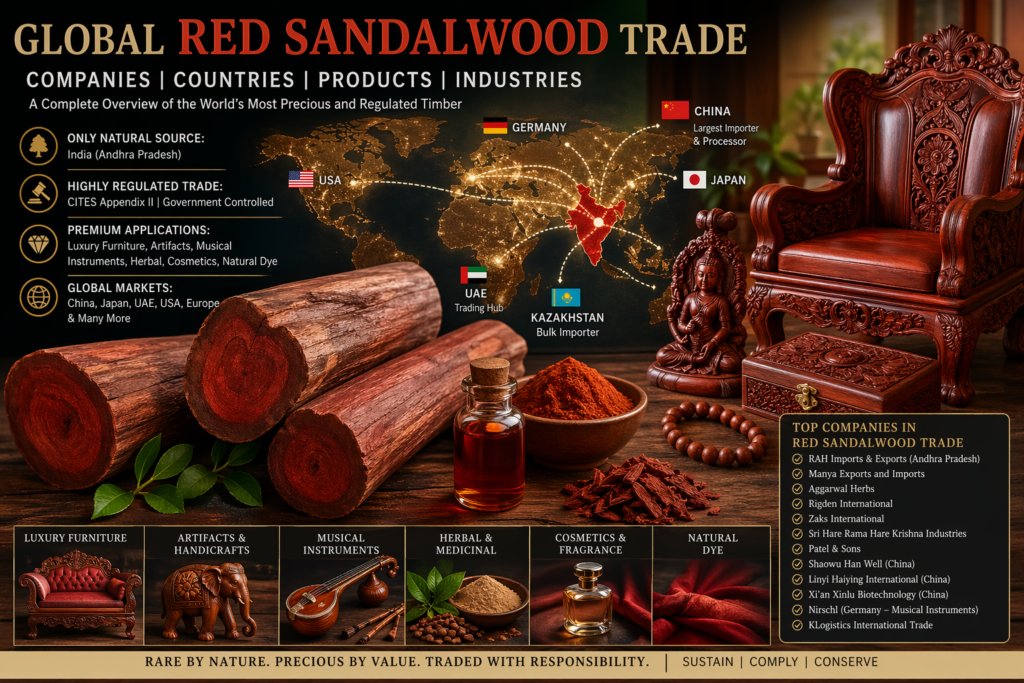
A Complete, Fact-Based Overview of Red Sanders International Business
Red Sandalwood (Pterocarpus santalinus)—also known as Red Sanders—is one of the world’s most valuable and tightly regulated timber species. Native primarily to India, this rare hardwood is widely used in luxury furniture, musical instruments, handicrafts, herbal medicine, natural dyes, and cosmetics.
However, unlike typical timber markets, red sandalwood operates under a highly controlled global trade system, governed by international regulations and limited legal supply channels.
🌍 Global Trade Structure (How the Industry Actually Works)
🇮🇳 India: The Only Natural Commercial Source
India—especially Andhra Pradesh (Nellore, Chittoor, Kadapa belt)—accounts for over 90% of global supply.
Legal harvesting and primary supply are controlled by:
- Andhra Pradesh Forest Development Corporation Ltd
- State Forest Departments
These agencies conduct international auctions, supplying raw logs to approved global buyers.
⚖️ International Regulation
Red sandalwood trade is governed by:
- Convention on International Trade in Endangered Species of Wild Fauna and Flora (Appendix II)
Key Legal Points:
- Export requires CITES permits and traceability
- Raw log exports are highly restricted
- Legal trade allowed mainly through:
- Government auctions
- Licensed exporters
- Processed products (powder, carvings, extracts)
🏢 Key Companies in the Red Sandalwood Trade Ecosystem
👉 Important: There are no large multinational corporations dominating this trade. Instead, the ecosystem is made up of licensed exporters, importers, and processors.
🇮🇳 India – Exporters & Source-Side Traders
RAH Imports & Exports (Andhra Pradesh – Nellore Region)
- Operates within the core red sanders zone
- Deals in:
- Logs (regulated sourcing)
- Semi-processed wood
- Markets:
- China
- UAE
- Southeast Asia
Manya Exports and Imports
- Exporter of:
- Raw wood (limited)
- Carvings
- Markets: Asia & Middle East
Aggarwal Herbs
- Focus: Herbal & medicinal trade
- Products:
- Powder
- Extract-grade material
- Markets:
- USA
- Middle East
- Asia
Rigden International
- Supplies:
- Logs
- Wood blocks
- Known for:
- Government-compliant sourcing
Zaks International
- Deals in:
- Industrial-use red sandalwood
- Raw material supply
Sri Hare Rama Hare Krishna Industries
- Supplies:
- Logs
- Roots
- Cut blocks
Patel & Sons
- Traditional timber supplier
- Supplies wood for:
- Furniture
- Musical instruments
- Carvings
🇨🇳 China – Processing, Manufacturing & Global Demand Hub
China is the largest importer and consumer globally, especially for luxury wood industries.
Key Trade & Processing Companies:
Shaowu Han Well Import & Export Trade Co., Ltd.
- Trades:
- Processed wood
- Wooden crafts
Linyi Haiying International Trade Co., Ltd.
- Focus:
- Hardwood imports
- Timber distribution
Xi’an Xinlu Biotechnology Co., Ltd.
- Specialization:
- Red sandalwood extracts
- Industries:
- Pharmaceuticals
- Nutraceuticals
- Cosmetics
🌍 Global Importers & Industrial Buyers
Inditex
- Uses sandalwood-derived inputs in:
- Perfumes
- Fragrance products
Retail Group Kazakhstan LLP
- Bulk importer
- Role:
- Regional distribution
KLogistics International Trade
- Supplies:
- Bulk red sandalwood
- Applications:
- Musical instruments
- Woodcraft
- industrial use
🇩🇪 Germany – Musical Instrument Ecosystem
Nirschl
- High-end instrument manufacturer
👉 Important:
- Germany is not a primary trader of red sandalwood
- Instead, it participates through:
- Precision manufacturing
- Use of imported exotic hardwoods in niche cases
🧩 Industry-Wise Applications & Trade Segments
🪵 1. Logs & Raw Timber
- Supplied through:
- Government auctions
- Licensed exporters
👉 Major buyers:
- China
- UAE
🪑 2. Luxury Furniture Industry
- Dominated by China
- Used for:
- Hongmu furniture
- Antique-style luxury pieces
🎨 3. Handicrafts & Wooden Artifacts
- Products:
- Sculptures
- Religious idols
- Decorative items
- Trade hubs:
- India
- China
- Japan
🎼 4. Musical Instruments
- Niche but high-value segment
Used in:
- Indian veena
- Japanese instruments
- Specialty guitar tonewood
👉 Requires:
- High-quality processed wood
- Legal sourcing compliance
🌿 5. Herbal & Medicinal Trade
- Products:
- Powder
- Extract
Uses:
- Ayurveda
- Traditional Chinese medicine
- Skincare
💄 6. Cosmetics & Fragrance
- Used in:
- Perfumes
- Organic skincare
- Demand from:
- Europe
- USA
- Middle East
🎨 7. Natural Dye Industry
- Contains natural pigments (Santalin)
- Used in:
- Textile dye
- Natural coloring agents
👉 This is a small but specialized segment
🌎 Major Countries Driving the Trade
| Country | Role |
|---|---|
| India | Sole natural supplier |
| China | Largest importer & processor |
| UAE | Re-export & trading hub |
| Japan | Premium niche market |
| USA | Herbal & cosmetic demand |
| Germany | Instrument manufacturing ecosystem |
| Kazakhstan | Bulk import & redistribution |
📊 Ground Reality of the Market
🔺 Supply vs Demand Control
- Supply controlled by India (government auctions)
- Demand dominated by China
🔺 Trade Characteristics
- No open commodity market
- No large global corporations dominating
- Highly dependent on:
- Regulation
- Licensing
- Documentation
🔺 Value Chain Flow
India (source) → Licensed exporters → Importers (China/UAE/Japan) → Manufacturers → Global luxury markets
⚠️ Final Insight
Red sandalwood is not a conventional investment or trading commodity.
It operates within:
- A policy-driven supply system
- A scarcity-based demand structure
- A compliance-heavy global trade network
👉 This is why:
- Prices are extremely high
- But market access is tightly controlled
🧠 Conclusion
The global red sandalwood trade is a unique intersection of conservation policy, luxury demand, and controlled supply chains.
- India controls availability
- China controls consumption
- Global companies participate only within regulated frameworks
Understanding this structure is critical for:
- Investors
- Traders
- Farmland buyers
- Export-oriented businesses