
With inflation continuing to reshape global economies, investors are asking a critical question:
Should you invest in farmland, gold, or stocks to protect and grow your wealth?
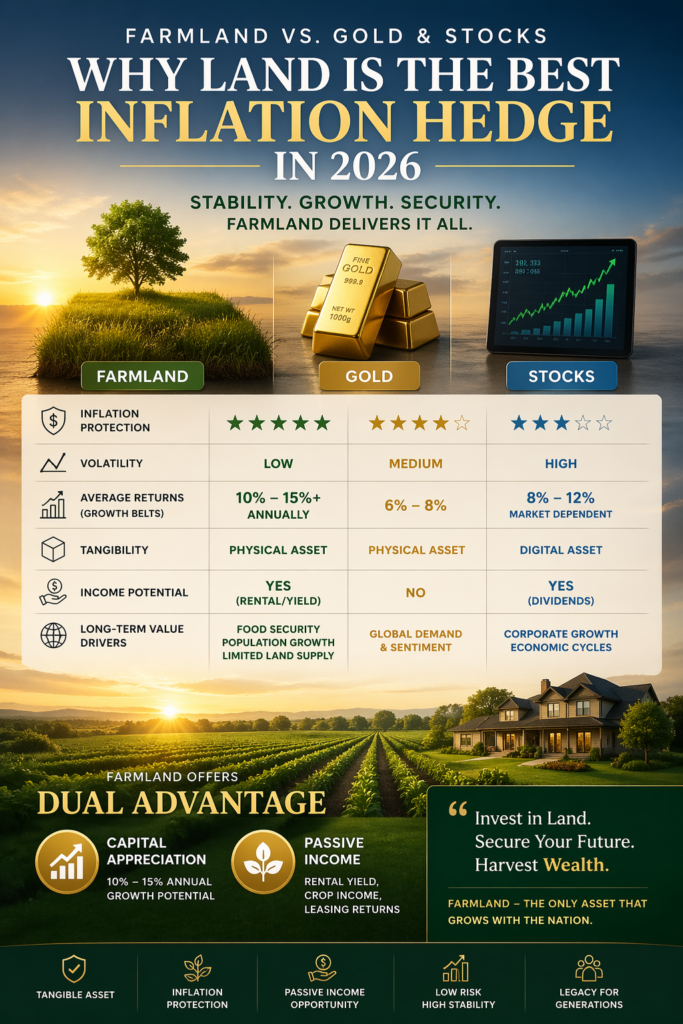
While gold has long been considered a “safe haven” and stocks promise high returns, farmland is emerging as the most powerful inflation hedge in 2026—especially in high-growth corridors where land appreciation often reaches 10–15% annually.
Let’s break down why.
📊 Farmland vs Gold vs Stocks: The 2026 Reality Check
| Asset Class | Inflation Protection | Volatility | Average Returns | Tangibility |
|---|---|---|---|---|
| Farmland | ⭐⭐⭐⭐⭐ | Low | 10–15%+ (growth belts) | ✅ Physical Asset |
| Gold | ⭐⭐⭐⭐ | Medium | 6–8% | ✅ Physical Asset |
| Stocks | ⭐⭐⭐ | High | 8–12% (market dependent) | ❌ Digital |
👉 Conclusion: Farmland stands out for consistent appreciation + low volatility + real-world utility.
🌱 1. Tangible Asset Value: Land You Can See, Use, and Grow
Unlike stocks or digital assets, farmland is a finite, physical resource.
Why This Matters:
- You own real land, not just paper or digital value
- Land never becomes obsolete
- Can generate passive income through farming or leasing
- Offers emotional + lifestyle value (farmhouse, weekend retreat)
In uncertain economic times, investors are shifting toward hard assets, and farmland leads that category.
🌍 2. Global Food Security: The Ultimate Long-Term Driver
One of the strongest reasons farmland is outperforming in 2026 is global food demand.
Key Trends:
- Rising population → Increased food consumption
- Shrinking arable land due to urbanization
- Climate challenges impacting food supply
👉 This creates a powerful economic reality:
Food production land is becoming more valuable every year.
Unlike gold or stocks, farmland is directly tied to a basic human necessity — food.
📈 3. Dual Returns: Appreciation + Income
Farmland offers a unique dual-income model:
💰 Capital Appreciation
- Growth corridors (like peri-urban zones) see 10–15% annual rise
- Infrastructure developments boost land value rapidly
🌾 Agricultural Income
- Crop sharing
- Plantation returns (e.g., sandalwood, fruit crops)
- Leasing to farmers or agri-companies
👉 No other asset class consistently delivers both growth and income together.
🛡️ 4. Low Volatility Compared to Stocks
Stock markets react instantly to:
- Global news
- Political instability
- Interest rate changes
Farmland, however:
- Grows steadily over time
- Is less affected by short-term shocks
- Offers predictable long-term appreciation
👉 This makes farmland ideal for risk-averse and long-term investors.
🪙 5. Gold vs Farmland: The Silent Shift
Gold has been a traditional hedge, but:
| Factor | Gold | Farmland |
|---|---|---|
| Income Generation | ❌ None | ✅ Yes |
| Utility | ❌ Limited | ✅ High |
| Demand Driver | Investment sentiment | Food necessity |
| Growth Potential | Moderate | High (emerging regions) |
👉 Investors are gradually moving from “store of value” (gold) to “productive value” (farmland).
🚀 6. 2026 Investment Trend: Managed Farmland
Urban professionals are increasingly choosing managed farmland investments, where:
- Experts handle cultivation
- Security & maintenance are provided
- Investors earn hands-free income
This removes traditional barriers like:
- Farming knowledge
- Time commitment
- Operational risks
🏡 7. Lifestyle + Legacy Investment
Farmland isn’t just an investment—it’s:
- A weekend escape from city stress
- A legacy asset for future generations
- A hedge against urban uncertainty
👉 It combines wealth creation + quality of life, something no stock or gold can offer.
📍 Why 2026 is the Right Time to Invest in Farmland
- Inflation is rising globally
- Land prices in growth corridors are still affordable
- Infrastructure expansion is accelerating
- Demand for organic & sustainable living is booming
👉 Early investors are securing maximum upside potential.
🎯 Final Verdict: Why Farmland Wins in 2026
✔ Real, tangible asset
✔ Strong inflation protection
✔ Driven by global food demand
✔ Dual income potential
✔ Low volatility
✔ Lifestyle + legacy value
👉 Farmland is not just an investment—it’s a future-proof asset.