
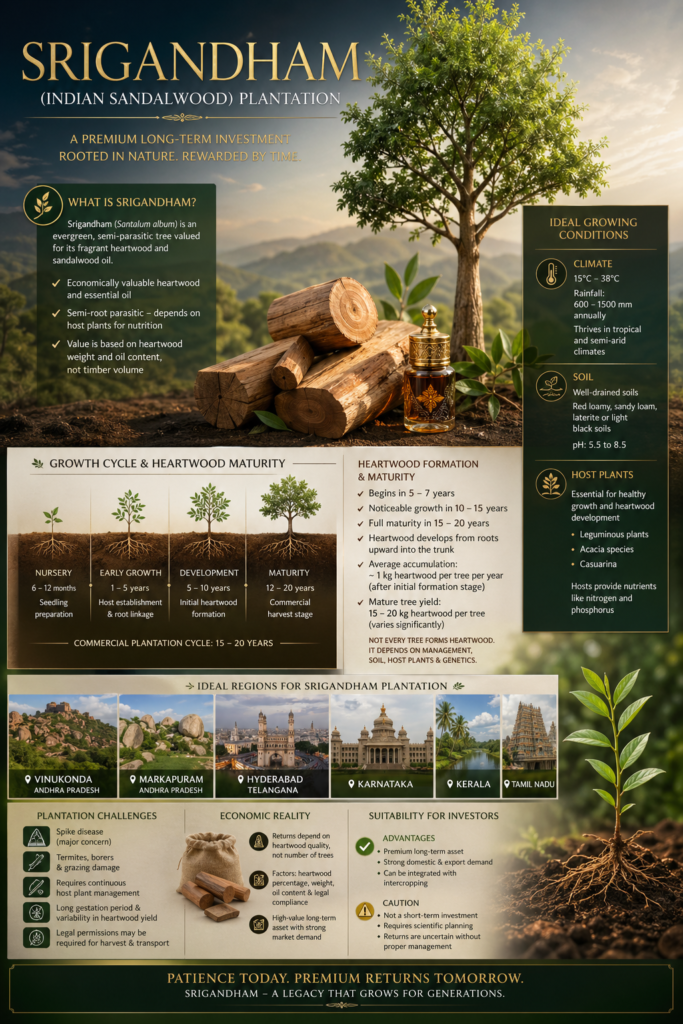
Growth Conditions, Heartwood Maturity & Cultivation in India
Srigandham, scientifically known as Santalum album, is one of the most valuable agroforestry species in India. Known for its fragrant heartwood and high-value essential oil, it has been cultivated for centuries and continues to be a premium long-term plantation crop.
🌱 1. What is Srigandham?
Srigandham (White Sandalwood) is an evergreen, semi-parasitic tree belonging to the Santalaceae family.
Key Characteristics:
- Produces valuable heartwood and sandalwood oil
- Semi-root parasitic – depends on host plants for nutrients
- Value is based on heartwood weight and oil content, not timber volume
Unlike conventional trees, its economic return depends entirely on heartwood formation, making scientific cultivation critical.
🇮🇳 2. Where Srigandham is Grown in India
🌿 Traditional Core Regions
- Karnataka (largest natural and cultivated base)
- Tamil Nadu
- Kerala
These regions form the natural habitat of sandalwood under dry deciduous forest ecosystems.
🌱 Expanding Cultivation Regions
With policy relaxations and private farming adoption, Srigandham is now cultivated across:
- Andhra Pradesh
- Telangana
- Maharashtra
- Madhya Pradesh
- Gujarat
- Rajasthan
📍 Key Suitable Zones in Andhra Pradesh & Telangana
Field-level observations and plantation practices show that the following regions are well-suited for Srigandham cultivation, provided soil and host management are correct:
- Vinukonda
- Palnadu
- Markapuram
- Areas in and around Hyderabad
These regions offer:
- Suitable semi-arid to sub-tropical climate
- Availability of red soils and well-drained land
- Compatibility with agroforestry models
🌦️ 3. Ideal Growing Conditions
🌡️ Climate
- Temperature: 15°C – 38°C
- Rainfall: 600 – 1500 mm annually
- Thrives in tropical and semi-arid climates
🌱 Soil Requirements
- Well-drained soils are essential
- Suitable soil types:
- Red loamy soil
- Sandy loam
- Laterite soil
- Light black soil
- Ideal pH: 5.5 to 8.5
🌿 Host Plant Requirement (Critical Factor)
Srigandham is a hemiparasitic tree, meaning it partially depends on other plants.
Common Host Plants:
- Leguminous plants
- Acacia species
- Casuarina
Host plants supply essential nutrients like nitrogen and phosphorus, directly influencing growth and heartwood development.
🌳 4. Growth Cycle of Srigandham Plantation
⏳ Typical Lifecycle
| Stage | Duration | Description |
|---|---|---|
| Nursery | 6–12 months | Seedling preparation |
| Early Growth | 1–5 years | Host establishment & root linkage |
| Development | 5–10 years | Initial heartwood formation |
| Maturity | 12–20 years | Commercial harvest stage |
Commercial plantations typically follow a 15–20 year cycle.
💎 5. Heartwood Formation & Maturity
The heartwood is the only economically valuable part of the tree.
🔬 Formation Timeline
- Begins: 5–7 years
- Noticeable growth: 10–15 years
- Full maturity: 15–20 years
📈 Growth Behavior
- Starts from roots and progresses upward
- Expands into trunk over time
- Average accumulation:
- Around 1 kg/year after initial formation stage
🌳 Mature Tree Yield
- Typical yield: 15–20 kg heartwood per tree (varies significantly)
⚠️ Critical Reality
Heartwood formation is not guaranteed in every tree.
It depends on:
- Host plant management
- Soil and moisture conditions
- Genetic quality of planting material
Some trees may produce low or negligible heartwood even after 15+ years.
🌿 6. Plantation Challenges
⚠️ Biological Risks
- Spike disease (major concern)
- Termites and stem borers
- Grazing damage
⚠️ Cultivation Challenges
- Requires continuous host plant management
- Long gestation period
- Variability in heartwood yield
⚠️ Regulatory Considerations
- Harvesting and transport may require government permissions
- Rules vary by state but are gradually being liberalized
💰 7. Economic Reality
Srigandham is often marketed as a high-return crop, but actual returns depend on:
- % of trees forming heartwood
- Heartwood weight per tree
- Oil content quality
- Legal compliance and market access
👉 The key insight:
Profit depends on heartwood quality—not number of trees.
🌱 8. Suitability for Farmland Investors
✔ Advantages
- Premium long-term asset
- Strong domestic and export demand
- Can be integrated with intercropping
⚠️ Important Caution
- Not a short-term investment
- Requires scientific planning
- Returns are uncertain without proper management
🧭 Final Insight
Srigandham plantation is a precision agroforestry model, not a simple tree plantation.
Success depends on:
- Right location and soil
- Proper host plant ecosystem
- Long-term patience (15–20 years)
Regions like Vinukonda, Palnadu, Markapuram, and areas around Hyderabad are emerging as practically viable zones, but only when cultivation follows scientific and realistic methods.