
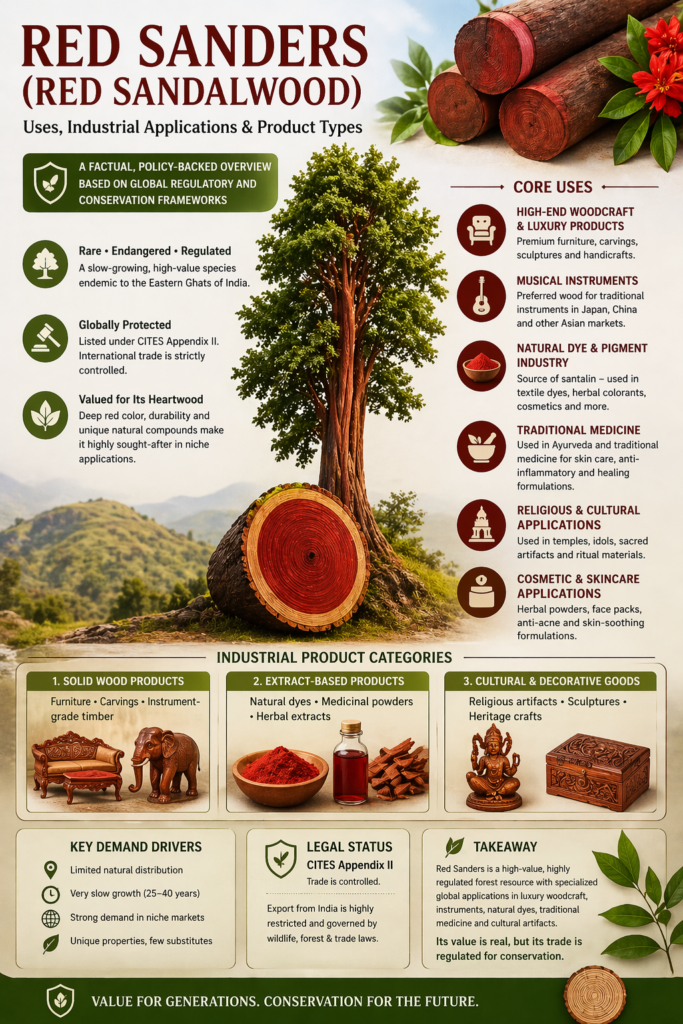
A factual, policy-backed overview based on global regulatory and conservation frameworks
1. Introduction: Why Red Sanders is Highly Valued
Red Sanders (Pterocarpus santalinus) is a rare, slow-growing hardwood species endemic to the Eastern Ghats of India, particularly in Andhra Pradesh. It is classified as an endangered species and its international trade is strictly regulated under global wildlife trade frameworks such as CITES (Appendix II).
The species is widely studied and monitored by organizations such as TRAFFIC and WWF due to its role in illegal wildlife trade and high-value timber markets.
Its exceptional value is driven by:
- Extremely dense and durable heartwood
- Deep natural red pigmentation (santalin)
- Limited geographic availability
- Strong demand in niche international markets
2. Core Uses of Red Sanders
A. High-End Woodcraft & Luxury Products
The primary legal use of Red Sanders is in high-value woodcraft industries.
Key Products:
- Premium furniture and cabinetry
- Decorative carvings and sculptures
- Export-grade handicrafts
The wood’s ability to retain polish and color for decades makes it highly desirable in luxury markets.
B. Musical Instruments (Major Global Demand Driver)
One of the most significant international applications is in traditional and high-end musical instruments, particularly in East Asia.
Key Products:
- Japanese instruments such as shamisen and koto
- Components for string instruments
- Specialty acoustic wood elements
Its fine grain and density provide superior tonal properties, making it irreplaceable in certain instrument categories.
C. Natural Dye & Pigment Industry
Red Sanders contains santalin, a natural red pigment with multiple industrial applications.
Key Products:
- Textile dyes
- Herbal and traditional medicine colorants
- Cosmetic pigments
- Limited traditional food coloring uses
This makes it valuable beyond timber—as a bio-based industrial raw material.
D. Traditional Medicine Systems
Red Sanders has a long history in Ayurveda and traditional Asian medicine systems.
Forms & Products:
- Powder (churna)
- Paste (lepam)
- Herbal extracts and decoctions
Reported Applications:
- Anti-inflammatory uses
- Skin treatments and wound care
- Cooling and soothing formulations
While widely used traditionally, modern clinical validation remains limited, and usage is largely based on historical practice.
E. Religious & Cultural Applications
In India, Red Sanders holds strong spiritual and cultural significance.
Key Products:
- Temple architecture elements
- Idols and sacred artifacts
- Ritual powders and ceremonial materials
Its association with auspiciousness and purity drives demand in religious contexts.
F. Cosmetic & Skincare Applications
Due to its natural properties, Red Sanders is used in herbal cosmetic formulations.
Key Products:
- Face packs and skincare powders
- Anti-acne preparations
- Skin-soothing herbal blends
These uses are primarily rooted in traditional knowledge systems, with growing niche market interest.
3. Industrial Product Classification
From a policy and trade perspective, Red Sanders products fall into three major categories:
1. Solid Wood Products
- Furniture
- Carvings
- Instrument-grade timber
2. Extract-Based Products
- Natural dyes
- Medicinal powders
- Plant-based extracts
3. Cultural & Decorative Goods
- Religious artifacts
- Sculptures
- Heritage crafts
These categories represent the core of both regulated trade and illegal trafficking flows.
4. Demand Drivers: A Policy-Level Understanding
Global demand for Red Sanders is shaped by:
- Extremely limited natural distribution
- Long maturation cycle (often 25–40 years)
- Strong demand from China and Japan
- Lack of viable substitutes for certain applications
This imbalance between restricted supply and niche demand has led to persistent illegal trade concerns.
5. Legal Status & Trade Restrictions
Red Sanders is not a freely tradable commodity.
Key Regulatory Aspects:
- Listed under CITES Appendix II → International trade is controlled
- Export from India is highly restricted and policy-driven
- Governed by:
- Forest conservation laws
- Wildlife protection regulations
- National and international trade policies
This means that market access is tightly regulated, and large portions of global trade historically fall outside legal channels.
6. Ground Reality vs Market Perception
A critical, evidence-based understanding reveals:
- ✔ Demand exists, but is highly specialized—not mass market
- ✔ Major uses are limited to luxury goods, instruments, and niche industries
- ✔ Trade operates under strict regulatory oversight
- ❗ It is not a general-purpose commercial timber
- ❗ Many commercial narratives overstate ease of monetization and market access
✅ Final Conclusion
Red Sanders is a high-value, highly regulated forest resource with specialized global applications in:
- Luxury woodcraft and musical instruments
- Natural dyes and pigment industries
- Traditional medicine and cosmetics
- Religious and cultural artifacts
Its economic potential is real—but strictly tied to regulated, niche markets and long-term ecological constraints, not broad commercial exploitation.