
🌿 Introduction
Pterocarpus santalinus, commonly known as Red Sandalwood or Red Sanders, is one of the most valuable and regulated timber species in the world. Native primarily to the Eastern Ghats of India, especially Andhra Pradesh, it has been prized for centuries for its deep red heartwood, medicinal properties, and luxury applications.
Today, it stands at the intersection of high-value global trade, strict legal control, and farmland investment opportunities.
🌍 Global Demand & Uses
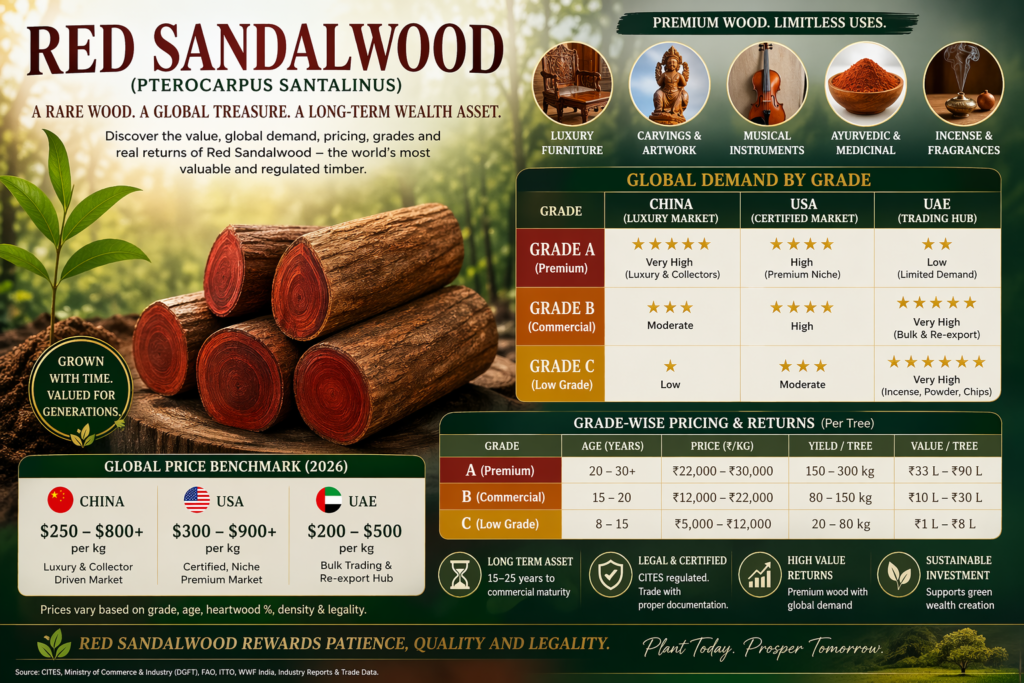
Red Sandalwood has diverse international demand, driven by luxury, culture, and industrial applications:
🔹 Key Uses
- Luxury furniture & carvings
- Musical instruments
- Ayurvedic & herbal medicine
- Natural dyes (santalin pigment)
- Incense & fragrance products
The wood is especially valued in China, where it has been used historically in imperial furniture (Zitan wood), making it one of the most prestigious hardwoods globally.
Global demand spans:
- China, Japan, UAE, USA, Europe
- Pharmaceutical and luxury manufacturing industries
⚖️ Legal & Regulatory Reality
Red Sandalwood trade is heavily regulated worldwide:
- Listed under CITES Appendix II → export requires certification
- India allows export only under restricted authorization
- Export quotas and origin verification are mandatory
👉 Recent policy updates confirm:
- Export from private plantations is allowed but strictly controlled
- Documentation and certification are essential for legal trade
💰 Global Price Benchmarks (2026)
🌐 Base Price (India – Origin)
- ₹12,000 – ₹30,000 per kg (premium logs in auctions)
🌍 Export Market Comparison
| Market | Price Range ($/kg) | Market Nature |
|---|---|---|
| 🇨🇳 China | 250 – 800+ | Luxury & collector demand |
| 🇺🇸 USA | 300 – 900+ | Certified, niche premium |
| 🇦🇪 UAE | 200 – 500 | Bulk trading hub |
👉 Prices vary significantly based on:
- Heartwood percentage
- Age of tree
- Log diameter
- Legal certification
Scarcity and regulation make pricing volatile and opaque in global trade.
🌳 Grade-wise Pricing (A / B / C)
🔴 Grade A (Premium Investment Grade)
- Age: 20–30+ years
- Heartwood: 80–100%
- Price: ₹22,000 – ₹30,000/kg
- Use: Luxury furniture, collectors
🟠 Grade B (Commercial Grade)
- Age: 15–20 years
- Heartwood: 50–80%
- Price: ₹12,000 – ₹22,000/kg
- Use: Furniture, carvings
🟡 Grade C (Low Grade / Early Harvest)
- Age: 8–15 years
- Heartwood: <50%
- Price: ₹5,000 – ₹12,000/kg
- Use: Powder, incense
👉 Grade depends on:
- Grain pattern
- Density
- Heartwood formation
Premium “A grade” often has distinct wavy grain and higher density, commanding higher prices.
📊 Demand by Grade (China vs USA vs UAE)
| Grade | 🇨🇳 China | 🇺🇸 USA | 🇦🇪 UAE |
|---|---|---|---|
| 🔴 A | Very High (Luxury) | High (Certified niche) | Low |
| 🟠 B | Moderate | High | Very High |
| 🟡 C | Low | Moderate | Very High |
Key Insights:
- China → Premium (Grade A focused)
- USA → Balanced (A + B + C with certification)
- UAE → Volume market (B + C dominant)
📈 Real Investment Returns (Ground Reality)
Per Tree (Realistic Range)
| Grade | Yield | Value per Tree |
|---|---|---|
| A | 150–300 kg | ₹33L – ₹90L |
| B | 80–150 kg | ₹10L – ₹30L |
| C | 20–80 kg | ₹1L – ₹8L |
⚠️ Reality Check (Very Important)
- Only 5–10% trees reach Grade A
- Majority plantation output:
- Grade B → 50–70%
- Grade C → 20–40%
👉 Many farmland marketing claims assume 100% premium yield, which is unrealistic.
💸 Price Gap: Farmer vs Global Buyer
Example (High-grade wood):
- Farmer/Auction: ₹20,000/kg
- China buyer: ₹40,000–₹70,000/kg
👉 Margin gap:
- 2x–3x increase across supply chain
This gap exists due to:
- Export restrictions
- Limited legal supply
- International demand pressure
⚠️ Risks & Challenges
1. Legal Complexity
- Export approvals required
- Strict traceability needed
2. Illegal Trade Impact
- Red Sandalwood is one of the most smuggled timber species
- High demand has led to overexploitation and trafficking
3. Adulteration Risk
- Fake or substituted wood is common
- Lower-grade species often sold as genuine
4. Long Growth Cycle
- Commercial maturity: 15–25 years
🧠 Strategic Insights for Farmland Investors
✔️ Best Strategy
- Hold trees 20+ years for premium value
- Focus on quality growth, not early harvest
✔️ Market Targeting
- Grade A → China market
- Grade B → UAE + USA
- Grade C → UAE bulk + industrial markets
✔️ Profit Drivers
- Heartwood formation
- Tree age
- Legal certification
📌 Final Conclusion
Red Sandalwood is not just a tree—it is a regulated global luxury commodity.
- High returns are possible
- But depend on time, quality, and legality
- Market demand is strong but segmented by grade and geography
👉 For farmland investors:
- It is a long-term wealth asset, not a short-term crop
- Real success depends on scientific cultivation + legal market access
🌟 Final Takeaway
“Red Sandalwood rewards patience, not speculation.”