
💰 Executive Summary
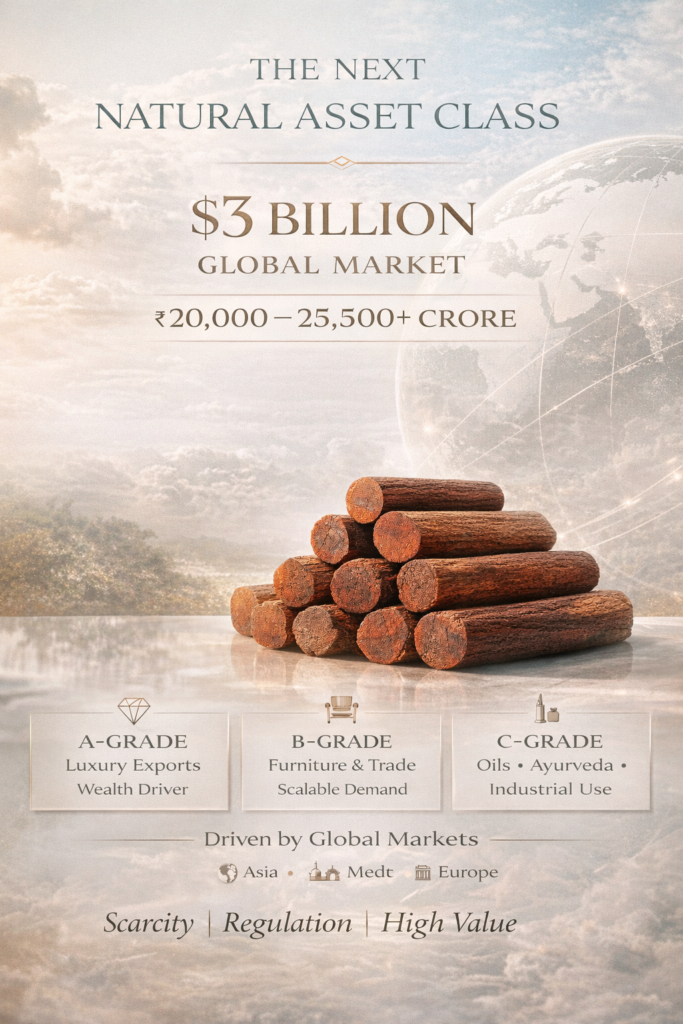
Red Sanders (Pterocarpus santalinus) is one of the world’s most valuable and rare natural resources, forming a $2.5 – $3 Billion (₹20,000 – ₹25,000+ crore) global market.
Unlike traditional commodities, this is a scarcity-driven, regulation-controlled asset class, where value is determined by grade, legality, and international demand.
🌍 Global Market Landscape
📊 Market Size (2025–2026)
- Total Industry Value: $2.5 – $3 Billion
- Core Timber Segment: $2.1 – $2.3 Billion
- By-products & Derivatives: $300 – $500 Million
👉 Despite its relatively niche size, Red Sanders operates as a high-value, low-volume global trade ecosystem.
🪵 Understanding the Grade-Based Value Chain
💎 A-Grade: Wealth Driver
- Premium deep-red heartwood with superior density
- Primary use:
- Luxury furniture
- Musical instruments
- Export-grade collectibles
👉 Contribution: ~50–60% of total market value
👉 Investor Insight: Core profit generator with ultra-premium pricing
🪵 B-Grade: Scalable Trade Segment
- Moderate quality with broader usability
- Applications:
- Semi-luxury furniture
- Decorative wood products
👉 Contribution: ~25–35%
👉 Investor Insight: Strong volume-driven segment balancing cost and demand
🌿 C-Grade: Industrial Backbone
- Lower-grade wood and smaller logs
- Applications:
- Powder & extracts
- Incense and religious products
- Ayurvedic formulations
👉 Contribution: ~10–20%
👉 Investor Insight: Ensures full resource utilization and steady demand
🧴 High-Growth By-Product Economy
Beyond timber, Red Sanders feeds a rapidly expanding value-added ecosystem:
- Essential oils & extracts
- Luxury perfumes (Middle East & Europe markets)
- Ayurvedic medicine & herbal products
- Cosmetics & skincare
- Incense and spiritual products
👉 This segment delivers higher margins and long-term scalability
🌏 Global Demand Drivers
- 🇨🇳 China → Premium furniture & collectibles
- 🇯🇵 Japan → Traditional instruments
- 🇦🇪 Middle East → Perfumes & incense
- 🇮🇳 India → Ayurveda & exports
👉 Asia-Pacific dominates with over 60% demand, driven by cultural and luxury consumption patterns.
📈 Strategic Market Characteristics
✔️ Extremely limited supply (endemic and protected species)
✔️ Strict global regulations governing trade
✔️ High price per tonne (among the costliest woods globally)
✔️ Zero-waste ecosystem (every grade has commercial value)
💡 Investment Perspective for HNIs & NRIs
🔑 Why Red Sanders Matters
- Acts as a natural hedge asset similar to gold or rare commodities
- Benefits from supply scarcity and regulatory barriers
- Offers multi-layer revenue streams (timber + derivatives)
- Increasing shift toward legal cultivation and structured trade
⚖️ Risk Considerations
- Regulatory complexities in export and ownership
- Long gestation period for cultivation
- Price sensitivity to international demand cycles
🧾 Final Insight
Red Sanders is not just a forest product — it is a strategic natural asset class.
👉 A-Grade builds wealth
👉 B-Grade scales trade
👉 C-Grade sustains industry
Together, they form a globally relevant, high-value ecosystem with long-term potential for patient, well-structured investors.
🔚 Conclusion
For discerning HNIs & NRIs seeking diversification beyond real estate and equities, Red Sanders presents a rare intersection of scarcity, luxury demand, and natural capital appreciation.
It is not a mass-market play —
it is a precision-driven, high-value opportunity for informed investors.