
🔷 Overview
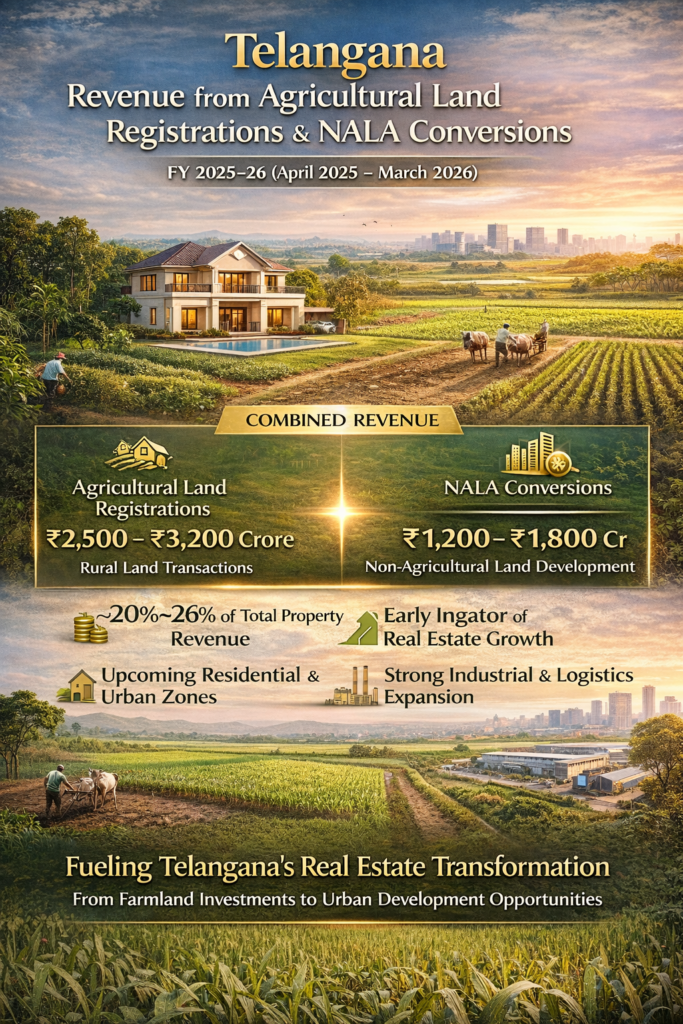
Telangana continues to strengthen its position as a high-growth real estate market, with significant contributions coming from agricultural land registrations and NALA (Non-Agricultural Land Assessment) conversions.
These two segments are critical not only for government revenue generation but also as leading indicators of future urban expansion, plotted developments, and industrial growth.
For the financial year 2025–26 (April 2025 – March 2026), both segments have shown strong momentum across rural and peri-urban regions.
🌾 Revenue from Agricultural Land Registrations
💰 Estimated Revenue: ₹2,500 – ₹3,200 Crore
Agricultural land registrations form a major share of transactions across Telangana, especially in rural and developing zones.
📌 Key Revenue Sources:
- Sale and purchase of agricultural lands
- Family transfers (gift, inheritance, partition)
- Land consolidation and fragmentation transactions
📊 Revenue Mechanism:
Government revenue is primarily generated through:
- Stamp Duty
- Transfer Duty
- Registration Charges
👉 Combined, these typically account for ~6% of the land transaction value.
📈 Growth Drivers
- Increasing demand for farmland investments
- Expansion of peri-urban areas around Hyderabad and tier-2 towns
- Land banking by investors and developers
- Rising participation from HNIs & NRIs
- Improved transparency through digitization of land records
🏗️ Revenue from NALA (Non-Agricultural Land Conversion)
💰 Estimated Revenue: ₹1,200 – ₹1,800 Crore
NALA conversion is a major catalyst for transforming agricultural land into high-value real estate assets.
📌 What NALA Covers:
- Conversion of agricultural land into:
- Residential layouts (open plots)
- Villa and gated community projects
- Commercial developments
- Industrial and logistics zones
📊 Revenue Mechanism
- Conversion charges collected by the government
- Increase in land value after conversion
- Higher stamp duty collections due to revised market value
📈 Growth Drivers
- Rapid urbanization and infrastructure development
- Growth in plotted developments and gated communities
- Expansion of industrial corridors and logistics hubs
- Rising demand for second homes and long-term investments
💰 Combined Revenue Contribution
| Category | Estimated Revenue (FY 2025–26) |
|---|---|
| Agricultural Land Registrations | ₹2,500 – ₹3,200 Cr |
| NALA Conversions | ₹1,200 – ₹1,800 Cr |
| Total Revenue | ₹3,700 – ₹5,000 Cr |
📊 Strategic Importance
- Contributes approximately 20%–26% of total property-related revenue
- Serves as a foundation layer for future real estate development
- High NALA activity indicates:
- Upcoming residential layouts
- Expansion of urban boundaries
- Future commercial and industrial hubs
🚀 Key Insights
- Agricultural land is evolving into a high-potential investment asset class
- NALA conversions are accelerating due to infrastructure-led growth
- Revenue increases significantly after land-use conversion due to higher valuations
- Strong correlation between NALA activity and future real estate hotspots
🧠 Conclusion
Revenue from agricultural land registrations and NALA conversions highlights Telangana’s transition into a structured, growth-driven real estate ecosystem.
With increasing demand, expanding urban corridors, and continuous infrastructure development, this segment will remain a key driver of both revenue generation and long-term investment opportunities in the state.