
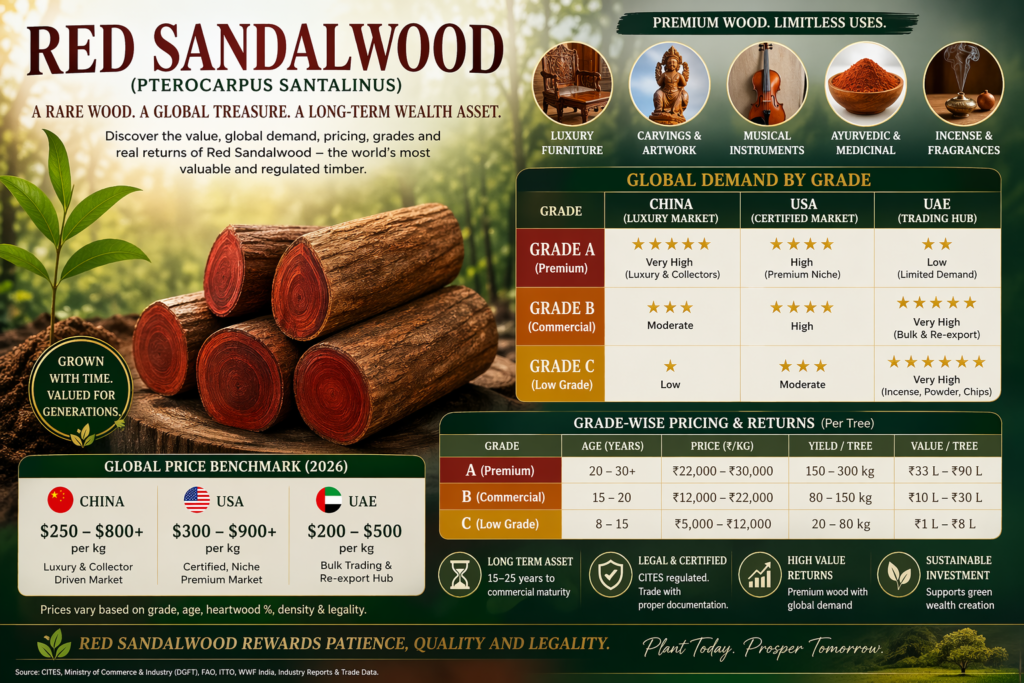
1. 🪵 What Defines “Mature Heartwood” in Red Sanders?
Heartwood is the only commercially valuable portion of Pterocarpus santalinus. Its maturity determines price, export eligibility, and industrial use.
Scientifically accepted maturity benchmarks:
- Natural forests: 25–40 years for full maturity
- High-value export logs: typically 30+ years old trees
- Plantation wood:
- 10–12 yrs → immature heartwood
- 15–20 yrs → developing commercial grade
- 25+ yrs → true dense, pigment-rich heartwood
👉 Key biochemical indicator:
- Presence of Santalin A & B (red pigment compounds)
- These compounds accumulate only in mature heartwood
2. 📊 Heartwood Quality Standards (Trade & Industry Specifications)
There is no single universal BIS-style grading system, but globally accepted trade standards exist based on:
A. Heartwood Ratio (Most Important)
- Export-grade logs: ≥85% heartwood content
- Below 70–75% → low commercial grade
B. Tree Age Standard
- Premium logs sourced from:
- ≥30 years trees (preferred)
- Younger plantation wood → discounted pricing
C. Grain Pattern
- Wavy grain → A-grade (highest value)
- Straight grain → B-grade
- Irregular grain → C-grade
D. Density & Specific Gravity
- High quality: 0.95–1.10 g/cm³ (very dense hardwood)
E. Moisture Content (for export logs)
- Surface: ≤18%
- Core: 22–26%
F. Physical Log Specifications (Indian trade norms)
- Length: ≥150 cm
- Girth: ≥36 cm
- Straight, defect-free logs
3. 🧪 Laboratory Quality Parameters (Advanced Buyers & Export Markets)
High-end buyers (China, Japan, Europe) often test:
- Santalin content (color intensity)
- Absence of dyes/adulteration
- Density & microstructure
- Mineral accumulation (Zn, Cu, Sr influence color/density)
👉 Premium certification often includes:
- Chemical analysis report
- Wood anatomy verification
4. 📜 Who Issues Heartwood Quality Certification?
This is where most misinformation exists—there is NO single “heartwood quality certificate authority” like BIS hallmark for gold.
Instead, certification is multi-layered and purpose-specific:
A. 🌿 Government Authorities (Mandatory Legal Certification)
1. State Forest Department (India)
- Issues:
- Certificate of Origin
- Transit permits
- Tree verification (for private plantations)
👉 This is the most important legal document
- Without it → illegal wood
✔ Confirms:
- Source (forest / plantation)
- Legality of harvest
2. DGFT (Directorate General of Foreign Trade)
- Issues export authorization
- Required for legal export consignments
3. 🌍 CITES (International Certification)
- Red Sanders is listed under CITES Appendix II
👉 Export requires:
- CITES Export Permit
✔ Confirms:
- Trade does not harm species survival
- International legality
B. 🧪 Technical / Quality Certification (Non-Government)
4. Wood Testing & Research Institutes
Examples:
- Indian Institute of Wood Science & Technology (IIWST)
- Forest Research Institute (FRI), Dehradun
✔ Provide:
- Wood density reports
- Species verification
- Chemical composition testing
5. Third-Party Inspection Agencies
- SGS
- Bureau Veritas
- Intertek
✔ Provide:
- Log grading inspection
- Moisture & quality reports
- Shipment verification
6. Exporter / Auction Grading Systems
- Government auctions (AP Forest Dept)
- Private exporters
✔ Provide:
- Grade classification (A/B/C)
- Lot-based quality description
👉 Note:
These are commercial grading systems—not legal certifications
5. ⚠️ Critical Reality (Very Important for Investors)
👉 There is NO official “A-grade certificate” issued by government
What exists:
- Legal certification → Forest Dept + CITES
- Quality validation → labs + buyers
- Market grading → traders/exporters
👉 So:
- “Certified A-grade plantation wood” claims are often marketing—not regulated standards
6. 🧠 How Real Buyers Validate Quality
Professional buyers rely on:
- Cross-section heartwood ratio
- Age verification (tree records / girth analysis)
- Grain pattern inspection
- Lab testing (for high-value deals)
- Legal documentation (Forest + CITES mandatory)
7. ✅ How to Achieve Certifiable Premium Quality in Plantations
To meet export-grade standards:
- Grow trees 20–25+ years minimum
- Ensure ≥70–80% heartwood formation
- Maintain moderate stress soil conditions
- Avoid rapid growth (over-fertilization)
- Keep traceable plantation records (for certification)
📌 Final Insight
Red Sanders quality is not defined by certificates alone—but by a combination of:
- 🌳 Age (most critical)
- 🌍 Soil stress & environment
- 🧪 Chemical composition (santalin content)
- 📜 Legal traceability
👉 Certification ensures legality and authenticity
👉 Quality determines price and demand