
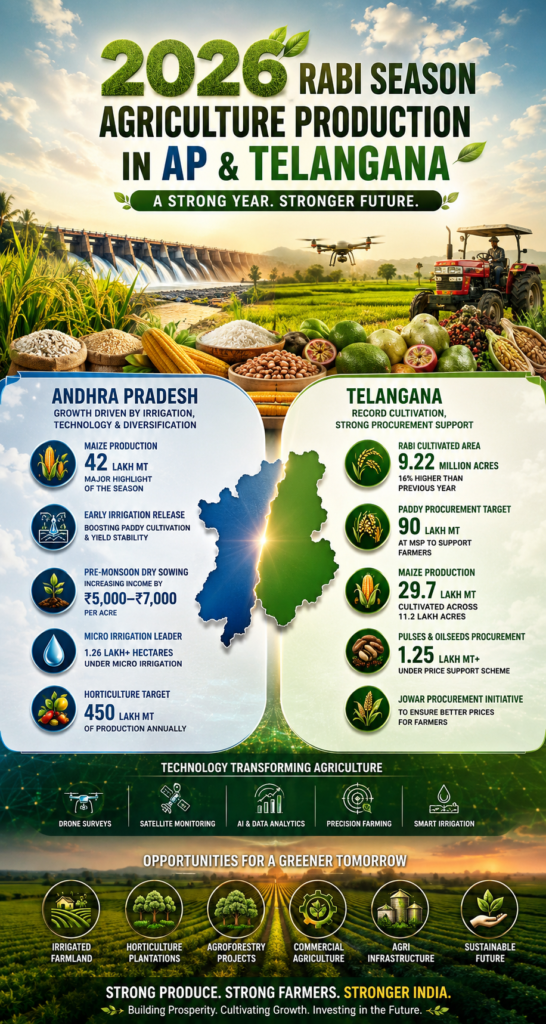
A Strong Agricultural Year Driven by Irrigation, Technology & Expanding Crop Cultivation
The 2026 Rabi season has emerged as a highly productive agricultural cycle for both Andhra Pradesh and Telangana, reinforcing the importance of South India in India’s food security and agri-economy.
Supported by improved irrigation infrastructure, favorable reservoir levels, expanded cultivation acreage, government procurement support, and adoption of scientific farming methods, both states witnessed significant growth in paddy, maize, horticulture, pulses, and commercial crop cultivation during the season.
As agriculture increasingly evolves from subsistence farming toward commercial and technology-driven cultivation, Andhra Pradesh and Telangana are becoming major destinations for long-term farmland and agroforestry investments.
Understanding the Rabi Season
The Rabi season in India typically begins after the monsoon, with sowing occurring between October and December and harvesting taking place from March to May.
In Andhra Pradesh and Telangana, major Rabi crops include:
- Paddy (Rice)
- Maize
- Bengal Gram (Chickpea)
- Black Gram (Urad)
- Groundnut
- Sunflower
- Jowar (Sorghum)
- Horticulture crops
- Commercial plantations
The performance of the Rabi season depends heavily on:
- Irrigation water availability
- Reservoir storage levels
- Groundwater conditions
- Climate patterns
- Government procurement policies
- Market prices
India’s Overall Rabi Production Reached Record Levels in 2025–26
According to the Ministry of Agriculture & Farmers Welfare, Government of India, India recorded one of its strongest agricultural years in 2025–26.
The Second Advance Estimates released in March 2026 projected:
- Total Rabi foodgrain production: 1,745.13 lakh metric tonnes
- Rabi rice production: 167.20 lakh metric tonnes
- Record Rabi maize production: 159.03 lakh metric tonnes
- Strong growth in pulses and oilseeds production
This national agricultural growth trend was strongly reflected in Andhra Pradesh and Telangana.
Andhra Pradesh: Expanding Scientific Agriculture & Commercial Crop Cultivation
Agriculture continues to play a vital role in Andhra Pradesh’s rural economy, with the state rapidly moving toward high-value agriculture, horticulture, micro-irrigation, and climate-resilient farming practices.
Maize Production Emerged as a Major Highlight
One of the biggest agricultural developments during the 2026 Rabi season was Andhra Pradesh’s strong maize output.
The state projected nearly 42 lakh metric tonnes of maize production, making it one of the largest maize-producing regions in South India.
However, strong production also resulted in market oversupply, pushing open market prices below the Minimum Support Price (MSP). The Andhra Pradesh government requested central support under the Price Deficiency Payment Scheme (PDPS) to protect farmers from losses.
Improved Irrigation Strengthened Rabi Cultivation
The Andhra Pradesh government accelerated irrigation water releases into major delta systems ahead of the cultivation season.
Early water release in Krishna and Godavari delta regions significantly supported:
- Paddy cultivation
- Crop planning
- Water security
- Yield stability
Officials stated that proactive irrigation management would help reduce climate-related crop risks and improve productivity.
Rapid Adoption of Scientific Farming Practices
Anticipating below-normal monsoon conditions due to El Niño concerns, Andhra Pradesh launched large-scale Pre-Monsoon Dry Sowing (PMDS) programs across rain-fed districts such as:
- Anantapur
- Sri Sathya Sai
- Kurnool
- Kadapa
- Prakasam
The technique aims to:
- Reduce water consumption
- Lower fertilizer usage
- Improve crop resilience
- Increase farmer income
Officials estimate that PMDS can improve farmer earnings by ₹5,000–₹7,000 per acre.
Andhra Pradesh Leading in Micro Irrigation
The state also emerged as India’s top performer in micro-irrigation implementation during 2025–26.
According to official reports:
- Over 1.26 lakh hectares were brought under micro irrigation
- More than 1.08 lakh farmers benefited
- Drip irrigation accounted for the majority of installations
Micro irrigation is becoming increasingly important for:
- Water conservation
- Commercial horticulture
- Agroforestry
- Sustainable farming systems
Strong Push Toward Horticulture & Commercial Agriculture
The Andhra Pradesh government is aggressively promoting horticulture and commercial crop diversification.
NABARD’s 2026–27 credit plan allocated major funding toward:
- Horticulture
- Agricultural mechanization
- Irrigation
- Agro infrastructure
- Allied farming activities
The state has set ambitious horticulture production targets of nearly 450 lakh metric tonnes annually.
Special focus areas include:
- Cocoa cultivation
- Avocado farming
- Fig plantations
- Pepper cultivation
- Natural farming
- Agro-processing
This shift reflects the growing preference for high-value farming models with long-term income potential.
Telangana: Record Paddy Cultivation & Procurement Operations
Telangana recorded one of its strongest Rabi seasons in recent years, especially in paddy cultivation and procurement.
Improved irrigation infrastructure and reservoir management significantly boosted cultivation acreage across the state.
Telangana Achieved Record Rabi Crop Coverage
According to state agriculture department reports, Telangana’s total Rabi cultivated area crossed 9.22 million acres by April 2026 — approximately 16% higher than the previous year and well above the normal seasonal acreage.
Key crop acreage included:
- Paddy: 6.54 million acres
- Maize: 1.64 million acres
- Jowar: 4 lakh+ acres
The increase was largely supported by:
- Kaleshwaram Lift Irrigation Project
- Reservoir storage improvements
- Tank restoration programs
- Better irrigation planning
Massive Paddy Procurement Operations
The Telangana government launched one of the largest procurement operations in the state’s history during the 2026 Rabi season.
The state targeted procurement of:
- 90 lakh metric tonnes (LMT) of paddy
- Across approximately 54.48 lakh acres of paddy cultivation
- Expected paddy production of nearly 1.52 crore metric tonnes
Government procurement at MSP played a crucial role in:
- Protecting farmer income
- Reducing market volatility
- Ensuring smooth grain movement
MSP rates announced for the season were:
- ₹2,389 per quintal for Grade A paddy
- ₹2,369 per quintal for common variety paddy
Telangana’s Maize Production Also Increased Sharply
Telangana experienced strong maize production growth during both Kharif and Rabi seasons.
The crop was cultivated across approximately 11.2 lakh acres, with expected production reaching nearly 29.7 lakh metric tonnes.
However, falling maize market prices became a major concern. The Telangana government urged the Centre to include maize under the Price Support Scheme (PSS) to safeguard farmers.
Technology & Data-Driven Agriculture Are Expanding
Both Andhra Pradesh and Telangana are increasingly adopting:
- Satellite crop monitoring
- Drone-based crop surveys
- Precision farming
- Remote sensing technologies
- Digital agriculture systems
Recent agricultural studies conducted in Telangana and Andhra Pradesh demonstrated the growing role of:
- UAV-based crop monitoring
- Multispectral imaging
- Remote sensing
- AI-based yield estimation systems
These technologies are expected to improve:
- Crop productivity
- Irrigation efficiency
- Disease monitoring
- Yield forecasting
- Farm profitability
Key Challenges Faced During the 2026 Rabi Season
Despite strong production numbers, several challenges remain for farmers across both states.
Falling Market Prices
Higher production in paddy and maize created temporary oversupply conditions, leading to lower open market prices in several districts.
Climate Uncertainty
El Niño concerns and below-normal rainfall forecasts continue to create uncertainty for future crop seasons.
Water Sustainability Concerns
Large-scale paddy cultivation raises long-term concerns regarding:
- Groundwater depletion
- Irrigation sustainability
- Water-use efficiency
Need for Value Addition
Experts increasingly emphasize the importance of:
- Food processing
- Cold storage infrastructure
- Agroforestry
- Crop diversification
- Agricultural exports
- Farm mechanization
to improve long-term farmer profitability.
What the 2026 Rabi Season Means for Farmland Investors
The 2026 Rabi season clearly demonstrates that Andhra Pradesh and Telangana continue to be among India’s strongest agricultural growth regions.
Key investment opportunities are rapidly emerging in:
- Irrigated farmland
- Agroforestry projects
- Horticulture plantations
- Commercial agriculture
- Natural farming
- Integrated farming systems
- Agricultural infrastructure
With expanding irrigation networks, improved rural connectivity, and growing demand for sustainable agriculture, productive farmland in South India is increasingly being viewed as a long-term real asset.
For investors, landowners, NRIs, and agricultural entrepreneurs, Andhra Pradesh and Telangana offer:
- Strong agricultural growth potential
- Government-backed agriculture support
- Rising food demand
- Export opportunities
- Long-term land value appreciation
- Increasing adoption of modern farming practices
making the region one of India’s most promising agricultural investment destinations.