
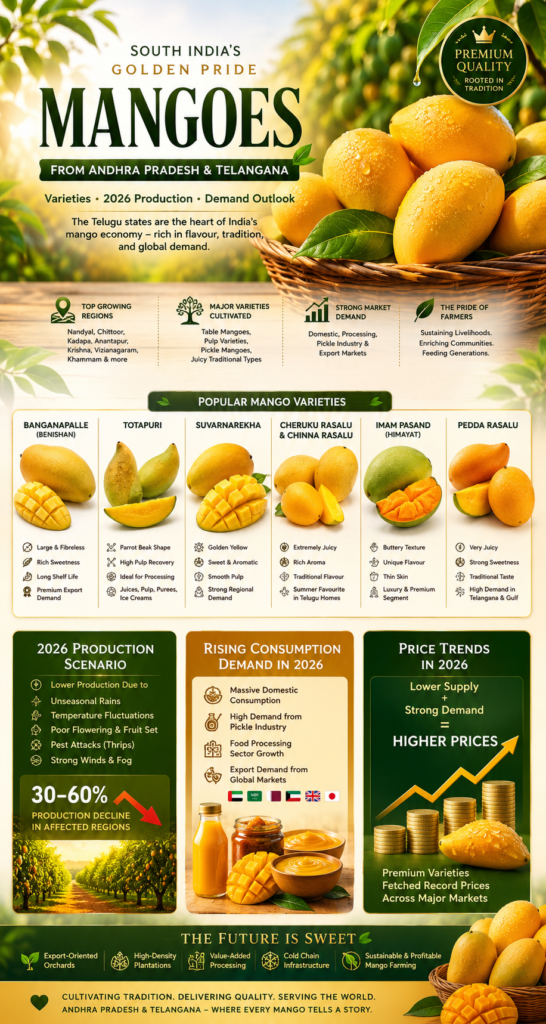
Mangoes are not just a seasonal fruit in the Telugu states — they are deeply connected to agriculture, culture, food processing, exports, and rural livelihoods. Andhra Pradesh and Telangana together form one of India’s most important mango-producing regions, supplying premium table varieties, pickle mangoes, pulp-grade fruits, and export-quality produce to domestic and international markets.
The 2026 summer season has emerged as a mixed year for the mango industry. While consumer demand has remained exceptionally strong across India and export markets, mango production in several districts of Andhra Pradesh and Telangana has witnessed noticeable declines due to erratic climate conditions, pest attacks, and unseasonal weather disturbances.
Andhra Pradesh & Telangana: India’s Premium Mango Hub
Andhra Pradesh remains one of India’s largest mango-producing states, cultivating mangoes across lakhs of hectares with historically massive annual output. Telangana also contributes significantly through premium juicy and traditional varieties cultivated across southern and central districts.
The Telugu states enjoy ideal tropical and semi-arid climatic conditions suitable for both:
- Premium table mangoes
- Industrial pulp varieties
- Pickling mangoes
- Juicy local varieties
- Export-oriented cultivation
Major mango-growing districts include:
- Nandyal
- Chittoor
- Kadapa
- Anantapur
- Krishna
- NTR District
- Eluru
- Vizianagaram
- Srikakulam
- Khammam
- Mahabubnagar
- Medak
- Rangareddy
Major Mango Varieties in AP & Telangana
Banganapalle (Benishan)
Banganapalle Mango
Banganapalle is the most commercially dominant mango variety in Andhra Pradesh and holds Geographical Indication (GI) recognition. Originating from Banganapalle region in Andhra Pradesh, it is widely cultivated due to its export potential and premium consumer preference.
Key Characteristics
- Large fruit size
- Fibreless pulp
- Rich sweetness
- Long shelf life
- Attractive golden-yellow skin
Major Market Uses
- Fresh table consumption
- Supermarket retail
- Export markets
- Premium gifting
In 2026, reduced arrivals pushed Banganapalle prices significantly higher in urban fruit markets.
Totapuri
Totapuri Mango
Totapuri is among South India’s most important industrial mango varieties. It is easily recognized by its parrot-beak shaped tip and is heavily used by the food processing industry.
Key Characteristics
- Mild sweetness
- Firm flesh
- High pulp recovery
- Excellent industrial suitability
Major Uses
- Mango pulp industry
- Juice manufacturing
- Ice creams
- Purees
- Beverage concentrates
Demand from processing industries continues to remain extremely strong due to increasing packaged beverage consumption.
Suvarnarekha
Suvarnarekha Mango
Suvarnarekha is a highly preferred traditional mango variety cultivated largely in North Andhra Pradesh districts. It is known for its attractive appearance and rich sweetness.
Characteristics
- Golden-yellow skin
- Sweet aroma
- Smooth pulp
- Strong regional demand
However, North Andhra mango belts suffered severe weather-related production losses during flowering and fruit-setting stages in 2026.
Cheruku Rasalu & Chinna Rasalu
Cheruku Rasalu Mango
Chinna Rasalu Mango
Rasalu varieties are among the most loved mangoes in Telugu households due to their exceptional sweetness and juice content.
Characteristics
- Extremely juicy pulp
- Traditional flavour profile
- Rich aroma
- Seasonal household favourite
Consumer Preference
These varieties are widely consumed for:
- Fresh juice extraction
- Homemade desserts
- Direct summer consumption
In 2026, lower availability and rising demand led to steep price increases across retail markets.
Imam Pasand (Himayat)
Imam Pasand Mango
Often referred to as one of India’s finest mangoes, Imam Pasand is known for its rich buttery texture and unique flavour profile.
Characteristics
- Buttery pulp texture
- Distinctive flavour
- Thin skin
- Premium positioning
Market Demand
- High-end fruit stores
- Luxury consumers
- NRI buyers
- Premium gifting market
Pedda Rasalu
Pedda Rasalu Mango
Pedda Rasalu remains one of Telangana’s most popular seasonal mangoes.
Characteristics
- Very juicy texture
- Strong sweetness
- Traditional Telugu taste
Market Demand
This variety continues to see strong demand in Telangana and Gulf export markets.
2026 Summer Mango Production Scenario
The 2026 mango season has been heavily influenced by climatic instability across South India.
Key Reasons Behind Production Decline
Farmers across Andhra Pradesh and Telangana reported:
- Unseasonal rainfall
- Temperature fluctuations
- Heavy fog and dew
- Poor flowering
- Black thrips infestation
- Fruit drop during early stages
- Strong winds during flowering season
Several industry reports estimate production declines ranging between 30% and 60% in affected regions.
Most Affected Mango Regions
Production losses were particularly visible in:
- Vizianagaram
- Srikakulam
- Anakapalle
- Krishna district
- NTR district
- Chittoor
- Kadapa
- Anantapur
In some North Andhra regions, mango productivity reportedly dropped from normal levels of 6–8 tonnes per hectare to nearly 2–3 tonnes per hectare.
Rising Consumption Demand in 2026
Despite lower yields, consumption demand has remained extremely high.
1. Massive Domestic Consumption
India consumes the overwhelming majority of its mango production domestically, and the Telugu states continue to maintain strong seasonal demand from households, retail chains, and urban fruit markets.
2. Pickle Industry Demand
Raw mango demand remains exceptionally strong due to large-scale preparation of traditional pickles such as Avakaya across Andhra Pradesh and Telangana.
Avakaya
Every summer, lakhs of households purchase raw mangoes specifically for pickle preparation, creating massive seasonal demand.
3. Food Processing Industry Growth
Demand from processing industries continues to rise due to increasing consumption of:
- Mango beverages
- Fruit pulp
- Ice creams
- Yogurt products
- Packaged juices
- Frozen desserts
Totapuri and pulp-grade mango varieties remain critical to this industry segment.
4. Export Market Demand
Premium varieties from Andhra Pradesh and Telangana continue to attract export demand from:
- UAE
- Saudi Arabia
- Qatar
- Kuwait
- United Kingdom
- Japan
Export-oriented varieties include:
- Banganapalle
- Imam Pasand
- Pedda Rasalu
- Totapuri
However, logistics disruptions and increasing freight costs impacted export volumes during the 2026 season.
2026 Price Trends
The combination of lower production and strong demand has resulted in significant price increases during the 2026 summer season.
Market observations indicate:
- Premium mango varieties witnessed sharp retail price increases
- Early-season arrivals fetched record market prices
- Juicy varieties became costlier due to supply shortages
- Processing industries competed aggressively for Totapuri procurement
In several cities, premium mango retail prices increased substantially compared to previous seasons.
Future Outlook for Mango Farming
Despite climate-related challenges, the long-term outlook for mango cultivation remains highly positive.
Emerging Opportunities
Export-Oriented Orchards
Premium-quality mangoes continue to attract strong international demand.
High-Density Plantations
Modern high-density mango farming is improving productivity and orchard management efficiency.
Agroforestry Integration
Mango cultivation is increasingly being integrated with long-term agroforestry models.
Value-Added Processing
The rise of mango-based processed foods is creating new commercial opportunities.
Cold Chain Infrastructure
Better storage and transportation systems are expected to improve farmer profitability.
Conclusion
The 2026 mango season in Andhra Pradesh and Telangana clearly demonstrates the growing importance of climate resilience in horticulture farming. While production declined in several regions due to weather disturbances and pest pressures, consumer demand remained exceptionally strong across domestic and export markets.
Premium varieties such as Banganapalle, Totapuri, Rasalu, Imam Pasand, and Suvarnarekha continue to dominate market preference due to their taste, commercial value, and processing potential.
For farmers, agribusiness companies, exporters, and farmland investors, mango cultivation remains one of the strongest long-term horticulture opportunities in South India — especially when supported by scientific orchard management, irrigation infrastructure, pest control, and post-harvest value addition.