
Most investments are measured in years.
Some assets are measured in generations.
A premium plantation can belong to the second category.
For an HNI, entrepreneur or family office, the question isn’t always:
“What can this investment make next year?”
Sometimes the question is:
“What asset can I create today that my children can inherit tomorrow?”
This is where a long-duration Red Sandalwood plantation becomes an interesting concept.
From Personal Wealth to Family Wealth
An entrepreneur may build a company.
A professional may build a portfolio.
A real estate investor may build properties.
But a family can build something different:
a portfolio of tangible, productive land assets.
A plantation can become part of that family balance sheet.
Why Red Sanders Fits the Legacy Concept
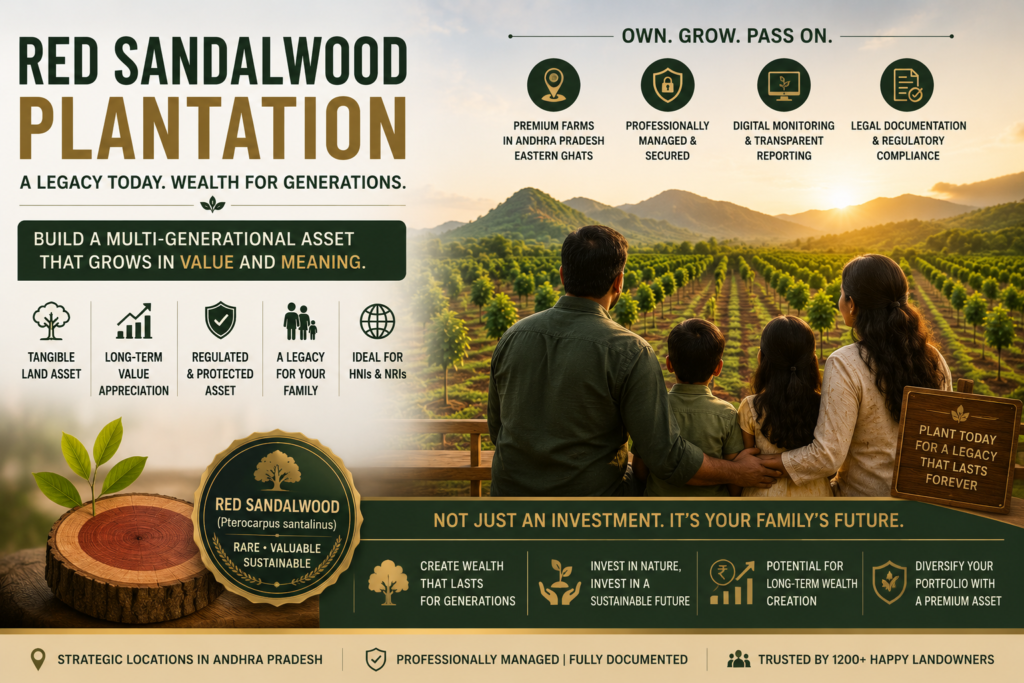
Red Sanders, scientifically known as Pterocarpus santalinus, is a high-value species associated naturally with Andhra Pradesh’s Eastern Ghats. Government sources describe its distinctive heartwood and international demand, while also emphasising its regulated status.
That combination makes it fundamentally different from ordinary farmland.
It is:
rare + biological + land-based + regulated + long-term
The Family Portfolio Model
Instead of buying one large plantation, an HNI family could potentially consider building a diversified plantation portfolio over time.
For example:
Portfolio A — Starter Allocation
A smaller plantation holding designed to introduce the next generation to agricultural assets.
Portfolio B — Family Wealth Allocation
A larger plantation holding intended as a long-term family asset.
Portfolio C — Multi-Generation Portfolio
Multiple plantation parcels acquired at different times, creating a diversified acquisition timeline.
The right structure depends on the family’s objectives, legal ownership structure and financial circumstances.
Why Multiple Acquisition Years Can Matter
Imagine purchasing plantation assets in:
2026
2029
2032
2035
Instead of one single acquisition date, the family creates multiple plantation cohorts.
This can potentially create different maturity stages over time.
The idea is not to predict returns.
The idea is to build a long-duration asset pipeline.
Teach the Next Generation About Real Assets
A family plantation can also become an educational asset.
Children can learn:
- Land ownership
- Agriculture
- Forestry
- Sustainability
- Technology
- Rural economics
- Asset management
- Long-term thinking
Imagine a child visiting the plantation at age 10.
Then again at 15.
Then at 20.
The same land changes with them.
That creates something financial statements cannot:
a relationship with the asset.
Technology Makes Legacy Ownership More Transparent
A modern plantation can be digitally documented through:
- Geo-tagging
- Plantation maps
- Tree inventories
- Photographic records
- Digital monitoring
- Security systems
- Periodic reports
For an NRI family, this can be especially valuable.
The family may live in:
Dubai today.
London tomorrow.
Singapore the next generation.
But the plantation remains in India.
The Importance of Legal Structure
This is where HNI investors should think beyond the marketing brochure.
Before purchasing, consult qualified legal and tax professionals regarding:
- Ownership structure
- Succession
- Nomination
- Estate planning
- Tax implications
- Transferability
- Agricultural land rules
- Applicable Red Sanders regulations
A plantation should fit into the family’s broader wealth architecture.
What Happens at Maturity?
This is another critical point.
Red Sanders is regulated.
The current Indian framework provides specific requirements for cultivation-origin material, including documentation and applicable export authorisations.
Therefore, a family should plan long before harvest.
The eventual pathway may involve:
Verification → Permissions → Harvest → Transport → Sale/Processing → Applicable regulatory compliance
The exact process depends on the law and rules applicable at the relevant time.
Why This Is Not a “Get Rich Quick” Asset
This distinction should be central to the article.
Red Sandalwood plantation ownership is not:
❌ A stock trade
❌ A short-term property flip
❌ Guaranteed income
❌ Guaranteed timber pricing
❌ Guaranteed returns
It is better understood as:
✔ Long-duration land ownership
✔ Plantation development
✔ Biological asset growth
✔ Potential long-term value creation
✔ Family legacy planning
The HNI Mindset
Wealthy families often understand one important principle:
The best assets don’t always need to generate immediate cash flow.
Some assets are held because they preserve and potentially grow wealth over long periods.
A plantation can fit into this philosophy when purchased, managed and documented properly.
Build Something Your Children Can See
Stocks appear on a statement.
Bonds appear on a statement.
A plantation can be physically visited.
Your children can walk through it.
Your grandchildren can walk through it.
And decades later, the family can still point to the same land and say:
“Our family started this.”
That is the emotional power of a true legacy asset.
CTA
Start Building Your Family’s Plantation Legacy
If you are an HNI, entrepreneur, NRI or family office looking to diversify into long-duration land and plantation assets, explore professionally managed Red Sandalwood plantation opportunities in Andhra Pradesh.
Don’t just build wealth. Build something your family can inherit.