
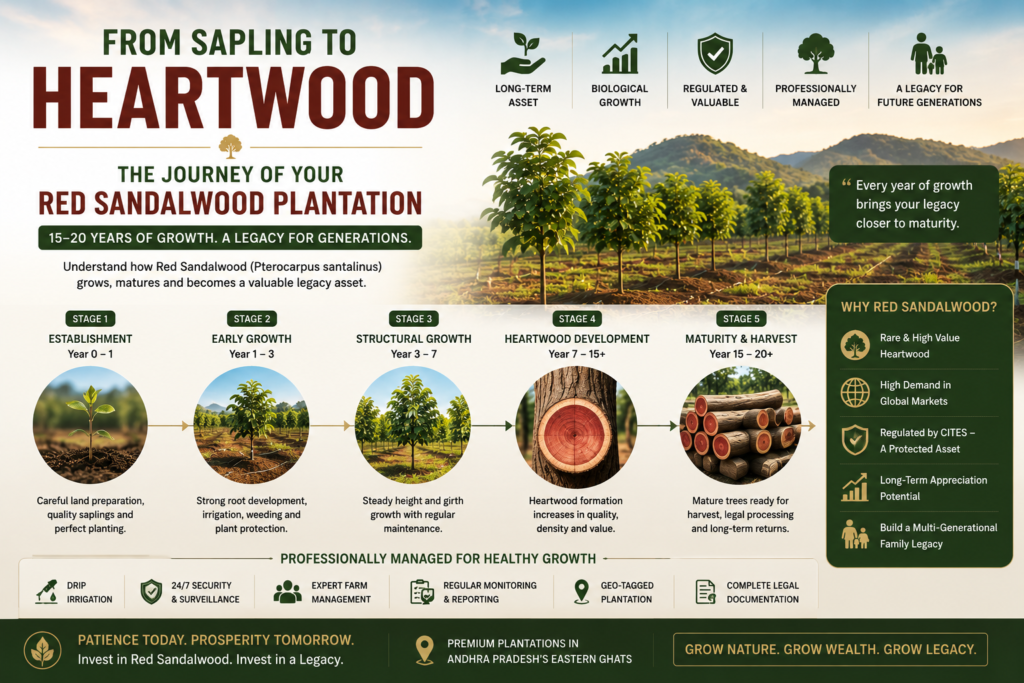
What happens after you buy a Red Sandalwood plantation?
This is one of the most important questions a long-term investor should ask.
Unlike an apartment or commercial plot, a plantation changes continuously.
The asset you purchase today is not the same asset you will see five, ten or fifteen years later.
The trees grow.
The trunks expand.
The plantation ecosystem develops.
And over time, the commercially important heartwood develops within the tree.
This makes Red Sanders plantation fundamentally different from conventional real estate.
Stage 1: Plantation Establishment
The journey begins before planting.
A professional plantation should consider:
- Land suitability
- Soil characteristics
- Drainage
- Water availability
- Climate
- Planting material
- Spacing
- Protection
- Irrigation
The objective is not simply to put a sapling into the ground.
The objective is to establish a healthy plantation.
Stage 2: Early Tree Development
During the initial years, survival and healthy vegetative growth are major priorities.
Management focuses on:
- Irrigation
- Weed control
- Soil care
- Plant protection
- Replacement of failed plants
- Security
The early years are foundational.
A plantation with poor establishment cannot simply be fixed by increasing the number of trees later.
Stage 3: Structural Growth
As trees mature, the focus shifts from establishment to long-term tree development.
The plantation becomes an increasingly visible biological asset.
This is when regular monitoring becomes important.
Investors should track:
- Tree survival
- Tree height
- Trunk development
- General health
- Plantation density
- Security
- Environmental conditions
Stage 4: Heartwood Development
The most important distinction is between sapwood and heartwood.
The commercially valued portion of Red Sanders is its heartwood.
The Andhra Pradesh Forest Department describes the wood’s distinctive colour and grain as key characteristics behind its value.
But investors should understand something critical:
Tree age alone does not guarantee a specific quantity, grade or market value of heartwood.
Heartwood development varies with biological and site conditions.
Therefore, projected financial outcomes should never be presented as guaranteed.
Stage 5: Mature Plantation
As the plantation moves toward maturity, the investor’s focus should shift increasingly toward:
documentation + valuation + regulatory planning + harvest planning
This is particularly important because Red Sanders is a regulated species.
The Government’s current framework provides specific requirements for cultivation-origin material and export authorisation.
The 15–20 Year Mindset
A plantation investment should be viewed differently from a short-term property transaction.
Think of it as:
Year 1 → Establishment
Years 2–5 → Growth
Years 5–10 → Plantation development
Years 10–15 → Mature asset development
Beyond → Long-term harvest/monetisation planning subject to applicable laws and permissions
This is not a guaranteed timetable for commercial maturity; actual outcomes depend on biological, site, management and regulatory factors.
Why Patient Capital Matters
HNIs frequently understand this concept better than short-term investors.
A family office doesn’t necessarily ask:
“What happens next month?”
It may ask:
“What will this asset look like in 15 years?”
That mindset fits long-duration plantations.
The Power of Biological Compounding
A financial asset compounds through reinvestment.
A plantation has another mechanism:
biological growth.
Every year, trees add biomass.
The physical asset changes while the land remains.
This creates an unusual investment narrative:
You are not only waiting for land appreciation. You are watching a biological asset develop on the land.
What Investors Should Monitor Every Year
A serious plantation owner should maintain a yearly record of:
- Number of surviving trees
- Tree growth
- Plantation health
- Irrigation
- Security
- Soil management
- Plantation photographs
- Geo-location
- Documentation
- Expenses
- Applicable legal requirements
This transforms a plantation from an invisible long-term holding into a monitored asset.
The Real Investment Question
Don’t ask:
“How much will one tree be worth?”
Ask:
“How professionally is my plantation being developed over the next 15–20 years?”
That is the better question.
CTA
Want to see what your plantation can look like over the next decade and beyond?
Ask for the Red Sandalwood Plantation Development Plan and understand:
Planting → Maintenance → Monitoring → Growth → Heartwood Development → Regulatory Planning
A long-term asset deserves long-term management.