
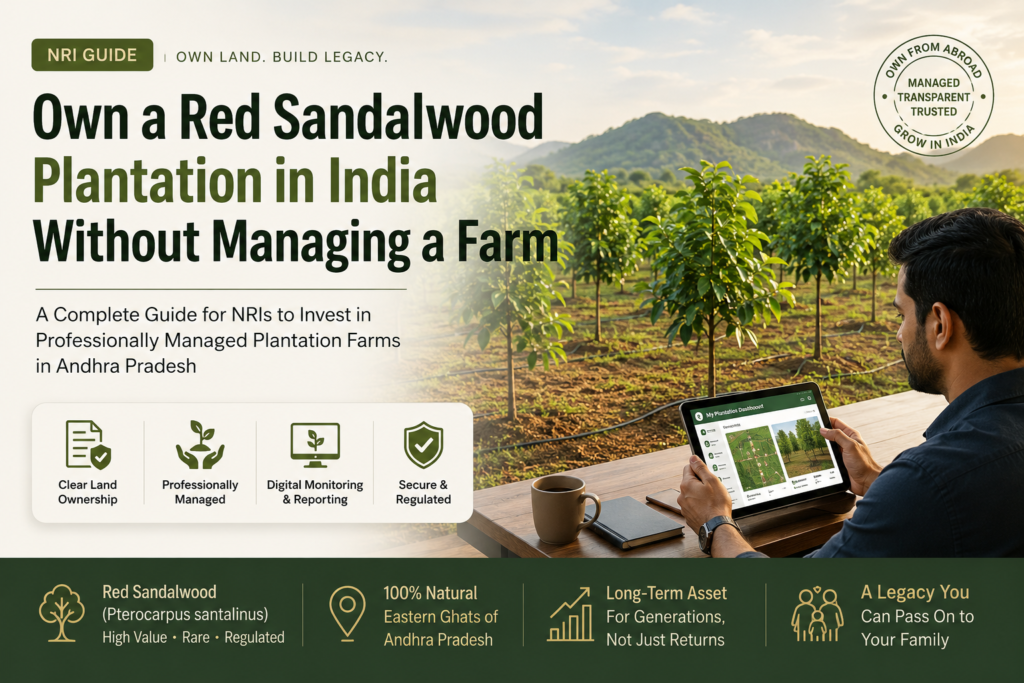
For a NRI living in Dubai, Singapore, the United States, the United Kingdom or Australia, owning land in India can be emotionally rewarding—but managing agricultural land from thousands of kilometres away can be extremely difficult.
There is a fundamental difference between owning farmland and managing a farm.
An NRI may want to own a long-term plantation asset in India without having to visit the property every month, hire workers, arrange irrigation, monitor trees or supervise everyday plantation activities.
This is where professionally managed plantation farms can create a different ownership experience.
Among high-value tree plantations, Red Sanders (Pterocarpus santalinus) has a particularly distinctive position because of its rarity, geographic association with Andhra Pradesh and international value. The species is regulated under CITES, and cultivation-origin material is subject to India’s export and documentation framework.
Why NRIs Are Looking Beyond Conventional Investments
Many NRIs already have exposure to:
- Residential property
- Commercial real estate
- Equity markets
- Fixed-income investments
- Gold
- Businesses
- International assets
But farmland introduces something fundamentally different:
a physical, productive land-based asset.
A plantation combines the ownership of land with the biological growth of trees.
The investor isn’t simply buying an empty parcel.
The long-term vision is to own:
Land + Plantation + Biological Growth + Documentation + Future Asset Value
That makes plantation ownership particularly interesting for investors who think in decades rather than months.
The NRI’s Biggest Problem: Distance
Imagine owning agricultural land in Andhra Pradesh while living in:
- Dubai
- Abu Dhabi
- London
- New York
- Toronto
- Singapore
- Melbourne
The problem isn’t buying the land.
The problem is managing it consistently.
Who checks the trees?
Who monitors irrigation?
Who replaces dead saplings?
Who maintains fencing?
Who coordinates labour?
Who documents plantation development?
Who sends updates?
A professionally managed plantation model is designed to address these operational challenges.
What Should an NRI Look for in a Managed Red Sandalwood Farm?
Before purchasing, an NRI should examine five major areas.
1. Land Ownership
Verify the underlying land documentation, title, survey details and applicable land-use status.
2. Plantation Documentation
The buyer should understand exactly what is being planted, where it is planted and how plantation records are maintained.
3. Tree Traceability
For a regulated species such as Red Sanders, traceability is particularly important.
Government frameworks place importance on legal sourcing, certificates of origin and physical verification for applicable export processes.
4. Plantation Management
Ask who is responsible for:
- Irrigation
- Weed management
- Plant replacement
- Soil management
- Security
- Fencing
- Plantation monitoring
5. Long-Term Exit Planning
An investor should never purchase a plantation simply because somebody says:
“The trees will become worth ₹X crore.”
Future timber prices are uncertain.
Instead, ask:
What is the legal and practical process for harvesting, sale, transportation and monetisation?
That is the more sophisticated investment question.
Why Red Sanders Is Different
The Andhra Pradesh Forest Department describes Red Sanders as endemic to southern Andhra Pradesh and notes its international recognition for its distinctive colour and grain.
Its international trade is regulated rather than unrestricted.
That distinction matters.
A serious plantation investor should view regulation not as something to ignore, but as part of the asset’s long-term due-diligence framework.
A Plantation You Can Watch From Anywhere
The ideal NRI plantation ownership experience should provide:
Purchase → Plantation → Monitoring → Reporting → Maintenance → Documentation → Long-term management
Technology can make this even more transparent through:
- Geo-tagged plantation records
- Periodic photographs
- Tree-count documentation
- Digital land records
- Plantation progress reports
- CCTV/security infrastructure
- Irrigation monitoring
The objective is simple:
You may live overseas. Your plantation shouldn’t become invisible.
The Emotional Advantage of Owning Land in India
For many NRIs, the attraction isn’t purely financial.
It is also about creating something tangible in India.
A plantation can become:
- A family asset
- A connection to India
- A long-term legacy
- A landholding for children
- A rural retreat
- A biological asset growing over time
Instead of leaving another financial statement to the next generation, an NRI can potentially leave behind an asset that can be physically visited.
Is a Red Sandalwood Plantation Right for Every NRI?
This is important.
Red Sanders plantation is a long-term, regulated, agriculture-linked asset, not a short-term trading instrument.
It may suit investors who:
- Have a long investment horizon
- Understand agricultural risk
- Want tangible assets
- Prefer long-term wealth creation
- Are comfortable with regulatory processes
- Do not require immediate liquidity
It may not suit investors seeking quick returns or guaranteed income.
Why Start With a Site Visit?
Even for an NRI, the purchase process should begin with verification rather than payment.
A proper site visit should examine:
Land → Location → Access → Soil → Water → Plantation → Security → Documentation → Management
If the investor cannot personally visit India, they should consider independent professional/legal verification and insist on clear documentation.
The NRI Opportunity
India’s relationship with its diaspora is increasingly connected to long-term ownership, family wealth and investment back home.
For the right investor, a professionally managed Red Sanders plantation can offer a rare combination:
Indian land ownership + plantation growth + long-term thinking + family legacy.
The objective isn’t to promise a predetermined return.
The objective is to own and manage a real asset with patience, discipline and proper documentation.
Final Thought
If you are an NRI looking for red sandalwood plantation investment in India, don’t begin with the question:
“How much can I earn?”
Begin with:
“What exactly am I buying, how is it managed, how is it documented, and what is the legal pathway to realise its value?”
That is how sophisticated investors evaluate long-term plantation assets.
Own the land. Grow the plantation. Stay connected to India—even from thousands of kilometres away.
CTA:
Explore Professionally Managed Red Sandalwood Plantation Farms
If you are an NRI interested in owning a managed Red Sanders plantation in Andhra Pradesh, request the land documents, plantation details, management model and site-visit options before making an investment decision.