
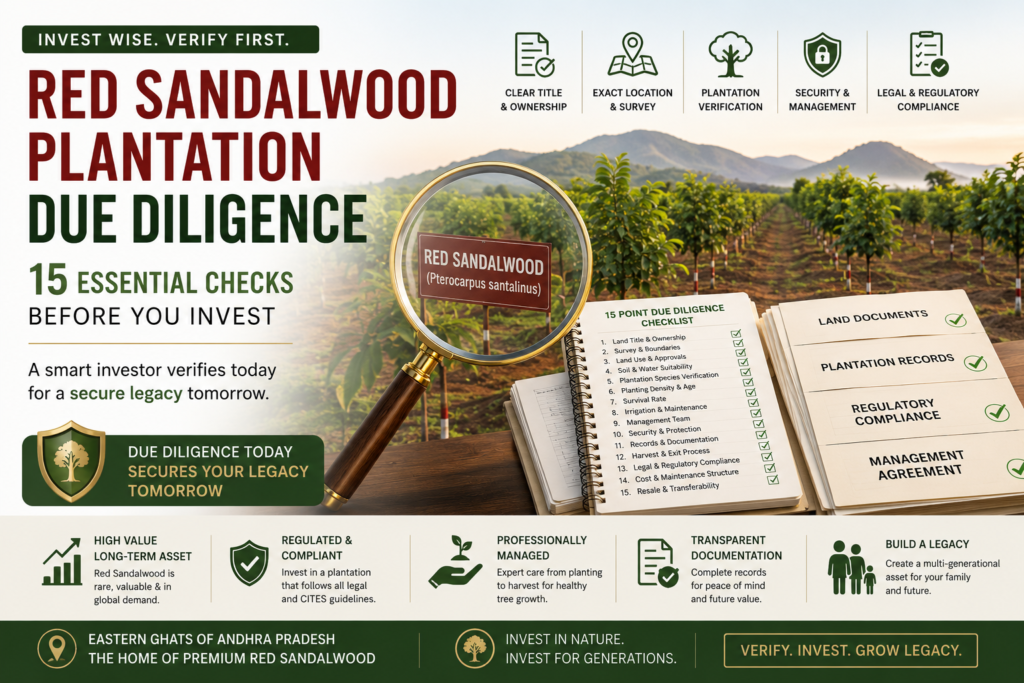
A high-net-worth investor rarely buys an asset because of a brochure.
They verify it.
They examine ownership.
They study the location.
They inspect documentation.
They understand regulations.
They evaluate the operator.
And only then do they make a decision.
The same principle should apply to Red Sandalwood plantation farms.
Red Sanders is not an ordinary agricultural commodity. It is a regulated species with international trade controls. India’s current framework specifically distinguishes cultivation-origin material and establishes documentation and quota requirements for applicable exports.
Therefore, due diligence is not optional.
It is part of the investment.
15 Questions Every Buyer Should Ask
1. Who owns the land?
Verify the legal owner.
2. What is the survey number?
Every buyer should know exactly which land parcel they are purchasing.
3. Is the title clear?
Obtain independent legal verification.
4. What is the extent of the land?
Confirm acres, cents/guntas and survey boundaries.
5. Where exactly is the plantation?
Do not rely only on Google Maps screenshots or brochures.
Visit the actual property.
6. What species is planted?
Confirm that the plantation actually contains Pterocarpus santalinus.
7. What is the planting density?
Ask how many trees are planted per acre and why.
8. What is the survival rate?
The number of saplings planted isn’t the same as the number of healthy surviving trees.
9. What is the plantation management system?
Ask who manages:
- Irrigation
- Weeding
- Nutrition
- Pest control
- Security
- Tree replacement
- Boundary maintenance
10. How is the plantation documented?
A modern plantation should ideally maintain systematic records.
11. How is the plantation protected?
Red Sanders is a high-value regulated timber species, making security and traceability important considerations.
12. What happens at harvest?
This is one of the most important questions.
The buyer should understand the applicable:
- Harvest permissions
- Transit rules
- Government procedures
- Verification requirements
- Sale process
- Export requirements
13. Who bears future management costs?
Understand the contractual structure clearly.
14. What happens if the investor wants to exit early?
Ask about resale, transferability and liquidity.
15. What are the risks?
A credible seller should be willing to discuss risks—not just returns.
The Biggest Mistake: Buying Trees Instead of Buying a System
Two plantations can both have 400 trees per acre and still be completely different investments.
Why?
Because plantation quality depends on:
Land + Genetics + Soil + Climate + Planting + Management + Survival + Security + Documentation + Long-term governance
This is why sophisticated investors should evaluate the entire plantation ecosystem.
Why Documentation Matters More for Red Sanders
The Government of India’s framework requires legal-source documentation and, for applicable export authorisations, certificates of origin and stock verification.
The Andhra Pradesh Forest Department also describes Red Sanders as a species whose international trade is governed by CITES.
That means investors should avoid treating Red Sanders like an unrestricted agricultural crop.
Compliance is part of value.
The HNI Investment Test
Before buying, ask yourself:
Land Test
Do I have verified ownership/title information?
Plantation Test
Can I independently verify the trees?
Management Test
Who will manage the plantation for the next decade?
Regulatory Test
Do I understand the applicable Red Sanders rules?
Financial Test
Can I hold the asset for the long term?
Exit Test
Do I understand how the asset can legally be monetised?
If you cannot answer these questions, don’t invest yet.
The Smart Investor’s Rule
Never buy Red Sandalwood because of the projected future price.
Buy only after understanding:
what you own + how it grows + how it is managed + how it is regulated + how it can eventually be monetised.
That is the difference between speculation and informed plantation ownership.
CTA
Thinking of buying a Red Sandalwood plantation farm?
Request the complete Due Diligence Pack before making your decision:
✔ Land documentation
✔ Plantation details
✔ Location information
✔ Management model
✔ Security system
✔ Plantation monitoring
✔ Applicable regulatory information
✔ Site-visit assistance
Invest after verification—not before it.