
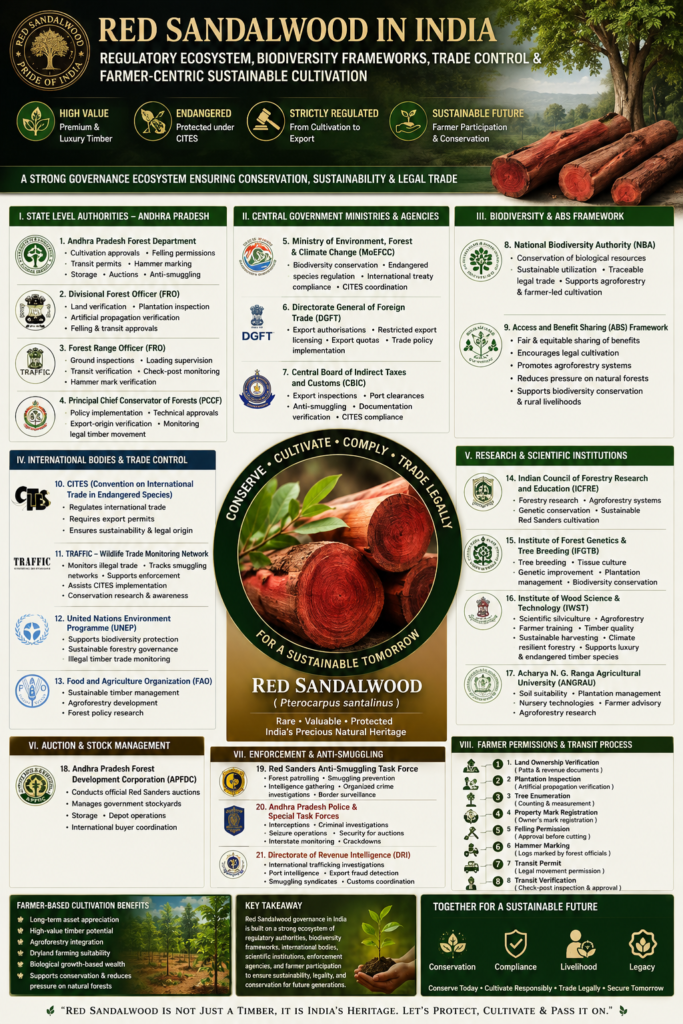
Red Sandalwood (Pterocarpus santalinus), commonly called Red Sanders, is one of the world’s most valuable and highly regulated timber species. Native to the Eastern Ghats region of Andhra Pradesh, the species is globally known for its premium heartwood, luxury timber value, medicinal importance, and international demand.
Because of historical illegal logging and smuggling pressures, India has developed a strong governance ecosystem involving forest departments, biodiversity authorities, international conservation bodies, customs agencies, research institutions, NGOs, and enforcement agencies to regulate cultivation, transit, auctions, exports, and conservation.
Today, farmers can legally cultivate Red Sanders on private lands through artificial propagation systems under regulated forestry and biodiversity frameworks.
Major Government Departments & Regulatory Authorities
Andhra Pradesh Forest Department
The Andhra Pradesh Forest Department is the primary authority governing Red Sanders cultivation, felling permissions, transit permits, storage, anti-smuggling enforcement, and auctions. It operates under:
- Andhra Pradesh Forest Act, 1967
- Andhra Pradesh Sandal Wood and Red Sanders Wood Transit Rules, 1969
- Andhra Pradesh Red Sanders Wood Possession Rules, 1989
Divisional Forest Officer (DFO)
The DFO handles farmer-level approvals including:
- Land verification
- Plantation inspections
- Artificial propagation verification
- Felling permissions
- Property mark registration
- Transit approvals
Forest Range Officer (FRO)
Forest Range Officers supervise:
- Ground inspections
- Loading supervision
- Transit verification
- Forest check-post monitoring
- Hammer mark verification
Principal Chief Conservator of Forests (PCCF)
The PCCF oversees:
- Policy implementation
- Technical approvals
- Export-origin verification
- Conservation systems
- Monitoring legal timber movement
Central Government Ministries & Agencies
Ministry of Environment, Forest and Climate Change (MoEFCC)
MoEFCC is India’s apex environmental authority responsible for:
- Biodiversity conservation
- Endangered species regulation
- Forest governance
- International treaty compliance
- CITES coordination
Directorate General of Foreign Trade (DGFT)
DGFT regulates:
- Export authorisations
- Restricted export licensing
- Export quotas
- International trade compliance
Red Sanders exports require government authorization under restricted trade categories.
Central Board of Indirect Taxes and Customs (CBIC)
Customs authorities supervise:
- Export inspections
- Port clearances
- Anti-smuggling operations
- Export documentation verification
- CITES compliance checks
Major export ports include Chennai, Krishnapatnam, and Visakhapatnam.
Biodiversity Governance & ABS Framework
National Biodiversity Authority (NBA)
The National Biodiversity Authority, established under the Biological Diversity Act, 2002, plays an important role in sustainable utilization and conservation of biological resources including Red Sanders.
The NBA framework supports:
- Farmer-led cultivation
- Biodiversity conservation
- Sustainable commercial utilization
- Traceable legal trade systems
- Agroforestry development
The authority encourages shifting from illegal forest extraction toward scientifically managed cultivation on private lands.
Access and Benefit Sharing (ABS) Framework
The ABS framework promotes fair and equitable sharing of benefits arising from biological resources.
In the Red Sanders ecosystem, ABS helps:
- Encourage legal cultivation
- Reduce pressure on natural forests
- Promote agroforestry systems
- Support biodiversity conservation
- Strengthen sustainable rural livelihoods
The framework integrates conservation with farmer participation and sustainable timber production.
International Conservation & Trade Bodies
CITES (Convention on International Trade in Endangered Species)
CITES regulates international trade in endangered species. Red Sanders is protected under CITES due to illegal trade pressures.
CITES ensures:
- Export regulation
- Sustainability monitoring
- Legal-origin verification
- International compliance
TRAFFIC – Wildlife Trade Monitoring Network
TRAFFIC is a leading global wildlife trade monitoring organization working with:
- WWF
- IUCN
- Forest authorities
- Customs agencies
- Wildlife crime enforcement bodies
TRAFFIC helps monitor:
- Illegal timber trade
- Smuggling networks
- Wildlife trafficking routes
- International endangered species markets
It also supports CITES implementation and conservation-based trade systems.
United Nations Environment Programme (UNEP)
UNEP supports:
- Biodiversity protection
- Sustainable forestry governance
- Illegal timber trade monitoring
- Climate-linked forestry initiatives
Food and Agriculture Organization (FAO)
FAO contributes to:
- Sustainable timber management
- Agroforestry development
- Forest policy research
- Conservation-linked farming systems
Research Institutions & Scientific Agencies
Indian Council of Forestry Research and Education (ICFRE)
ICFRE supports:
- Forestry research
- Agroforestry systems
- Genetic conservation
- Sustainable Red Sanders cultivation
Institute of Forest Genetics and Tree Breeding (IFGTB)
IFGTB contributes through:
- Tree breeding research
- Tissue culture
- Genetic improvement
- Plantation management
- Biodiversity conservation
Institute of Wood Science and Technology (IWST)
IWST, functioning under ICFRE, supports sustainable cultivation of luxury and endangered timber species including:
- Red Sandalwood
- Sandalwood
- Teak
- Rosewood
- Mahogany
IWST Areas of Support
- Scientific silviculture practices
- Agroforestry systems
- Farmer training
- Plantation spacing models
- Timber quality improvement
- Sustainable harvesting approaches
- Climate-resilient forestry systems
Institutions like IWST help shift the sector from illegal forest extraction toward scientifically managed farmer-based cultivation systems.
Acharya N. G. Ranga Agricultural University (ANGRAU)
ANGRAU supports:
- Soil suitability studies
- Plantation management
- Nursery technologies
- Farmer advisory services
- Agroforestry research
Auction Conducting Bodies
Andhra Pradesh Forest Development Corporation (APFDC)
APFDC conducts official Red Sanders auctions and manages government stockyards.
Responsibilities
- Auction management
- Storage of seized timber
- Depot operations
- International buyer coordination
Enforcement & Anti-Smuggling Agencies
Red Sanders Anti-Smuggling Task Force
Specialized task forces monitor:
- Illegal logging
- Smuggling routes
- Organized trafficking networks
- Forest surveillance
Andhra Pradesh Police & Special Task Forces
Police agencies support:
- Highway interceptions
- Criminal investigations
- Seizure operations
- Smuggling crackdowns
Directorate of Revenue Intelligence (DRI)
DRI investigates:
- International timber trafficking
- Export fraud
- Port intelligence operations
- Smuggling syndicates
Farmer Permissions & Transit Process
Farmers cultivating Red Sanders on private lands must follow regulated procedures including:
- Land ownership verification
- Plantation inspection
- Tree enumeration
- Property mark registration
- Felling permission
- Hammer marking
- Transit permit issuance
- Transit verification at check-posts
Artificial Propagation & Farmer-Based Cultivation
India permits Red Sanders cultivation through artificial propagation on private lands under regulated forestry systems.
Benefits for Farmers
- Long-term asset appreciation
- High-value timber potential
- Agroforestry integration
- Dryland farming suitability
- Biological growth-based wealth creation
Farmer participation in cultivated Red Sanders ecosystems can reduce dependence on extraction from natural forests while supporting biodiversity conservation.
NGOs & Conservation Organizations
World Wide Fund for Nature (WWF)
WWF supports biodiversity conservation and sustainable forestry initiatives.
International Union for Conservation of Nature (IUCN)
IUCN contributes to:
- Conservation research
- Sustainable species management
- Biodiversity policy frameworks
Conclusion
Red Sandalwood remains one of India’s most strategically regulated and conservation-sensitive timber species. Its cultivation, conservation, transit, auctions, exports, biodiversity governance, scientific management, and international trade monitoring involve a wide ecosystem of government departments, biodiversity authorities, research institutions, NGOs, conservation bodies, customs agencies, and enforcement organizations.
Organizations such as MoEFCC, NBA, ABS frameworks, CITES, TRAFFIC, ICFRE, IFGTB, IWST, AP Forest Department, APFDC, and international conservation bodies are helping shape a more sustainable, traceable, farmer-inclusive, and scientifically managed Red Sanders ecosystem.
As India strengthens conservation-linked agroforestry systems, Red Sanders cultivation on private lands may increasingly support:
- Forest conservation
- Sustainable timber production
- Rural economic development
- Biodiversity protection
- Long-term agroforestry wealth creation