
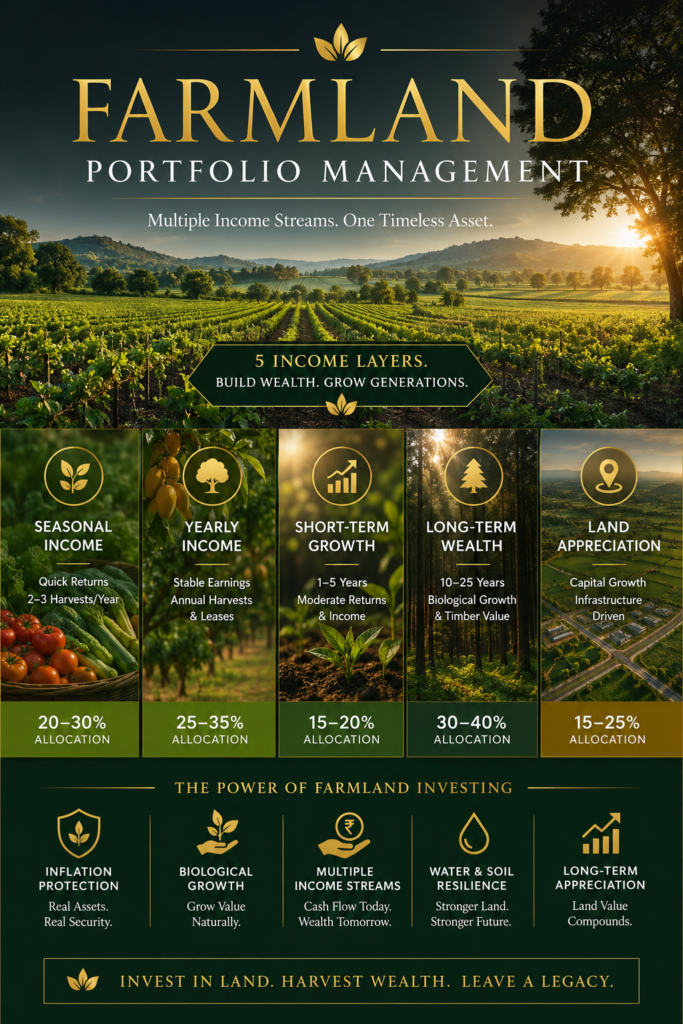
Farmland is one of the few asset classes capable of generating multiple layers of returns simultaneously. Unlike traditional real estate, a well-structured farmland portfolio can provide recurring cash flow, biological asset growth, inflation protection, and long-term capital appreciation.
Successful agricultural investors do not rely on a single crop or a single source of income. Instead, they build diversified farmland portfolios that combine seasonal income, annual income, short-term opportunities, long-term biological assets, and strategic land banking.
Understanding the Five Income Layers of a Farmland Portfolio
1. Seasonal Income Portfolio
Seasonal income assets generate cash flow within a few months and provide liquidity for farm operations.
Typical assets include:
- Vegetables
- Pulses
- Millets
- Groundnut
- Maize
- Chilli
- Turmeric
- Watermelon
- Flower cultivation
These crops generally produce harvests within 3 to 6 months and may allow multiple cropping cycles annually depending on water availability.
Benefits
- Quick returns
- Frequent cash flow
- Helps fund farm maintenance and operations
- Reduces dependence on long-term assets
Recommended Allocation
20%–30% of the overall farmland portfolio.
2. Yearly Income Portfolio
Yearly income assets provide more stable and predictable earnings compared to seasonal crops.
Typical assets include:
- Mango orchards
- Coconut plantations
- Oil palm
- Banana plantations
- Bamboo
- Dairy-linked agricultural land
- Long-term lease farming
These assets typically generate annual harvests and recurring income streams.
Benefits
- Stable cash flow
- Lower operational intensity
- Long-term production cycles
Recommended Allocation
25%–35% of the overall farmland portfolio.
3. Short-Term Growth Portfolio (1–5 Years)
This segment balances moderate appreciation and recurring income.
Typical investments include:
- Bamboo plantations
- Papaya
- Banana
- Pomegranate
- Dragon fruit
- Medicinal crops
- Agricultural land near growing towns
Benefits
- Faster return cycles
- Medium-term appreciation potential
- Diversification from annual crops
Recommended Allocation
15%–20% of the overall farmland portfolio.
4. Long-Term Wealth Creation Portfolio (10–25 Years)
This segment serves as the primary wealth-building engine of the farmland portfolio.
Typical assets include:
- Red sandalwood
- White sandalwood
- Teak
- Agarwood
- High-value timber plantations
- Large agricultural land banks
These investments benefit from biological growth and increasing scarcity over time.
Benefits
- Significant wealth creation potential
- Inflation protection
- Biological compounding
- Intergenerational asset transfer
Recommended Allocation
30%–40% of the overall farmland portfolio.
5. Land Appreciation Portfolio
This segment focuses on capital growth driven by infrastructure and economic development.
Ideal locations include farmland near:
- Ring roads
- Highways
- Industrial corridors
- Logistics parks
- Tourism zones
- Warehousing hubs
- Data center corridors
- Future airports and transportation projects
In rapidly expanding regions around Hyderabad and surrounding districts, strategic agricultural land banking has become an important long-term investment strategy.
Recommended Allocation
15%–25% of the overall portfolio.
What Is Biological Growth?
Biological growth is one of the most unique and powerful advantages of farmland investing.
Unlike conventional real estate, agricultural assets can increase in value even when land prices remain unchanged.
Biological growth refers to the natural increase in value of living assets through:
- Tree growth
- Timber volume expansion
- Heartwood formation
- Fruit productivity increases
- Biomass accumulation
- Soil ecosystem improvement
- Livestock development
In simple terms, living assets continue creating value through natural growth processes.
Biological Growth vs Land Appreciation
Biological growth and land appreciation are often confused but represent different wealth creation mechanisms.
Biological Growth
Value increases because the living asset itself grows.
Examples:
- Teak trees becoming larger
- Red sandalwood developing heartwood
- Mango orchards reaching peak productivity
- Bamboo producing additional biomass
Land Appreciation
Value increases because land prices rise due to external factors such as:
- Urban expansion
- Infrastructure projects
- Industrial development
- Population growth
- Improved connectivity
The strongest farmland investments benefit from both biological growth and land appreciation simultaneously.
Examples of Biological Growth
Teak Plantation
A young teak plantation has limited commercial value.
As trees mature:
- Trunk diameter increases
- Timber volume expands
- Wood quality improves
- Market value rises significantly
Larger trees often generate disproportionately greater value because timber volume increases faster than simple height growth.
Red Sandalwood
In regions of Andhra Pradesh and Telangana, red sandalwood is considered one of the world’s most valuable timber species.
As trees age:
- Heartwood formation increases
- Density improves
- Grain quality matures
- Scarcity value rises
This biological development can substantially increase the value of the asset over long holding periods.
White Sandalwood
The value of white sandalwood often depends on:
- Heartwood development
- Oil content
- Tree maturity
Older trees generally command significantly higher market value than younger plantations.
Fruit Orchards
Fruit orchards also demonstrate biological growth.
For example, mango orchards typically experience:
- Establishment phase: Years 1–3
- Moderate production phase: Years 4–7
- Peak productivity phase: Years 8–20
As the orchard matures, annual production and economic returns generally increase.
The Power of Biological Compounding
Agricultural assets convert sunlight, water, nutrients, and time into economic value.
Unlike financial assets that compound through interest, biological assets compound through physical growth and increasing productivity.
Over long periods, biological growth can become a major driver of wealth creation.
This is particularly evident in:
- Teak plantations
- Sandalwood plantations
- Agarwood plantations
- Bamboo cultivation
- Mature fruit orchards
Risk Management in Farmland Portfolios
Water Security
Water availability remains the most critical factor affecting agricultural performance.
Investors should prioritize:
- Drip irrigation
- Farm ponds
- Rainwater harvesting
- Groundwater sustainability
- Efficient water management
Soil Health
Healthy soil supports:
- Higher yields
- Better tree growth
- Stronger biological productivity
- Long-term land value enhancement
Best practices include:
- Organic matter application
- Crop rotation
- Mulching
- Soil microbiology enhancement
- Natural farming inputs
Geographic Diversification
Avoid concentrating investments in:
- A single district
- One rainfall zone
- One crop category
- One water source
Diversification reduces climatic and market risks.
Ideal Farmland Portfolio Allocation
A balanced farmland portfolio may follow the structure below:
| Portfolio Segment | Allocation |
|---|---|
| Seasonal Income | 20–30% |
| Yearly Income | 25–35% |
| Short-Term Growth | 15–20% |
| Long-Term Timber & Agroforestry | 30–40% |
| Land Appreciation | 15–25% |
The Advanced Farmland Wealth Model
The most successful farmland investors combine four wealth-building layers:
Cash Flow Layer
- Seasonal crops
- Lease farming
- Dairy operations
- Intercropping
Biological Growth Layer
- Timber plantations
- Orchards
- Bamboo
- Agroforestry systems
Appreciation Layer
- Strategic land banking
- Infrastructure-driven locations
- Urban expansion corridors
Protection Layer
- Water security
- Soil health
- Geographic diversification
Conclusion
Farmland is not merely agricultural land. When professionally managed, it becomes a diversified portfolio of income-producing, biologically growing, and appreciating assets.
The most resilient farmland portfolios combine:
- Seasonal cash flow
- Annual income
- Medium-term growth opportunities
- Long-term biological assets
- Strategic land appreciation
This integrated approach creates multiple income streams, protects against inflation, harnesses biological compounding, and builds long-term generational wealth.