
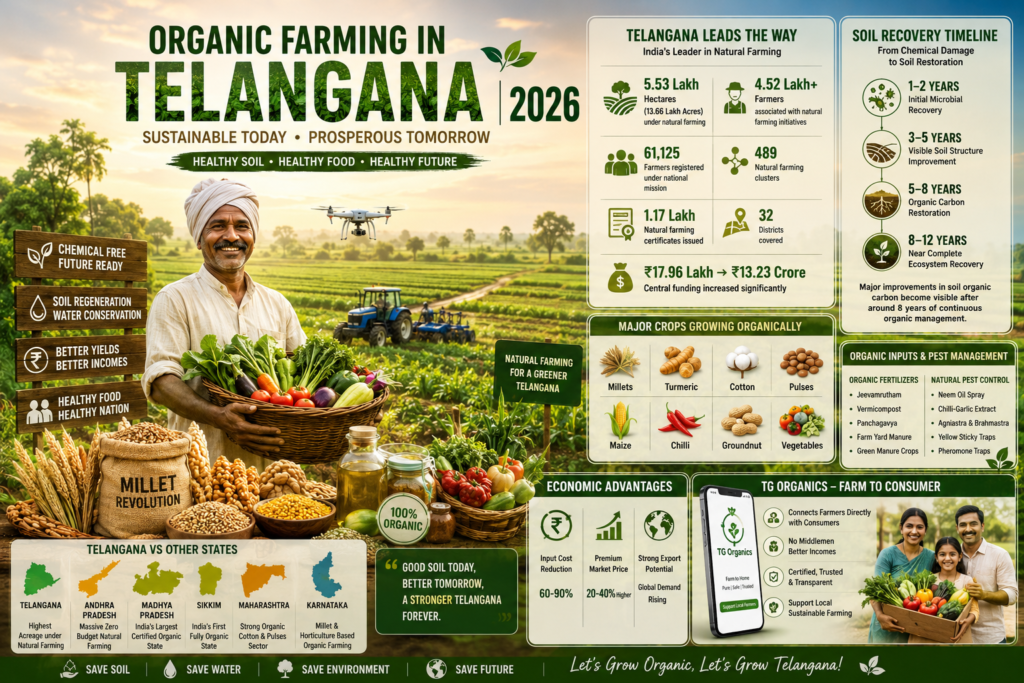
Telangana is witnessing a major agricultural transformation in 2026 as organic and natural farming rapidly expand across the state. Driven by climate challenges, rising consumer demand for chemical-free food, increasing input costs in conventional farming, and strong government support, Telangana is emerging as one of India’s fastest-growing sustainable agriculture ecosystems.
From millet cultivation and turmeric farming to bio-fertilizers, soil restoration, farm-to-consumer supply chains, and water conservation, the state is building a large-scale movement toward eco-friendly agriculture.
Today, Telangana is not only reducing dependency on chemical farming but also creating new economic opportunities for farmers, agri-startups, women self-help groups, rural entrepreneurs, and export-oriented food businesses.
Telangana’s Rise in Organic & Natural Farming
According to 2026 government and parliamentary data, Telangana has brought approximately 5.53 lakh hectares — nearly 13.66 lakh acres — under natural farming practices, making it one of India’s leading states in chemical-free agriculture.
More than 4.52 lakh farmers are currently associated with natural farming initiatives across Telangana, while over 61,000 farmers are directly registered under central and state-supported natural farming missions.
The state currently operates:
- 489 natural farming clusters
- Coverage across 32 districts
- Over 1.17 lakh natural farming certificates issued
- Nearly 979 trained Krishi Sakhis and field resource persons
The central government funding support for natural farming in Telangana increased significantly in recent years, rising from around ₹17.96 lakh to more than ₹13.23 crore, reflecting the growing importance of sustainable agriculture in national policy planning.
Why Telangana is Shifting Towards Organic Farming
For decades, agriculture in Telangana depended heavily on:
- Urea
- DAP fertilizers
- Synthetic pesticides
- Herbicides
- Monocrop paddy cultivation
Although these methods initially increased yields, they gradually caused:
- Soil degradation
- Declining organic carbon
- Groundwater contamination
- Rising pest resistance
- Reduced soil microbial activity
- Higher farming costs
- Farmer debt stress
Agricultural experts now believe excessive chemical dependency has weakened long-term soil fertility in several farming belts.
Organic and natural farming are now being promoted as long-term solutions for:
- Soil regeneration
- Water conservation
- Climate resilience
- Reduced input costs
- Better farmer profitability
- Healthier food production
Telangana Compared with Other Organic Farming States
Telangana is becoming one of India’s strongest natural farming regions, competing with several major agricultural states.
| State | Organic/Natural Farming Strength |
|---|---|
| Telangana | Largest acreage under natural farming |
| Andhra Pradesh | Massive Zero Budget Natural Farming movement |
| Madhya Pradesh | India’s largest certified organic state |
| Sikkim | India’s first fully organic state |
| Maharashtra | Strong organic cotton and pulses sector |
| Karnataka | Millet and horticulture-based organic farming |
While Sikkim became globally famous as India’s first fully organic state, Telangana is gaining recognition for implementing natural farming on a much larger commercial scale.
Major Crops Under Organic Farming in Telangana
Organic farming is expanding across multiple crop categories including:
Food Crops
- Millets
- Red gram
- Maize
- Groundnut
- Pulses
Commercial Crops
- Cotton
- Turmeric
- Chilli
- Oilseeds
Horticulture
- Vegetables
- Fruits
- Leafy greens
- Medicinal plants
High-Potential Organic Export Crops
- Turmeric
- Millets
- Spices
- Herbal products
Millet Revolution in Telangana
Millets are becoming the backbone of Telangana’s organic farming movement.
Popular millet varieties include:
- Jowar
- Bajra
- Ragi
- Foxtail millet
- Little millet
Millets are gaining popularity because they:
- Require less water
- Tolerate drought conditions
- Need fewer chemical inputs
- Improve climate resilience
- Have high nutritional value
- Possess strong export potential
The Hyderabad-based Indian Institute of Millets Research has played a major role in promoting millet cultivation, processing technologies, value-added products, and farmer training programs.
Turmeric Success Under Natural Farming
Turmeric has emerged as one of Telangana’s most successful natural farming crops.
Field-level studies in Telangana showed:
- Natural farming turmeric yields: 20–25 tonnes/hectare
- Chemical farming yields: 22–28 tonnes/hectare
- Yield gap: only around 9.78%
Despite slightly lower production, organic turmeric often earns higher market prices due to:
- Premium quality
- Export demand
- Chemical-free certification
- Consumer preference
This demonstrates that natural farming can remain economically viable while reducing long-term environmental damage.
Soil Damage from Chemical Agriculture
Continuous chemical fertilizer usage has severely impacted soil biology in many farming regions.
Common problems include:
- Soil hardening
- Loss of earthworms
- Declining microbial activity
- Reduced nutrient absorption
- Water runoff
- Increased dependence on synthetic fertilizers
Experts warn that soil is a living ecosystem and excessive chemical exposure weakens its natural regenerative capacity.
How Long Does Soil Take to Recover?
One of the most important concerns among farmers transitioning to organic farming is soil recovery time.
Research indicates the following recovery cycle:
| Soil Recovery Stage | Approximate Duration |
|---|---|
| Initial microbial recovery | 1–2 years |
| Visible soil texture improvement | 3–5 years |
| Organic carbon restoration | 5–8 years |
| Near-complete ecosystem recovery | 8–12 years |
Farmers typically experience:
- Yield reduction during the first 2–3 years
- Stabilization by years 4–5
- Improved moisture retention after year 5
- Strong long-term fertility after year 7
Scientific studies show major soil organic carbon improvements become visible after around 8 years of continuous organic management.
Major Organic Fertilizers Used in Telangana
Jeevamrutham
A microbial liquid fertilizer prepared using:
- Cow dung
- Cow urine
- Jaggery
- Pulse flour
- Soil microbes
Widely used in:
- Paddy
- Cotton
- Vegetables
- Turmeric
Vermicompost
Earthworm-based organic compost rich in nutrients and microbial life.
Best suited for:
- Vegetables
- Flowers
- Horticulture crops
Panchagavya
Traditional organic growth stimulant made from:
- Milk
- Curd
- Ghee
- Cow urine
- Cow dung
Used in:
- Tomato
- Chilli
- Fruits
- Leafy vegetables
Farm Yard Manure (FYM)
Natural manure produced from decomposed cattle waste.
Commonly applied in:
- Millets
- Pulses
- Groundnut farming
Green Manure Crops
Natural nitrogen-fixing crops such as:
- Sunhemp
- Dhaincha
These crops are cultivated and mixed into the soil to improve fertility and organic matter.
Organic Pest Management Methods
Telangana farmers are increasingly replacing chemical pesticides with natural alternatives.
Neem Oil Spray
Controls:
- Aphids
- Whiteflies
- Mealy bugs
Chilli-Garlic Extract
Effective against:
- Leaf-eating insects
- Caterpillars
Agniastra
Traditional organic pesticide prepared using:
- Cow urine
- Tobacco
- Garlic
- Chilli
Brahmastra
Used for severe pest infestations.
Eco-Friendly Traps
Farmers are also using:
- Yellow sticky traps
- Pheromone traps
- Light traps
These methods reduce chemical residues while improving biodiversity.
Water Conservation Benefits
Organic farming significantly improves:
- Water retention capacity
- Soil aeration
- Rainwater absorption
- Drought resilience
Healthy organic soils can retain substantially more moisture than chemically degraded soils.
This is extremely important for Telangana’s semi-arid climate and drought-prone districts.
Economic Advantages of Organic Farming
Reduction in Input Costs
Natural farming can reduce:
- Fertilizer costs by 60–80%
- Pesticide expenses by 70–90%
- Long-term soil rehabilitation expenses
This helps reduce farmer dependency on agricultural loans and expensive chemical inputs.
Premium Pricing
Organic products often command higher prices for:
- Turmeric
- Millets
- Vegetables
- Fruits
- Spices
Export Opportunities
Global demand is rising for:
- Organic spices
- Millets
- Herbal crops
- Natural food products
Telangana has strong potential to become an export-oriented organic agriculture hub.
Challenges in Organic Farming
Despite rapid growth, several challenges remain.
Certification Delays
Organic certification can be:
- Expensive
- Time-consuming
- Difficult for small farmers
Transition Period Yield Loss
Farmers may face:
- Lower yields during initial years
- Market uncertainty
Market Access Issues
Many rural farmers still lack:
- Direct buyers
- Storage facilities
- Premium organic marketplaces
Fake Organic Labeling
Unverified “organic” branding reduces consumer trust.
Experts believe digital traceability systems and farmer producer organizations (FPOs) are essential for long-term growth.
Rise of Farm-to-Consumer Ecosystems
Urban consumers in Hyderabad are increasingly demanding:
- Organic vegetables
- Chemical-free rice
- Cold-pressed oils
- Millet-based foods
- Natural turmeric
To support this trend, the Telangana government launched the “TG Organics” mobile application, which directly connects certified farmers with consumers.
This platform helps:
- Eliminate middlemen
- Improve farmer income
- Build consumer trust
- Strengthen local organic markets
Women & Youth Participation
Women self-help groups and rural youth are becoming major participants in:
- Millet processing
- Organic vegetable cultivation
- Seed production
- Food processing
- Farm-based enterprises
The integration of agriculture with rural entrepreneurship is creating new employment opportunities beyond traditional farming.
Future of Organic Farming in Telangana
Experts believe Telangana has the potential to become:
- India’s largest commercial natural farming ecosystem
- A leading organic turmeric exporter
- A millet innovation hub
- A climate-resilient agriculture model
Future growth will depend on:
- Scientific farmer training
- Strong certification systems
- Export infrastructure
- Water-efficient farming
- Digital market access
- Soil restoration programs
With rising health awareness, climate challenges, and increasing global demand for clean food, organic farming is expected to become one of Telangana’s most important agricultural transformations over the coming decade.
The state’s journey reflects a broader shift in Indian agriculture — moving from chemically intensive farming toward a more sustainable, profitable, and environmentally responsible future.