
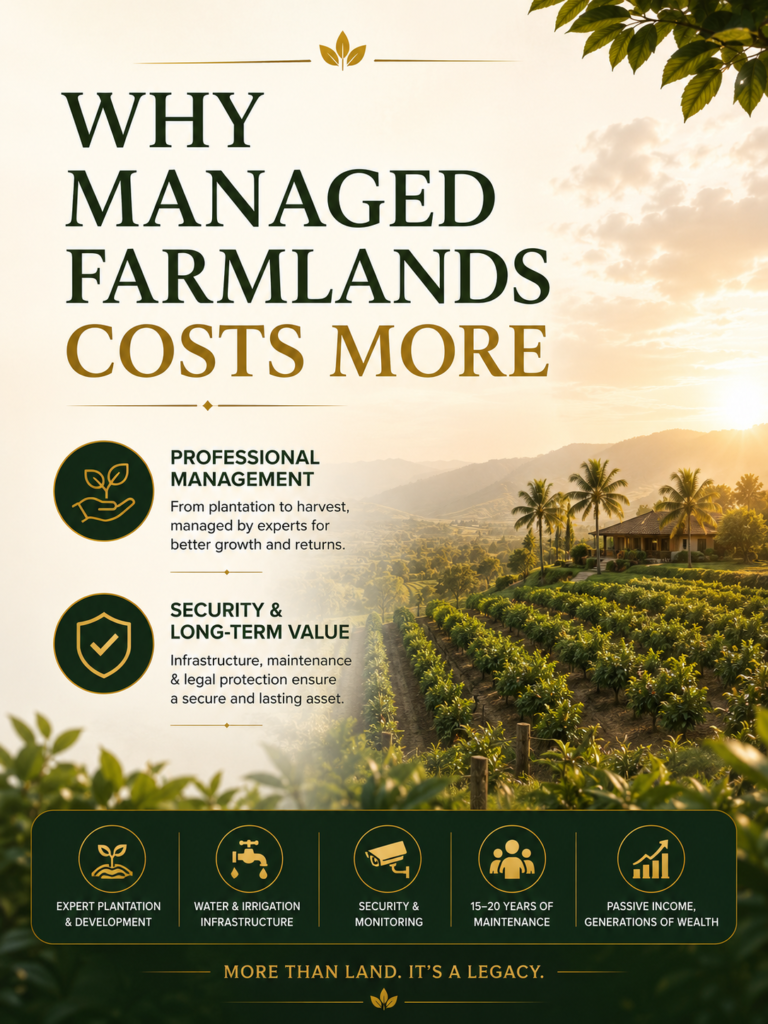
Looking Beyond the Land Price
One of the most common questions asked by farmland investors is:
“Why should I buy a managed farmland unit when I can purchase agricultural land directly from a farmer at a lower price?”
At first glance, the comparison appears reasonable.
However, the comparison itself is incomplete.
The reality is that managed farmland ventures are not simply selling land. They are creating, developing, maintaining, and managing an agricultural asset over a period that may extend 15 to 20 years or more.
The difference between buying raw land and investing in a managed farmland venture is similar to the difference between buying a vacant plot and purchasing a fully developed villa with maintenance and security included.
The Land Price Is Only the Beginning
When a developer acquires agricultural land, the purchase price represents only the first stage of investment.
Creating a productive, secure, legally compliant, and professionally managed plantation requires substantial additional investment over many years.
Most investors see only the final sale price.
They often do not see the enormous costs incurred before and after the sale.
Example: The Journey of a ₹10 Lakh Land Parcel
Assume a developer purchases farmland for ₹10 lakhs.
Many people assume the project cost is ₹10 lakhs plus a profit margin.
In reality, the total lifetime investment may be several times higher.
1. Land Acquisition
Initial Land Cost:
₹10 Lakhs
This is only the foundation of the project.
Before any development begins, the developer must also incur expenses related to:
• Legal verification
• Survey charges
• Documentation
• Registration support
• Land consolidation
• Compliance processes
2. Infrastructure Development
A professionally planned farmland community requires infrastructure.
These investments include:
✓ Internal Roads
✓ Approach Roads
✓ Electricity Infrastructure
✓ Water Distribution Systems
✓ Entry Gates
✓ Common Utility Areas
✓ Drainage Systems
✓ Security Infrastructure
In addition, a portion of land is allocated for roads and common facilities, reducing the saleable area.
The cost of infrastructure often runs into several lakhs per acre depending on the location and project standards.
3. Plantation Development
Agricultural wealth is not created by land alone.
It is created by what grows on the land.
Developers invest heavily in:
✓ Premium quality saplings
✓ Scientific plantation design
✓ Pit preparation
✓ Soil improvement
✓ Organic manure
✓ Plantation labor
✓ Crop establishment
✓ Growth monitoring
The objective is to maximize survival rates and future yields.
4. Water Security Investments
Water is the lifeline of any plantation.
Developers invest in:
✓ Borewells
✓ Pumps and motors
✓ Water storage systems
✓ Drip irrigation
✓ Water pipelines
✓ Maintenance of irrigation systems
These investments continue throughout the life of the plantation.
5. Fencing and Asset Protection
One of the biggest risks in agricultural land ownership is asset protection.
Managed farmland ventures provide:
✓ Boundary fencing
✓ Security personnel
✓ Surveillance systems
✓ Regular inspections
✓ Encroachment prevention
For absentee owners, NRIs, and professionals, this protection becomes extremely valuable.
The Biggest Cost: Long-Term Maintenance
This is where most people underestimate the true cost of farmland ownership.
Trees do not grow by themselves.
Successful plantations require continuous care for years.
Annual Maintenance Activities
Every year, the plantation may require:
✓ Weeding
✓ Soil management
✓ Organic fertilization
✓ Pest and disease management
✓ Irrigation supervision
✓ Pruning and maintenance
✓ Replacement of failed plants
✓ Growth monitoring
✓ Security inspections
✓ Record keeping
These activities continue year after year.
Human Resources
A professional plantation may employ:
✓ Agricultural Experts
✓ Plantation Specialists
✓ Farm Managers
✓ Site Supervisors
✓ Skilled Workers
✓ Security Personnel
✓ Harvest Coordinators
The cumulative cost of these services over 15–20 years can exceed the original land value itself.
A Simple Real-World Illustration
Imagine two investors.
Investor A
Buys one acre directly from a farmer.
Cost:
₹10 Lakhs
Additional responsibilities:
• Legal verification
• Borewell
• Fencing
• Irrigation
• Labor
• Security
• Maintenance
• Harvest management
• Marketing
• Travel and supervision
The investor becomes responsible for every aspect of ownership.
Investor B
Buys a managed farmland unit.
Cost:
Higher than raw land.
However, the investor receives:
✓ Developed farmland
✓ Established plantation
✓ Water infrastructure
✓ Security systems
✓ Professional management
✓ Periodic maintenance
✓ Agricultural expertise
✓ Harvest support
✓ Long-term asset monitoring
The investor owns the asset while professionals manage the operations.
What Investors Are Actually Paying For
The premium paid for a managed farmland venture is not merely for land.
It represents the cost of creating and maintaining an agricultural ecosystem.
Investors are paying for:
• Land acquisition
• Infrastructure creation
• Plantation development
• Water systems
• Security
• Agricultural expertise
• Legal compliance
• Long-term maintenance
• Harvest support
• Asset protection
• Administrative management
• Community development
• Operational continuity
Why Many NRIs and Professionals Prefer Managed Farmland
Modern investors often have limited time.
They may live in cities, work in demanding professions, run businesses, or reside overseas.
They want ownership without operational headaches.
Managed farmland provides:
✓ Passive ownership
✓ Professional cultivation
✓ Reduced operational burden
✓ Asset security
✓ Organized management
✓ Long-term wealth creation potential
✓ Easier inheritance planning for future generations
The Correct Comparison
The correct comparison is not:
Raw Land Price vs Managed Farmland Price
The correct comparison is:
Raw Land
versus
Raw Land + Development + Plantation + Water Infrastructure + Security + 15–20 Years of Maintenance + Professional Management + Harvest Support + Asset Protection
When viewed from this perspective, the pricing difference becomes much easier to understand.
Conclusion
Managed farmland ventures are not simply land transactions.
They are long-term agricultural development projects that require years of investment, planning, cultivation, maintenance, and management.
While the initial purchase price may be higher than buying land directly from a farmer, investors receive a professionally managed agricultural asset designed to reduce risk, save time, protect ownership, and create long-term value.
As experienced farmland investors often say:
“Buying land is easy. Creating a productive, secure, and wealth-generating plantation is where the real investment begins.”
That ongoing investment is what managed farmland ventures deliver.