
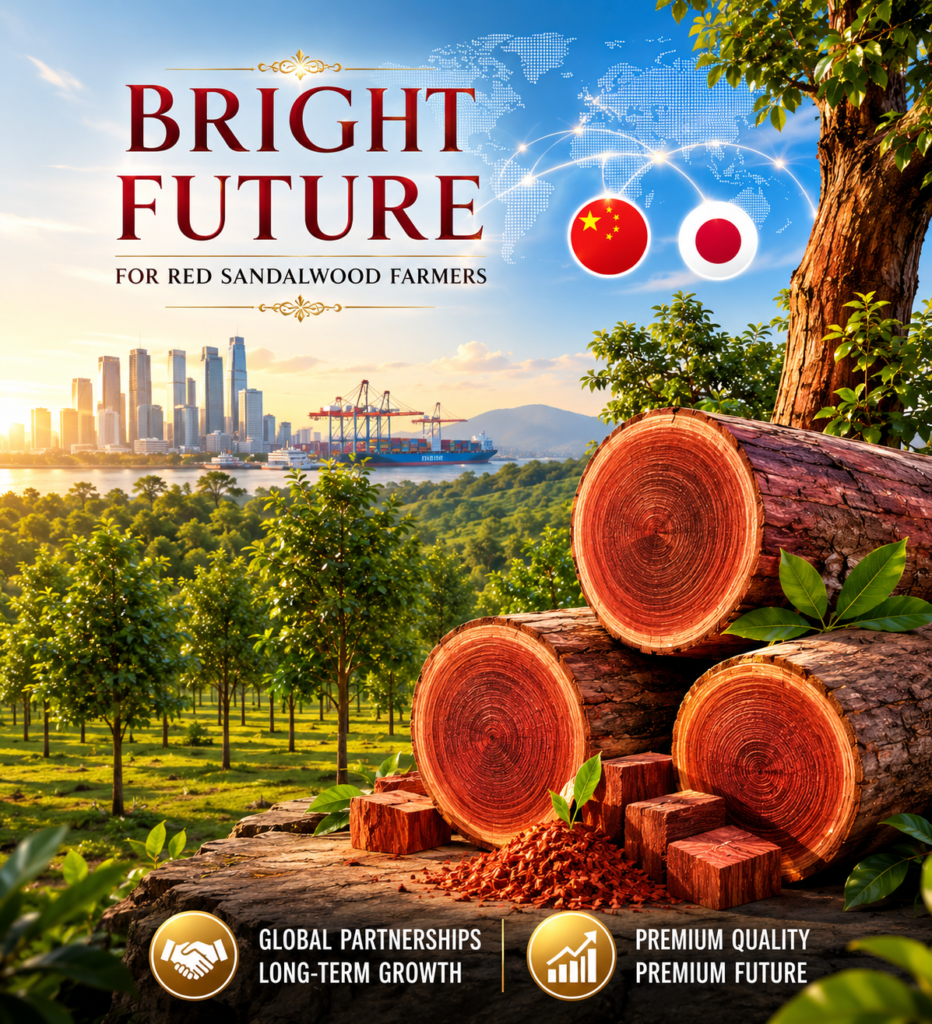
A New Era for Red Sandalwood Cultivation
Artificially propagated Red Sandalwood (Pterocarpus santalinus) cultivation is emerging as one of the most promising long-term agroforestry opportunities in India. With increasing global demand, limited natural availability, and growing acceptance of plantation-grown timber, the future looks exceptionally bright for farmers cultivating Red Sandalwood in suitable agro-climatic regions.
Industry observers anticipate that international interest in plantation-grown Red Sandalwood will accelerate significantly over the coming decade. In particular, companies from China, Japan, and other East Asian countries are expected to explore strategic partnerships with farmers and plantation owners in India to secure future supplies of high-quality Red Sandalwood heartwood.
Rising Global Demand
Red Sandalwood is highly valued across international markets for its:
- Premium furniture manufacturing
- Luxury handicrafts and carvings
- Traditional musical instruments
- Decorative veneers
- Specialty wood products
- Cultural and ceremonial applications
- High-end interior décor
China remains one of the largest consumers of premium Red Sandalwood products, while Japan’s appreciation for rare and high-quality timber continues to create demand for sustainably sourced plantation-grown wood.
As natural forest resources become increasingly restricted worldwide, plantation-grown Red Sandalwood is expected to play a critical role in meeting future demand.
Why Global Companies Are Looking at Plantation Farming
Establishing a new Red Sandalwood plantation requires patience, expertise, and suitable growing conditions. Since quality heartwood development takes several years, international buyers may increasingly prefer securing future supplies rather than waiting for timber shortages.
Industry experts foresee two possible approaches:
1. Direct Acquisition of Plantation Assets
Large timber processors and international trading companies may seek to acquire mature plantations or invest in plantation projects located in high-potential growing regions.
Such investments could provide long-term supply security while ensuring access to quality timber resources.
2. Advance Purchase Agreements
Another likely model is the provision of advance funding to farmers and plantation owners against future harvests.
Under such arrangements, companies may:
- Provide advance capital.
- Secure future harvest rights.
- Offer technical support.
- Establish quality standards.
- Create long-term procurement partnerships.
This model is already common in several agricultural and forestry sectors around the world.
Importance of Location and Timber Quality
Not all regions are equally suitable for producing premium-quality Red Sandalwood.
Factors influencing heartwood quality include:
- Climate
- Soil composition
- Rainfall patterns
- Temperature variations
- Elevation
- Plantation management practices
Regions within the Eastern Ghats of Andhra Pradesh have historically been recognized for producing some of the world’s finest Red Sandalwood. Locations with proven agro-climatic suitability are expected to attract greater attention from future investors and timber buyers.
As international demand grows, plantations capable of producing dense, richly colored, high-heartwood-yield trees may command premium valuations.
Benefits for Farmers
The increasing participation of global buyers could create multiple benefits for Red Sandalwood farmers:
Better Price Discovery
Greater competition among buyers may improve market pricing.
Assured Market Access
Long-term procurement agreements can provide confidence regarding future sales.
Access to Capital
Advance funding mechanisms may help farmers manage plantation expenses.
Technical Support
International buyers often encourage best practices that improve timber quality and yields.
Wealth Creation
Red Sandalwood plantations have the potential to become valuable long-term assets that can be passed on to future generations.
Andhra Pradesh’s Strategic Advantage
Andhra Pradesh enjoys a unique position in the global Red Sandalwood ecosystem.
The state offers:
- Naturally suitable agro-climatic conditions.
- Historical association with premium Red Sandalwood.
- Growing plantation awareness among farmers.
- Expanding infrastructure and logistics networks.
- Access to ports, highways, rail connectivity, and industrial corridors.
As global timber buyers seek reliable sources of plantation-grown Red Sandalwood, strategically located plantations in suitable regions of Andhra Pradesh are expected to attract increasing interest.
Looking Ahead
The future of artificially propagated Red Sandalwood cultivation appears highly promising. Growing international demand, declining availability of natural resources, and increasing acceptance of plantation-grown timber are creating conditions for long-term growth.
While market dynamics will continue to evolve, farmers cultivating Red Sandalwood in proven high-yield locations may find themselves well positioned to benefit from future opportunities, including international partnerships, advance purchase agreements, and premium market access.
For investors and farmers alike, Red Sandalwood is increasingly being viewed not merely as a crop, but as a long-term wealth creation asset with significant global demand potential.