
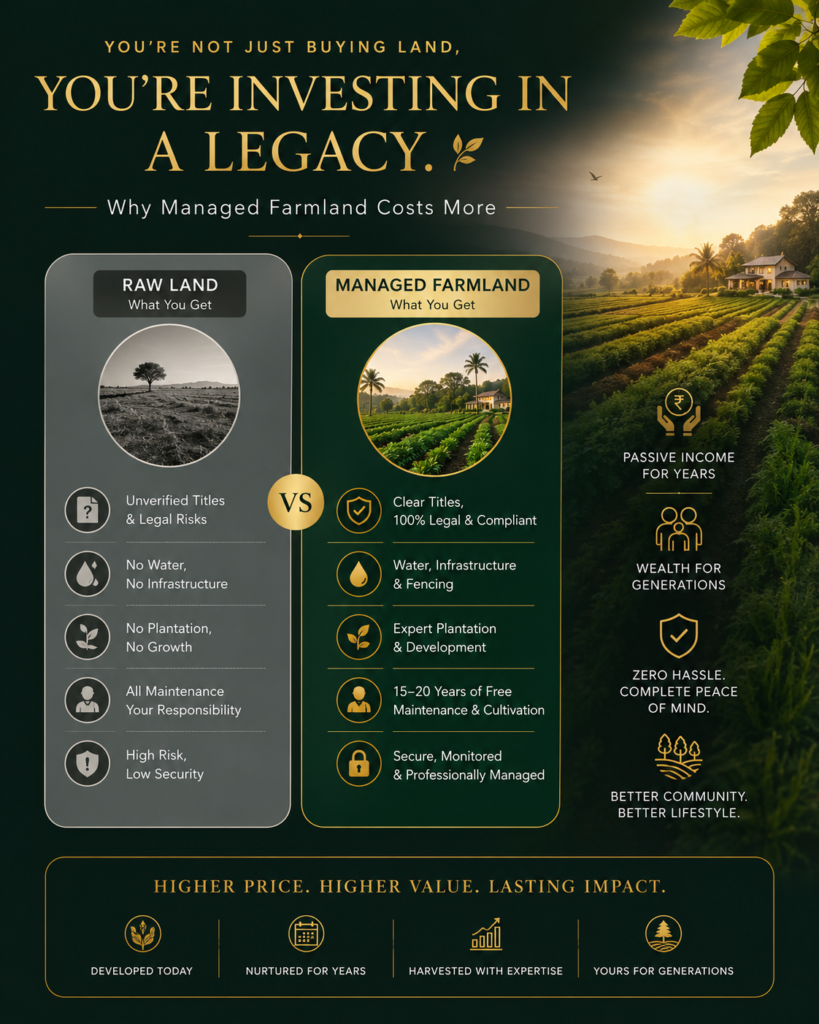
The Difference Between Buying Land and Owning a Professionally Managed Agricultural Asset
One of the most common questions prospective investors ask is:
“Why should I pay ₹9.5 lakhs or ₹12 lakhs for a managed farmland unit when similar agricultural land may be available directly from farmers at a lower price?”
The answer is simple.
You are not merely purchasing land.
You are purchasing a fully developed, legally structured, professionally managed agricultural asset that includes infrastructure, plantation establishment, maintenance, security, cultivation, harvest management, and long-term asset protection.
The price difference reflects years of investment, management, and risk undertaken by the developer on behalf of the investor.
The Biggest Misconception
Many people compare:
Raw Agricultural Land = Managed Farmland Venture
This is like comparing:
A vacant plot of land = A fully constructed villa
Both may occupy the same area, but their value is entirely different.
A managed farmland project includes multiple layers of investment beyond the land purchase itself.
Example: Understanding the Cost Structure
Assume a developer acquires farmland worth ₹100.
The investor sees only the final selling price and assumes the margin is excessive.
However, the actual project economics are very different.
Stage 1: Land Acquisition
Land Purchase Cost = ₹100
This is only the starting point.
Stage 2: Land Sacrificed for Infrastructure
To create a functional farmland community:
- Internal Roads
- Approach Roads
- Green Buffers
- Utility Corridors
- Common Areas
Approximately 20% of the land is allocated for infrastructure.
Example
100 Acres Purchased
After roads and common infrastructure:
Usable Saleable Area = 80 Acres
This means the cost of every saleable acre automatically increases because a portion of land cannot be sold.
Stage 3: Amenities and Common Facilities
Managed farmland ventures often provide:
- Entry Gate
- Security Facilities
- Water Storage
- Farm Office
- Community Areas
- Worker Facilities
Another 5–10% of project value may be invested here.
Stage 4: Agricultural Development
Raw land does not generate wealth.
The land must be transformed into a productive plantation.
Typical expenses include:
Plantation Establishment
✓ High-quality saplings
✓ Soil testing
✓ Pit digging
✓ Land leveling
✓ Organic manure
✓ Initial plantation labor
✓ Scientific plantation design
Infrastructure
✓ Borewells
✓ Drip irrigation
✓ Water pipelines
✓ Electrical connections
✓ Pumps and motors
✓ Fencing
✓ Water storage facilities
For long-term plantations, development expenses can easily equal or exceed the original land cost.
Stage 5: 15–20 Years of Maintenance
This is the cost most investors underestimate.
Many assume trees grow automatically.
Professional plantation management requires:
Annual Activities
✓ Irrigation
✓ Weeding
✓ Pruning
✓ Soil conditioning
✓ Organic fertilizers
✓ Pest management
✓ Disease control
✓ Growth monitoring
✓ Gap filling
✓ Security patrols
✓ Harvest planning
Human Resources
✓ Farm Managers
✓ Plantation Specialists
✓ Agricultural Experts
✓ Supervisors
✓ Skilled Workers
✓ Security Teams
Over a 15–20 year plantation cycle, cumulative maintenance costs can become larger than the original land value.
Numerical Illustration
Assume raw land costs ₹10 lakhs.
A professional developer may incur:
| Component | Approximate Cost |
|---|---|
| Land Purchase | ₹10 Lakhs |
| Roads & Infrastructure Loss | ₹3 Lakhs |
| Plantation Development | ₹4 Lakhs |
| Borewells & Irrigation | ₹2 Lakhs |
| Fencing & Security | ₹1 Lakh |
| Maintenance (15–20 Years) | ₹7 Lakhs |
| Farm Management | ₹3 Lakhs |
| Harvest & Marketing Support | ₹1 Lakh |
| Administration & Compliance | ₹2 Lakhs |
Total Project Cost
₹33 Lakhs
Before considering inflation, business risk, capital costs, and operational overheads.
This explains why a professionally managed farmland unit can be significantly more expensive than raw land.
What Investors Receive in Return
When purchasing a managed farmland unit, investors gain:
Legal Security
✓ Clear title verification
✓ Structured documentation
✓ Professional due diligence
✓ Compliance support
Physical Security
✓ Fencing
✓ Security personnel
✓ Surveillance
✓ Encroachment prevention
✓ Asset monitoring
Agricultural Security
✓ Expert cultivation
✓ Professional maintenance
✓ Scientific farming practices
✓ Plantation monitoring
Financial Security
✓ Reduced operational burden
✓ Organized harvest support
✓ Better market access
✓ Potential economies of scale
The Hidden Cost of Buying Directly From Farmers
Many buyers focus only on acquisition cost.
However, after purchasing land independently, they must handle:
- Legal verification
- Fencing
- Water sourcing
- Borewell drilling
- Electricity connections
- Labor management
- Security
- Irrigation setup
- Crop management
- Harvest planning
- Marketing
These responsibilities require both time and expertise.
For NRIs, professionals, business owners, and retirees, managing farmland personally may not be practical.
Why HNIs and NRIs Prefer Managed Farmland
High Net Worth Individuals often value:
Time
Their focus is on business, profession, or investments.
Convenience
They prefer experts managing operations.
Transparency
Structured ownership and reporting systems provide peace of mind.
Asset Protection
Professional oversight reduces risks associated with absentee ownership.
Legacy Creation
Managed farms can be easily transferred to future generations while remaining operational and maintained.
A Better Comparison
Instead of comparing:
Raw Land vs Managed Farmland
Compare:
Raw Land
vs
Raw Land + Infrastructure + Plantation + Water Systems + Security + Maintenance + Professional Management + Harvest Support + Legal Compliance + Asset Protection
Only then does the pricing difference become understandable.
Final Thought
A managed farmland venture is not simply a land transaction.
It is a long-term agricultural asset backed by years of development, cultivation, management, and protection.
The higher price reflects the creation of a complete ecosystem that allows investors to enjoy farmland ownership without the burden of day-to-day farming operations.
For many investors, especially NRIs, professionals, and long-term wealth creators, the premium paid today is not merely for land—it is for convenience, security, expertise, and peace of mind over the next 15–20 years.
As the saying goes:
“Anyone can buy land. The real challenge is developing it, protecting it, managing it, and converting it into a productive wealth-generating asset.”
Managed farmland ventures are designed to solve exactly that challenge.