
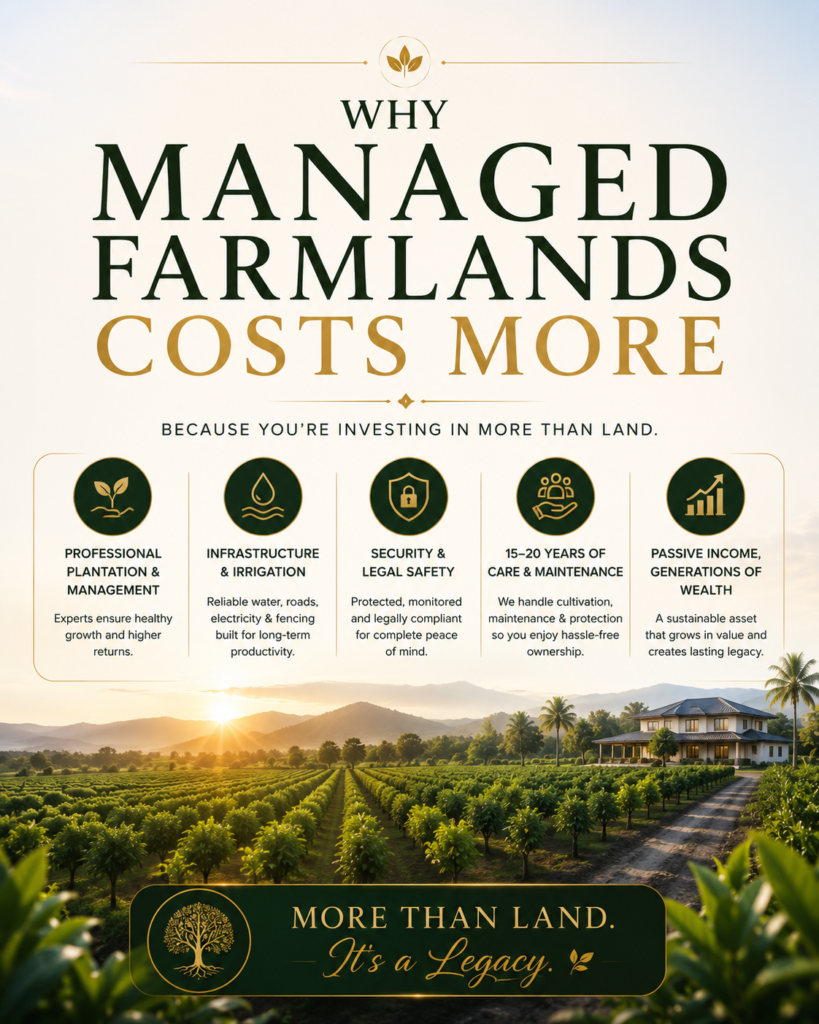
Understanding the Real Value Behind Managed Farmland Investments
Many investors compare the price of a managed farmland unit with the price of agricultural land purchased directly from a farmer and wonder why the managed farmland appears significantly more expensive.
The reality is that investors are not simply buying a piece of land. They are investing in a fully developed, legally compliant, professionally managed agricultural asset designed to generate long-term wealth with minimal effort from the owner.
1. Raw Land Is Only a Small Part of the Total Investment
The actual cost of acquiring farmland from farmers represents only a portion of the total project value. Typically, around 30% of the project cost goes towards purchasing the land itself.
The remaining investment is used to transform raw agricultural land into a productive, secure, and income-generating asset.
2. Infrastructure Development Requires Significant Investment
To create a well-planned farmland community, a substantial portion of land and capital is allocated for infrastructure development.
This includes:
✅ Internal roads and access networks
✅ Boundary fencing and security systems
✅ Borewells and water storage facilities
✅ Electricity infrastructure
✅ Drip irrigation systems
✅ Water distribution pipelines
✅ Plantation development
✅ Soil improvement and land preparation
Approximately 20% of the land may be dedicated to roads and access infrastructure, while another 10% may be utilized for common amenities and operational facilities.
These developments significantly improve accessibility, productivity, and long-term value.
3. Plantation Establishment Costs Are High
A managed plantation is not created overnight.
The project developer invests heavily in:
• High-quality saplings
• Scientific plantation design
• Soil testing and preparation
• Plantation experts and consultants
• Organic fertilizers and nutrients
• Crop protection systems
• Irrigation setup
• Initial cultivation and establishment costs
These investments are critical for achieving healthy growth and maximizing future harvest yields.
4. Long-Term Maintenance Is Included
One of the biggest advantages of managed farmland ventures is that investors are relieved from the burden of cultivation and maintenance.
For plantation projects that may run for 15 to 20 years, developers often bear the costs of:
✅ Weeding and intercultural operations
✅ Irrigation management
✅ Organic nutrient application
✅ Pest and disease management
✅ Security and surveillance
✅ Skilled labor
✅ Machinery and equipment
✅ Supervisors and plantation managers
✅ Harvest preparation
These expenses continue throughout the plantation cycle and can collectively exceed the original land cost.
5. Professional Management Creates Long-Term Value
Agriculture requires continuous monitoring and specialized knowledge.
Managed farmland ventures employ:
• Agricultural experts
• Plantation specialists
• Site supervisors
• Maintenance teams
• Security personnel
• Harvest coordinators
This professional management significantly increases the probability of successful crop growth and harvest outcomes.
6. Legal Compliance and Documentation
Investors also benefit from:
✅ Clear land titles
✅ Legal verification
✅ Proper registrations
✅ Compliance with applicable regulations
✅ Structured ownership documentation
This reduces risks that are often associated with individual land purchases.
7. Marketing and Harvest Support
The work does not end when the trees mature.
Developers often manage:
• Harvest planning
• Buyer identification
• Sale negotiations
• Logistics coordination
• Regulatory permissions
• Documentation and compliance requirements
These services help investors monetize their plantation assets more efficiently.
8. Community Living and Asset Protection
Managed farmland ventures offer benefits that individual land ownership may struggle to provide:
✅ Gated access
✅ Community environment
✅ Professional security
✅ Reduced risk of encroachment
✅ Continuous monitoring
✅ Better maintenance standards
This ensures long-term protection of the asset.
The True Comparison
When comparing prices, investors should not compare:
Raw Land vs Managed Farmland
Instead, they should compare:
Raw Land + Development + Plantation + Infrastructure + Maintenance + Security + Professional Management + Harvest Support + Legal Compliance
A managed farmland venture combines all these elements into a single investment opportunity.
Conclusion
Managed farmland units may have a higher upfront price compared to purchasing agricultural land directly from farmers. However, investors receive a fully developed and professionally managed agricultural asset that includes years of cultivation, maintenance, infrastructure, security, legal support, and harvest management.
For investors seeking passive ownership, long-term wealth creation, asset security, and generational value, managed farmland ventures offer convenience, peace of mind, and professional execution that individual land ownership often cannot provide.
The higher price reflects not just the land itself, but the complete ecosystem required to transform agricultural land into a productive, secure, and long-term wealth-generating asset.