
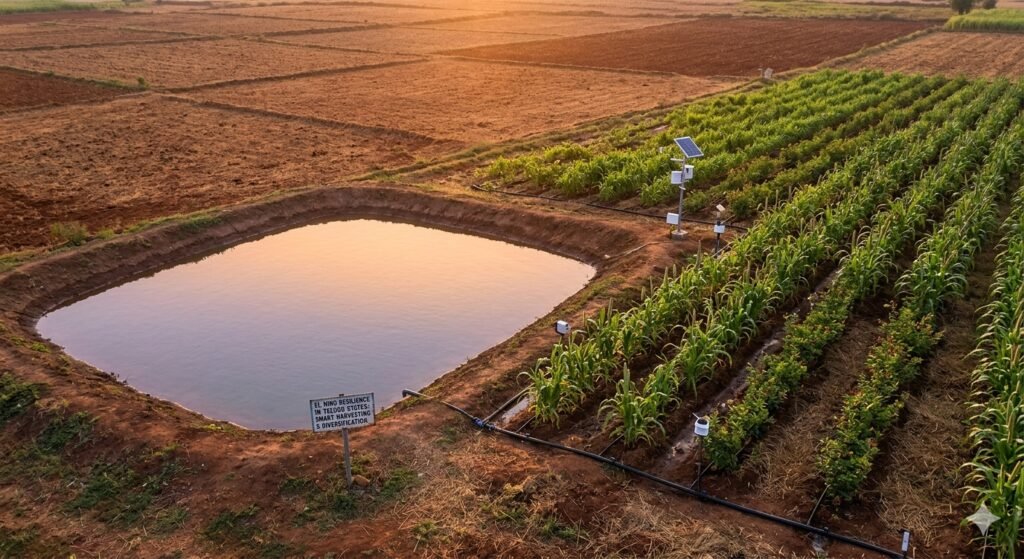
As farmers across Telangana and Andhra Pradesh, we are all too familiar with watching the skies. But the current El Niño cycle is rewriting our farming seasons, bringing a devastating 30–50% rainfall deficit across our major districts—from Nalgonda and Mahbubnagar to Anantapur and Chittoor.With reservoir levels plunging at Srisailam, Nagarjuna Sagar, and Jurala, canal water is being heavily restricted to safeguard drinking water. Relying blindly on borewells is pushing our water tables to dangerously low depths. To survive this climate shift, we must adapt our water management and cropping choices immediately.Here is your localized, actionable guide to managing the El Niño crisis, drawing lessons from global innovations and our own state command control centres.
Global vs. Telugu States: Localizing World-Class Strategies
The table below breaks down what global agricultural hubs are doing to combat drought, compared directly with the ongoing emergency strategies being rolled out across Telangana and Andhra Pradesh:Region / CountryPrimary ChallengeProven Water & Irrigation StrategyDirect Action for AP & Telangana FarmersAustralia (Murray-Darling)Rapid water-table depletion and extreme heat spikes.Computerized drip systems and strict volumetric water budgeting.Stop Flood Irrigation: Shift away from unmetered flooding. Free power shouldn’t mean wasting water.Vietnam (Mekong Delta)Severe river and reservoir exhaustion.Alternate Wetting & Drying (AWD) to drop rice water needs by 30%.AWD for Paddy: If you must grow paddy, let the soil crack slightly before flooding again instead of keeping it submerged.Telangana (Contingency Plan)31%+ rainfall deficit, shrinking Kharif sowing windows.State expert panel enforcing a strict crop-diversification shift away from water-heavy Paddy.Embrace Irrigated Dry (ID) Crops: Switch mid-season or Rabi setups to Cotton, Redgram, Bajra, Foxtail Millet, Castor, or Blackgram.Andhra Pradesh (4-Pillar Strategy)Over 50% rainfall drop in Rayalaseema; 25–30% reduced sowing area.Prioritizing micro-irrigation, natural farming, and activating the El Niño Control Centre.Switch Failing Groundnut: Swap drying groundnut fields in Anantapur for short-duration millets, pulses, or fodder.
3 Urgent Irrigation Upgrades for the Telugu StatesYou don’t need massive investments to transform your field layout. Implement these changes to preserve every drop of groundwater:1. Leverage the AP & Telangana Micro Irrigation Projects (MIP)Do not fund drip systems entirely out of pocket. Tap into the state subsidies offered under the National Mission for Sustainable Agriculture (NMSA) to install drip and micro-sprinklers. This target-delivers water straight to the root zone, cutting evaporative water loss by half compared to flooding.2. Implement “Warabandhi” (On/Off) Scheduling & Night WateringCoordinate with your local Water User Association (WUA) to implement Warabandhi—a strict rotational system for releasing tank and channel water. Couple this with night irrigation (watering between 9:00 PM and 5:00 AM) to completely beat the scorching midday evaporation rates common during our El Niño heatwaves.3. Transition to Furrow & Ridge ConfigurationsIf you are growing row crops like Cotton or Chillies, avoid open flood irrigation. Modify your land layout into ridges and furrows. Release water only through the furrows; this simple land-shaping technique cuts water usage by 30% while encouraging deeper root growth to endure dry spells.
Agronomic Tricks: Lock Moisture in the SoilPre-Monsoon Dry Sowing (PMDS) & Natural Farming: Follow the state advice to practice PMDS and natural farming. This maintains soil organic carbon levels, preventing the soil hardening caused by over-using chemical fertilizers. Healthy organic soil retains water far longer.Aggressive Mulching with Crop Residue: After harvesting, do not burn your crop residues. Spread cotton stalks, paddy straw, or groundnut shells back over the soil beds. This acts as a protective shield against the sun, reducing soil moisture evaporation.Participatory Groundwater Management: Follow successful community models in Mahbubnagar (Telangana) and Anantapur (Andhra Pradesh). Collaborate with your neighboring farmers to monitor borewell drawdowns collectively, avoiding competitive drilling that leaves everyone dry.The Bottom LineThe El Niño crisis requires a complete mindset shift. We must treat water as a strictly finite asset rather than an infinite resource. By moving away from unrestricted paddy flooding, adopting irrigated dry crops, and using state command resources, we can safely safeguard our families and our livelihoods.