
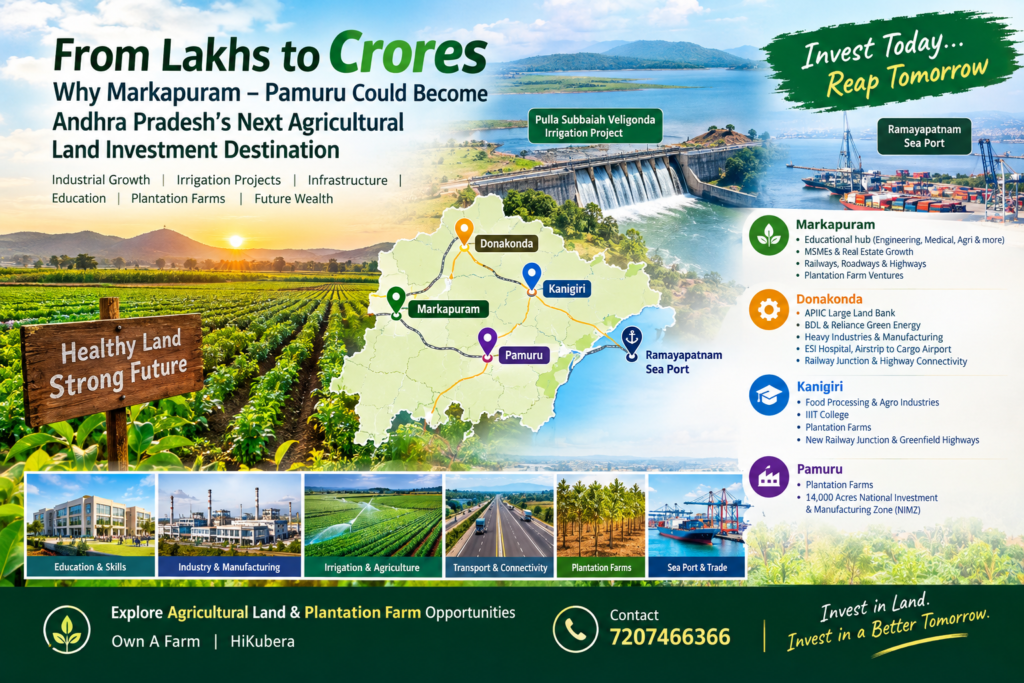
Discover the Potential of Emerging Industrial Corridors, Irrigation Projects, Infrastructure and Plantation Farms
The land that appears ordinary today could become a valuable asset tomorrow. The key is to identify emerging growth corridors early, verify the facts and invest with a long-term vision.
Introduction: What Hyderabad’s Real Estate Growth Teaches Us
Two decades ago, many investors who purchased land in the outskirts of Hyderabad could not have fully anticipated the scale of the transformation that lay ahead.
Locations such as Kokapet, Gachibowli, Gandipet, Tellapur and Mokila experienced significant changes as IT companies, Global Capability Centres (GCCs), multinational businesses, research institutions, commercial developments and residential communities expanded across the western corridor.
As employment opportunities increased, demand for office space, apartments, villas, educational institutions, hospitals and supporting infrastructure also grew. Selected land parcels experienced extraordinary appreciation, with some premium locations reaching values of several crores per acre and exceptional properties potentially exceeding ₹100 crore per acre.
However, these values are not representative of every property, and past appreciation does not guarantee future results.
The fundamental lesson is that economic development can transform the value of land when infrastructure, employment, investment and genuine demand converge in the same region.
Today, investors have an opportunity to study emerging regions of Andhra Pradesh through the same long-term perspective.
Among the locations worth examining are Donakonda, Markapuram, Kanigiri and Pamuru, along with the wider industrial and logistics network connecting inland Andhra Pradesh to Ramayapatnam Sea Port.
These areas have several potential growth drivers, including industrial land development, manufacturing, agricultural processing, irrigation infrastructure, transport connectivity and plantation farming. Their long-term prospects deserve serious consideration by investors willing to conduct proper due diligence.
1. Markapuram: An Emerging Centre for Education, Agriculture and Regional Development
Markapuram and its surrounding areas offer several factors that may support future economic development.
Educational institutions and skilled employment
A strong educational ecosystem can help a regional town develop into a centre for services, housing and commerce.
The broader Markapuram region can be evaluated for opportunities associated with:
- Engineering and management colleges.
- Medical colleges and healthcare education.
- Agricultural colleges and vocational training institutions.
- Technical, arts and commerce colleges.
- Schools and higher-quality educational facilities.
- Student accommodation, rental housing and related services.
As educational facilities expand, they can generate demand for hostels, residential properties, transport, retail services and supporting businesses. The scale of this impact will depend on the institutions actually operating or being established in the area.
Real estate and the MSME sector
Markapuram can also benefit from the expansion of small and medium-sized enterprises, local businesses, trading networks and agricultural services.
Potential economic activities include:
- Micro, Small and Medium Enterprises (MSMEs).
- Agricultural processing and storage.
- Construction and building materials.
- Warehousing and distribution.
- Commercial establishments and residential development.
- Services supporting nearby villages and industrial locations.
A growing MSME ecosystem can generate local employment and increase demand for commercial and residential property.
For land investors, the important question is whether economic activity is translating into measurable demand for land, rather than relying solely on future development expectations.
Railways, roadways and highway connectivity
Transport infrastructure is essential for connecting agricultural producers, workers, businesses and markets.
Improvements in railway connectivity, road networks and highways could strengthen Markapuram’s role as a regional service and commercial centre. Investors should examine existing connectivity and verify the alignment, approval and implementation status of proposed transport projects.
Plantation farm ventures
The surrounding rural areas may also offer opportunities for agricultural land ownership and professionally managed plantation farms.
Depending on soil conditions, water availability and local suitability, landowners may consider orchards, timber plantations where legally permissible, and other agricultural activities.
A well-managed farm can offer productive use alongside the possibility of long-term land appreciation. Its actual performance will depend on agricultural management, operating expenses, weather conditions and market demand.
2. Pulla Subbaiah Veligonda Project: A Major Water Infrastructure Development
One of the most significant regional development factors is the Pulla Subbaiah Veligonda irrigation project.
The project is intended to bring Krishna River water to drought-prone areas of western Andhra Pradesh. Its development has important implications for agriculture, irrigation reliability and the regional economy.
Improved irrigation can potentially support:
- Greater agricultural productivity.
- More reliable water availability in areas served by the project.
- Changes in cropping patterns.
- Increased opportunities for suitable horticultural and plantation activities.
- Agricultural processing and associated rural employment.
- Greater confidence in long-term agricultural planning.
The first phase of the Veligonda project was inaugurated in September 2026, marking an important milestone in bringing Krishna water to the drought-affected western region. Actual benefits will depend on the completion and operation of the necessary infrastructure, distribution systems and local irrigation networks. <Cite refs={[“turn305876search9″,”turn305876search59”]}/>
Why water infrastructure matters to land buyers
Water is one of the most important fundamentals of agricultural land.
A location with sustainable irrigation potential may offer advantages over a comparable location dependent entirely on uncertain rainfall. However, proximity to a reservoir or canal does not automatically provide a legal entitlement to water.
Before buying farmland, investors should verify local irrigation coverage, water allocations, seasonal availability, groundwater conditions and the project’s actual benefits for the particular parcel.
The long-term opportunity is not merely to buy land near an irrigation project, but to identify land that can genuinely benefit from improved water access.
3. Donakonda: Industrial Land and Manufacturing Potential
Donakonda is an important location to watch when assessing Andhra Pradesh’s industrial development plans.
The Prakasam district administration identifies the proposed Donakonda Mega Industrial Hub as a major industrial development initiative, with a large land area envisaged for future industrial activity. The scale of the opportunity will depend on land acquisition, industrial allotments, infrastructure delivery and investment implementation. <Cite refs={[“turn305876search0″,”turn305876search1”]}/>
APIIC and the industrial land bank
The Andhra Pradesh Industrial Infrastructure Corporation (APIIC) plays an important role in developing industrial areas and facilitating industrial investment.
The availability of large land parcels can support the establishment of manufacturing facilities, industrial parks and associated infrastructure where projects are approved and implemented.
Potential industrial activities and investment drivers to investigate include:
- Heavy industries and manufacturing units.
- Defence-related manufacturing, including any proposed involvement by Bharat Dynamics Limited (BDL).
- Green energy and renewable energy projects.
- Large industrial investments, including any proposed Reliance Industries projects.
- Industrial suppliers, logistics operators and supporting businesses.
- Warehousing, transport and maintenance services.
Specific company projects, land allocations and investment commitments must be verified independently. The presence of an industrial proposal does not itself confirm that a particular company will establish a facility at the location.
ESI hospitals and workforce infrastructure
Industrial development creates demand for supporting facilities, including healthcare, employee accommodation, transport, utilities and other essential services.
The establishment or expansion of Employees’ State Insurance (ESI) healthcare facilities, where officially sanctioned and operational, could support industrial workers and their families.
These facilities may contribute to the development of a more complete industrial ecosystem.
Proposed airstrip redevelopment and railway improvements
Donakonda’s potential can also be evaluated in relation to aviation and rail connectivity.
The redevelopment of an existing airstrip into a cargo airport, if officially approved and implemented, could potentially improve logistics for suitable industrial activities. Railway junction upgrades and improved highway connections could further strengthen freight and passenger movement.
However, investors must verify the current status of each proposal, including funding, approvals, construction and commissioning. An existing airstrip is not the same as an operational cargo airport.
What this could mean for land investment
If industrial projects translate into actual factories, employment, supporting businesses and infrastructure, demand for selected nearby properties may increase.
But industrial growth does not automatically convert agricultural land into industrial land or residential plots. Land-use rules, acquisition boundaries, access and planning restrictions remain critical.
The objective should be to identify legally secure agricultural parcels with sound fundamentals and a credible relationship to future regional development.
4. Kanigiri: Agricultural Processing, Education and New Connectivity
Kanigiri and its surrounding villages merit attention for their agricultural potential and possible integration into the wider regional development network.
Food processing and agro-industries
Agricultural production can generate additional economic value when supported by processing, storage, packaging, transportation and distribution.
Proposed or actual land allocations for food-processing and agro-industrial activities should be investigated through official records.
Potential opportunities include:
- Food-processing facilities.
- Agricultural warehouses and cold-chain infrastructure.
- Packaging and distribution businesses.
- Farm-input and agricultural service providers.
- Transport and logistics operations.
- Small-scale manufacturing and rural enterprises.
Such activities may create additional employment and demand for commercial land, housing and services if they are implemented successfully.
Higher education and technical skills
Educational institutions, including any proposed Indian Institute of Information Technology (IIIT) campus or other technical institutions, could contribute to the development of a skilled workforce and a broader regional economy.
Investors should confirm the institution’s official status, location, approvals and implementation timeline before including it in a property’s investment rationale.
New railway connectivity and greenfield highways
Proposed railway junctions, greenfield highways and improvements to existing roads could help connect Kanigiri with other economic centres.
Better connectivity can reduce travel times and improve access to markets, employment and services. The effect on land prices, however, depends on the final alignment, access points, construction progress and actual economic activity generated.
Plantation farm ventures
Kanigiri’s surrounding agricultural areas may also offer opportunities for plantation farms and other long-term agricultural activities, subject to suitable soil, water and climate conditions.
For investors seeking land that can be put to productive use, a well-maintained agricultural parcel may be worth considering independently of any future infrastructure-led appreciation.
5. Pamuru: Plantation Farming and the Proposed Manufacturing Zone
Pamuru occupies an important position in the wider agricultural and industrial development discussion.
Two factors deserve particular attention: the area’s plantation farming potential and the proposed National Investment and Manufacturing Zone (NIMZ).
The proposed 14,000-acre National Investment and Manufacturing Zone
Government documentation has identified a proposed NIMZ site of approximately 14,378 acres across Pamuru and P.C. Palli mandals in Prakasam district. This is a significant planning consideration, but the proposal should not be confused with a fully developed, operational manufacturing zone. <Cite refs={[“turn305876search60″,”turn305876search1”]}/>
If the project progresses through the required approvals and implementation stages, it could potentially support:
- Manufacturing and industrial facilities.
- Employment and workforce migration.
- Supplier networks and service businesses.
- Warehousing and logistics.
- Housing and commercial development.
- Demand for supporting infrastructure and regional services.
These are potential economic effects, not guaranteed outcomes. The actual impact will depend on implementation, investment commitments, land acquisition, utilities, environmental requirements and connectivity.
Plantation farms and agricultural land ownership
Pamuru and nearby rural areas can also be evaluated for plantation farming and other agricultural uses.
Investors should prioritise parcels with verified ownership, appropriate soil conditions, reliable water planning, legal road access and transparent management arrangements.
Agricultural productivity can provide an additional reason to own land while investors wait for broader economic development. However, plantation income and future land appreciation should be assessed separately rather than assumed to occur together.
6. Ramayapatnam Sea Port: A Potential Gateway for Industrial Growth
The development of Ramayapatnam Sea Port is another important infrastructure factor to consider when studying the wider region.
Ports can support economic activity by connecting manufacturing centres and agricultural producers with domestic and international markets.
The project is intended to strengthen cargo handling and trade connectivity. A July 2025 response in Parliament reported that the port’s first phase was planned for a capacity of approximately 34.04 million metric tonnes per annum. The subsequent progress, operational status and timelines should be checked against current official records. <Cite refs={[“turn305876search58″,”turn305876search3”]}/>
If the port and its supporting logistics network develop as intended, potential beneficiaries across the broader hinterland could include:
- Manufacturing and industrial businesses.
- Export-oriented agricultural and food-processing enterprises.
- Warehousing and distribution centres.
- Transport and logistics operators.
- Suppliers and service businesses.
- Industrial and commercial property markets in suitably connected locations.
Why the inland connection matters
A sea port does not benefit every inland property equally.
The strongest effects are generally expected where there are efficient transport links, suitable industrial activity and practical access to freight networks.
For buyers considering land around Donakonda, Markapuram, Kanigiri and Pamuru, the important task is to evaluate the actual distance, road and rail connectivity, freight routes and approved infrastructure projects relevant to each parcel.
7. Why Multiple Development Drivers Can Matter More Than One Announcement
A region’s economic prospects become more interesting when several independent development drivers reinforce one another.
Consider the potential interaction between:
- Industrial parks and manufacturing investment.
- Irrigation infrastructure and agricultural productivity.
- Educational institutions and skilled employment.
- Food processing and agro-industries.
- Railways, highways and logistics.
- Ports and export-oriented industries.
- Hospitals, housing and regional services.
- Plantation farming and long-term agricultural management.
If these elements progress together, the region may gradually develop a broader economic base.
That could create demand for agricultural land, industrial sites, housing and commercial properties in locations that benefit directly from the growth.
However, not every development will necessarily materialise, and even successful projects can take years to affect land prices. Some parcels may appreciate substantially, while others may experience limited growth or even lose value in real terms.
The investment opportunity lies in identifying the right property in the right location at the right entry price—not simply buying anywhere within a named growth corridor.
8. Why Investors Should Study the Markapuram–Pamuru Belt Today
Compared with already established premium urban markets, some agricultural locations in emerging regional corridors may offer lower entry prices.
This can make them worth researching for investors who have a long investment horizon and are comfortable with the risks associated with undeveloped land.
The potential attractions include:
Accessible entry points: Depending on the specific parcel, investors may be able to explore land ownership with a comparatively modest initial budget.
Agricultural use: Suitable land may support cultivation, orchards or professionally managed plantation activities.
Infrastructure-led potential: Verified improvements in irrigation, transport and industrial development may strengthen long-term demand in selected locations.
Regional economic diversification: The combination of agriculture, manufacturing, education and logistics could create more diverse sources of employment and business activity.
Long-term ownership: Land may form part of a family asset portfolio, provided the purchase is financially appropriate and the title is secure.
These are reasons to investigate the region, not promises of future returns.
A crucial distinction: Land price versus investment value
A parcel offered at a low price is not necessarily a bargain.
Investors should compare it with recent genuine transactions, assess the property’s legal status, understand access and water availability, investigate nearby development progress and calculate the full cost of ownership.
A well-located, legally secure parcel may offer a more attractive risk profile than a cheaper property with unclear title, poor access or uncertain land-use restrictions.
9. Well-Maintained Plantation Farms: Combining Land Ownership with Agricultural Management
For buyers interested in agricultural land, professionally managed plantation farms may offer an alternative to purchasing an unattended parcel.
A well-organised farm venture should provide clarity on:
- The exact land being purchased and the nature of ownership.
- Registered title and independently verifiable boundaries.
- Soil suitability and water availability.
- Plantation species, planting density and maintenance schedules.
- Irrigation, fencing, security and internal access.
- Management charges and the responsibilities of each party.
- Harvesting, sale, transfer and exit arrangements.
- Applicable agricultural, forestry and environmental regulations.
Investors must distinguish between ownership of a separately registered parcel and participation in a managed venture where different rights or contractual arrangements may apply.
For red sandalwood or any other regulated plantation, verify all applicable planting, harvesting, transit and sale requirements before investing.
No maintenance company can eliminate agricultural risk, guarantee future market prices or ensure that a plantation will generate a particular return.
The goal is to own well-documented land with productive potential and a credible management plan—not to depend on unsupported promises of future wealth.
10. Can Today’s Lakhs Become Tomorrow’s Crores?
The possibility of substantial appreciation is one reason investors study emerging corridors.
Consider a hypothetical example: an acre purchased for ₹10 lakh.
| Annual compound appreciation | Illustrative value after 20 years |
|---|---|
| 5% | ₹26.5 lakh |
| 8% | ₹46.6 lakh |
| 10% | ₹67.3 lakh |
| 12% | ₹96.5 lakh |
| 15% | ₹1.64 crore |
These figures are mathematical illustrations, not forecasts for Markapuram, Pamuru or any other location. They exclude transaction costs, taxes, maintenance, inflation and other expenses.
To grow from ₹10 lakh to ₹1 crore in 20 years, an investment must appreciate at approximately 12.2% annually on a compounded basis. Actual land appreciation is rarely smooth, and there is no guarantee that a parcel will achieve this rate.
The possibility of higher returns must be weighed against limited liquidity, legal risks, infrastructure delays, agricultural costs and the possibility of a prolonged period without appreciation.
Investors should never borrow beyond their capacity or commit money needed for essential expenses based on an expectation that land prices will rise.
11. A Due-Diligence Checklist for Buyers
Before purchasing agricultural land in the Markapuram–Pamuru region, complete these checks:
- Legal title: Obtain an independent legal opinion on ownership history, encumbrances, disputes and registered documents.
- Survey and boundaries: Verify the survey number, extent, boundaries, access and revenue records.
- Land-use restrictions: Investigate acquisition notifications, zoning, conversion requirements and other applicable restrictions.
- Infrastructure verification: Check government orders, approved alignments, tenders, funding and construction status for nearby projects.
- Water and soil: Assess the actual suitability of the parcel for the intended agricultural activity.
- Market pricing: Compare recent genuine transactions and assess whether the asking price is justified.
- Farm management: Review maintenance agreements, costs, responsibilities, security arrangements and performance reporting.
- Plantation regulations: Obtain specialist advice where forestry or regulated tree species are involved.
- Exit and liquidity: Understand how a future sale or transfer would work and how long it might take.
- Financial planning: Diversify investments and retain sufficient funds for emergencies and other obligations.
A qualified local property lawyer, surveyor and agricultural specialist can help buyers assess these issues before making a commitment.
Conclusion: Study the Growth Corridor Before the Growth Becomes Obvious
Hyderabad’s real estate history demonstrates how selected land parcels can experience exceptional appreciation when supported by sustained economic development, employment growth and infrastructure expansion.
The emerging development story around Donakonda, Markapuram, Kanigiri and Pamuru deserves careful attention because it brings together several potential growth drivers: industrial development, agricultural processing, irrigation infrastructure, education, transportation, plantation farming and connectivity to Ramayapatnam Sea Port.
The Pulla Subbaiah Veligonda project is particularly relevant to the agricultural outlook of the western region, while the proposed Donakonda industrial hub and the proposed NIMZ near Pamuru warrant continued monitoring.
The combination of these factors may create opportunities for long-term investors. However, the pace of development, the location of actual economic activity and the resulting effect on individual land parcels remain uncertain.
Our investment perspective
For investors who can hold land over the long term, the Markapuram–Kanigiri–Pamuru belt may be worth exploring before every proposed development is fully realised.
Look for land with clear title, fair pricing, practical access, agricultural suitability and a genuine connection to verified infrastructure and economic activity. Consider well-maintained plantation ventures where ownership and management arrangements are transparent.
Do not buy solely because a project has been announced or because someone predicts extraordinary appreciation.
Think long term. Research the corridor. Verify the property. Protect your capital.
The opportunity is to identify sound land investments today that may benefit from tomorrow’s economic development—not to assume that every acre will become worth crores.
For the right investor, with the right parcel, a realistic time horizon and disciplined due diligence, this region deserves a place on the agricultural land investment watchlist.