
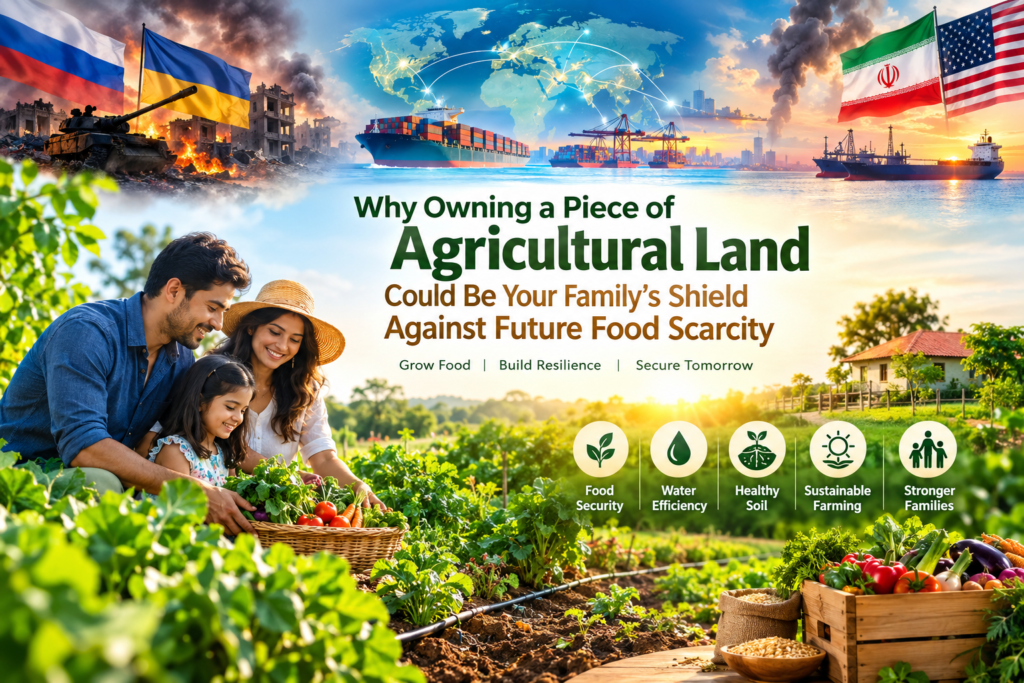
Food security is often discussed at the level of governments, nations and international organizations. But recent conflicts have demonstrated something much closer to home: when international trade routes, fuel supplies, fertilizer markets and food distribution networks are disrupted, households can also feel the consequences.
The Russia–Ukraine war has already shown how a regional conflict can affect global grain and fertilizer markets. In 2026, the escalation of conflict involving Iran and the wider Middle East has added another layer of risk through disruptions affecting energy, fertilizer and agricultural trade routes, particularly around the Strait of Hormuz.
This raises an important long-term question:
Should individuals and families consider having access to a small piece of productive agricultural land as part of their long-term food-security planning?
The answer is not that every family must become a full-time farmer. Rather, land combined with water, agricultural knowledge and sustainable cultivation can provide an additional layer of resilience when conventional food systems are under pressure.
🌍 Food Security Is More Than Producing Enough Food
A country can have sufficient food production and still experience food insecurity.
Food has to move through a complex chain:
Farm → Storage → Processing → Transport → Ports → International Trade → Distribution → Retail → Household
A disruption at any point can increase prices or reduce availability.
Wars and geopolitical conflicts can affect:
- Agricultural production
- Fuel availability
- Fertilizer supplies
- Seed and farm-input availability
- Farm labour
- Roads, railways and ports
- Shipping insurance and freight costs
- International trade routes
- Currency values
- Food-import costs
- Cold-chain and storage infrastructure
That is why modern food security depends not only on how much food the world produces, but also on whether people can access and afford it.
🇺🇦 What the Russia–Ukraine War Teaches Us
Ukraine and Russia are major participants in international agricultural markets. The war disrupted Ukrainian agricultural production, infrastructure and exports, while fertilizer and grain markets were also affected. Research has documented disruptions to global cereal trade networks and disproportionate impacts on vulnerable importing countries.
More recently, attacks affecting Black Sea shipping and agricultural infrastructure have created additional risks for grain and fertilizer flows. CSIS reported in September 2026 that attacks had severely disrupted shipping through important Ukrainian Black Sea ports and affected Russian grain and fertilizer export infrastructure as well.
But there is another lesson from Ukraine that is particularly relevant to households.
Small-scale agriculture can act as a safety net.
A 2026 FAO assessment covering more than 2,800 households in nine frontline Ukrainian regions found that 40% of surveyed households were engaged in agricultural production, and 86% of agricultural households primarily produced for their own consumption. FAO also found that agricultural households reported better food-security outcomes and more diverse diets than households not engaged in agriculture.
This does not mean a private farm can eliminate the effects of war. Ukrainian agriculture itself has suffered major damage and shortages of labour, inputs and income.
But it demonstrates an important principle:
When markets become uncertain, the ability to produce at least some food locally can provide a valuable buffer.
🇮🇷 The Iran Conflict Shows Another Vulnerability: Fertilizer and Energy
Agriculture is heavily dependent on energy.
Farmers need energy for:
- Irrigation
- Tractors and machinery
- Pumping water
- Cold storage
- Processing
- Transportation
- Fertilizer manufacturing
- Distribution
The 2026 conflict involving Iran and the wider Middle East illustrates how geopolitical instability can reach far beyond the countries directly involved.
According to the FAO, disruptions around the Strait of Hormuz have increased risks to global energy, fertilizer and agrifood systems. Higher energy costs and fertilizer shortages can raise agricultural production costs and potentially affect crop yields and food prices, particularly in import-dependent countries.
This creates a chain reaction:
Conflict → Shipping disruption → Higher fuel costs → Higher fertilizer costs → Higher farming costs → Higher food prices
The effects can therefore appear thousands of kilometres away from the battlefield.
🌎 How Wars Between Nations Can Affect Your Dinner Table
Modern food systems are interconnected.
Consider a simplified example:
Country A produces fertilizer
⬇️
Country B grows wheat
⬇️
Country C imports wheat
⬇️
Country D provides shipping and logistics
⬇️
Consumers around the world buy flour and bread
A conflict affecting Country A or D can eventually affect consumers in Country C.
This is why food-security planning increasingly needs to consider geopolitical risk, not just rainfall and agricultural production.
🇸🇩 Sudan: When Conflict Directly Destroys Food Security
Sudan demonstrates the extreme end of the problem.
FAO currently describes Sudan as one of the world’s largest hunger crises, with conflict, displacement and restricted access severely disrupting livelihoods and agricultural production. FAO estimates that 19.5 million people are experiencing high levels of acute food insecurity, while millions have been displaced.
Yet agriculture remains part of the response.
FAO and humanitarian organizations are supporting farmers with:
- Seeds
- Livestock interventions
- Agricultural inputs
- Crop production
- Irrigation and resilience measures
- Livelihood restoration
The objective is important: restore local food production instead of relying entirely on food arriving from outside the affected region.
This principle applies well beyond Sudan.
🇵🇸 Gaza: What Happens When Agricultural Land Becomes Inaccessible?
Gaza provides another powerful example of the connection between land and food security.
A 2026 FAO/UNOSAT assessment found that, as of June 24, only 448 hectares — around 3% of Gaza’s cropland — were both accessible and undamaged. FAO has emphasized that restoring agricultural production requires safe access to farmland and agricultural inputs.
The lesson is straightforward:
Having agricultural land is valuable — but land alone is not enough.
Food resilience also requires:
- Reliable water
- Healthy soil
- Seeds
- Agricultural knowledge
- Tools
- Energy
- Storage
- Security
- Access to markets
🌱 What Can We Learn From Countries Facing Food-System Stress?
Different countries demonstrate different approaches.
| Country/Region | Major challenge | Agricultural resilience lesson |
|---|---|---|
| Ukraine | War, disrupted infrastructure and markets | Household agriculture can provide food directly |
| Sudan | Conflict and displacement | Maintaining local farming is critical to preventing deeper food crises |
| Gaza | Damage and restricted access to farmland | Protecting agricultural land and restoring production are essential |
| Israel | Water scarcity and regional instability | Efficient irrigation, water infrastructure and controlled agriculture matter |
| India | Climate variability, rising input costs and population demand | Diversification, water efficiency and local food production can strengthen resilience |
Israel provides an especially useful example of water-management thinking. OECD reporting notes continued investment in water infrastructure, reservoirs and desalination while agricultural water allocations have faced pressure from drought.
The broader lesson is not to copy one country’s agricultural system. It is to recognize that food resilience increasingly depends on efficient use of land, water, technology and local resources.
🇮🇳 What Does This Mean for India?
India has a major advantage: a large agricultural sector and diverse climatic regions.
But India’s food system is also exposed to:
- Extreme heat
- Drought
- Floods
- Erratic rainfall
- Groundwater stress
- Rising agricultural-input costs
- Fuel-price fluctuations
- Global fertilizer markets
- International commodity-price volatility
Climate variability can compound geopolitical disruptions.
Therefore, food security should not be considered only a government responsibility.
It can also become a household-level resilience strategy.
🏡 Should Every Family Own Agricultural Land?
There is no scientifically universal acreage requirement that guarantees food security for every family.
The land required depends on:
- Number of family members
- Diet
- Crop selection
- Soil fertility
- Rainfall
- Irrigation
- Farming methods
- Crop intensity
- Livestock requirements
- Local climate
However, even a relatively small productive garden can contribute meaningfully to household food availability.
Research published through ICAR has demonstrated that planned kitchen gardens can produce substantial quantities of vegetables throughout the year. One ICAR study achieved year-round vegetable production from a 62 m² cultivated area, while another Indian study found that a planned 150 m² nutrition garden could support vegetable requirements for a medium-sized family.
That means food resilience doesn’t necessarily begin with owning a large farm.
It can begin with:
A garden → a small agricultural plot → a larger family farm → community-level food production.
🌾 The Concept of a Personal Food-Security Plot
Imagine a family owning a small piece of productive agricultural land outside the city.
Instead of treating it only as a passive asset, the land could gradually be developed into a family food-security plot.
Depending on local conditions, it could include:
Vegetables
Tomato, chilli, brinjal, okra, leafy vegetables, gourds and seasonal crops.
Fruits
Mango, guava, papaya, citrus and other locally suitable fruit trees.
Pulses
Suitable pulse crops can provide an additional source of plant protein.
Millets and grains
Where land, water and climate permit, small-scale cultivation can diversify food production.
Herbs and spices
Curry leaves, coriander, turmeric, ginger and other locally appropriate crops.
Composting
Organic household and farm waste can potentially be converted into useful soil amendments.
Rainwater harvesting
Capturing rainfall can reduce dependence on external water sources.
Drip irrigation
Water-efficient irrigation can improve water-use efficiency.
The objective isn’t complete isolation from the food market.
It is reducing dependence on it for at least part of the household’s food needs.
💧 Agriculture of the Future Must Be Water-Efficient
Simply owning land is not enough.
Future agriculture needs to be:
Water-efficient + climate-resilient + diversified + soil-friendly + energy-conscious
Important practices include:
1. Drip irrigation
Deliver water closer to plant roots and reduce unnecessary losses.
2. Mulching
Protect soil moisture and moderate soil temperature.
3. Rainwater harvesting
Capture and store rainfall for later use where feasible.
4. Crop diversification
Avoid dependence on a single crop.
5. Soil health management
Compost, organic matter and appropriate nutrient management can support productive soils.
6. Local seed planning
Maintaining access to suitable seeds reduces dependence on emergency purchases.
7. Agroforestry
Combining trees with crops can diversify production and improve long-term land use.
8. Solar-powered irrigation where appropriate
Renewable energy can potentially reduce dependence on conventional energy sources.
These approaches become particularly valuable when climate stress and geopolitical disruptions occur simultaneously.
🌱 The Future May Be About “Food Resilience,” Not Just Food Production
The traditional question is:
“How much food can we produce?”
The future question may be:
“How resilient is our food system when something goes wrong?”
A resilient food system has multiple layers.
National level
Strategic food reserves and domestic agricultural production.
Regional level
Local farmers, warehouses, markets and distribution networks.
Community level
Community gardens, farmer networks and local food systems.
Household level
Kitchen gardens and access to productive agricultural land.
Individual level
Basic knowledge of growing, preserving and storing food.
This creates a distributed food-security network rather than dependence on a single supply chain.
🌍 From Investment in Land to Investment in Resilience
Agricultural land has traditionally been viewed primarily through the lenses of:
Investment → Appreciation → Income → Wealth creation
But another perspective is emerging:
Land → Food → Resilience → Self-reliance
Owning agricultural land does not guarantee financial returns or food independence. Land can face drought, pests, crop failure, legal restrictions, water limitations and other risks.
But productive land can provide something that many financial assets cannot directly provide:
the physical capacity to grow food.
That capability can have value during periods of inflation, supply-chain disruption, extreme weather or geopolitical uncertainty.
🇮🇳 A Practical Vision for Indian Families
Instead of asking:
“How much agricultural land should everyone own?”
A better question may be:
“What level of agricultural access would help my family produce at least part of its own food?”
For some urban families, this may mean a terrace or kitchen garden.
For others, it could mean a small peri-urban agricultural plot.
For larger families or people with agricultural experience, it could mean a farm capable of producing vegetables, fruit, pulses, grains and other products.
The key is not simply land ownership.
The real objective is:
Productive Land + Water + Knowledge + Sustainable Farming + Long-Term Maintenance
🔐 Food Security Is Everyone’s Responsibility
Wars between nations can change the price of fertilizer.
A blocked shipping route can affect grain imports.
A damaged port can delay agricultural exports.
A fuel shortage can increase transportation costs.
A drought can reduce harvests.
A geopolitical crisis can change global commodity markets within weeks.
These events demonstrate that food security is interconnected with geopolitics, energy, water, agriculture and climate.
The Russia–Ukraine war has demonstrated how conflict can disrupt global agricultural trade. The 2026 Middle East conflict has highlighted the vulnerability of energy and fertilizer supply routes. Sudan and Gaza show how conflict can directly undermine local agricultural production and household food access.
And Ukraine offers an especially important household-level lesson: despite enormous difficulties, agricultural production continues to act as a food-security buffer for many families.
🌾 The New Definition of Agricultural Wealth
Perhaps the most important agricultural asset of the future will not simply be how much land a person owns.
It will be:
How productive is the land?
How secure is the water?
How healthy is the soil?
How sustainable is the farming system?
How much food can it produce?
Can it continue producing during difficult years?
This changes the way we think about agricultural land.
Agricultural land is not only a piece of property.
It can also be a productive resource, a food-security asset and part of a family’s long-term resilience strategy.
In a world facing geopolitical conflicts, climate uncertainty and increasingly interconnected supply chains, having some connection to productive agriculture may become an increasingly important form of preparedness.
Conclusion: Don’t Wait for a Food Crisis to Think About Food Security
Nobody can predict exactly where the next global disruption will come from.
It could be a war.
It could be a shipping crisis.
It could be fertilizer shortages.
It could be extreme weather.
It could be an energy shock.
Or several problems could occur simultaneously.
The sensible response is not panic or isolation.
It is resilience.
Governments can strengthen strategic reserves and domestic agriculture. Communities can support local farmers. Technology can improve water and resource efficiency. And families can consider developing access to productive land where practical.
You don’t need to become a farmer overnight.
But learning how food is produced—and having access to land where at least some food can be grown—can be one additional layer of resilience for the future.
The future of food security may begin not only with what we buy, but also with what we can grow.