
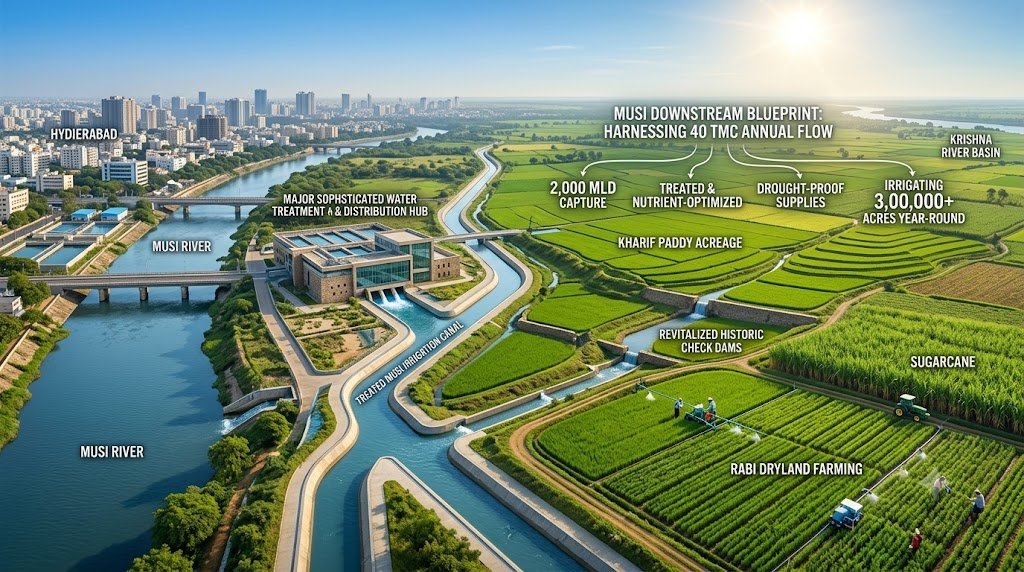
The Musi River, originating in the Ananthagiri Hills of Vikarabad, flows nearly 250 kilometers through the heart of Hyderabad before heading eastward into the agricultural belt of Telangana and merging with the Krishna River at Vadapally in Nalgonda district. While historically viewed as an urban discharge channel, the downstream flow of the Musi represents one of the most reliable, high-volume water resources in the state.
By capturing, treating, and systematically routing this continuous flow, Telangana can convert urban water runoff into guaranteed irrigation for lakhs of agricultural acres across surrounding regional districts.
1. The Numbers: Volume Flowing into the Krishna River
The sheer volume of water carried by the Musi River down to the Krishna River basin makes it a massive perennially flowing asset.
- Daily Urban Discharge: Greater Hyderabad generates approximately 1,950 to 2,000 Million Litres per Day (MLD) of wastewater and urban runoff.
- Annual Downstream Volume: 2,000 MLD translates to ~0.73 Cubic Kilometers (730 Billion Litres) or approximately 25.8 TMC (Thousand Million Cubic Feet) of water every single year.
- Monsoon Inflows: During peak monsoon months, upstream catchment runoff and stormwater add another 10 to 15 TMC of seasonal flow into the river channel.
- Total Annual Merging Volume: A total of 35 to 40 TMC of water flows downstream along the Musi corridor annually into the Krishna River at Vadapally.
2. Unlocking Downstream Agricultural Potential
Unlike traditional rivers that dry up outside the monsoon, Hyderabad’s household water consumption ensures the Musi remains a perennial river with an unceasing daily flow.
When this 2,000 MLD flow is captured and treated using advanced tertiary treatment systems—eliminating pollutants while preserving essential crop nutrients like nitrates and phosphates—it unlocks massive irrigation capacity across the downstream catchment districts of Yadadri Bhuvanagiri, Nalgonda, and Suryapet.
┌─────────────────────────────────────────────────────────────────┐
│                    2,000 MLD Daily Musi Flow                    │
│                        (~25.8 TMC/Year)                         │
└────────────────────────────────┬────────────────────────────────┘
                                 │
                  ┌──────────────┴──────────────┐
                  ▼                             ▼
       ┌────────────────────┐        ┌────────────────────┐
       │   Kharif Season    │        │    Rabi Season     │
       │  (Monsoon Crop)    │        │   (Winter Crop)    │
       └─────────┬──────────┘        └─────────┬──────────┘
                 │                             │
                 ▼                             ▼
        78,000–190,000 Acres          98,000–240,000 Acres
        Irrigation Capacity           Irrigation Capacity
Potential Irrigation Coverage Across Crop Cycles:
- Kharif Season (Wet Season):
- Paddy & Water-Intensive Crops: Can irrigate over 78,000 acres continuously.
- Pulses & Millets (Dryland Farming): Can extend coverage to 190,000 acres.
- Rabi Season (Winter Season): Lower temperatures reduce evaporation losses across open canals, increasing efficiency:
- Rabi Paddy: Can support over 98,000 acres.
- Oilseeds, Maize & Chickpeas: Can support over 240,000 acres.
Over a full agricultural year, capitalizing on this perennial supply can guarantee multi-cropping irrigation for over 3,00,000 acres of farm land across southern Telangana.
3. Financial & Ecological Impact
Capitalizing on the downstream Musi water system delivers immediate structural benefits to farmers and the regional economy:
- Drought Proofing: The flow is decoupled from rainfall; even during low-monsoon years, urban water usage remains constant, offering farmers a guaranteed crop yield year after year.
- Fertilizer Savings: Treated water retaining safe organic compounds reduces chemical fertilizer dependency, saving local farming communities tens of crores annually.
- Existing Infrastructure Integration: The Musi basin already contains 24 historic diversion check dams (Kathwas) and the major Musi Project Reservoir in Suryapet. Integrating modern canal networks with these existing structures minimizes capital costs while maximizing water reach.
By fully harnessing the 35+ TMC flowing through the Musi annually, Telangana can transform an underutilized urban discharge into an agricultural wealth generator—securing livelihoods, boosting crop yields, and establishing a benchmark for circular water management in India.