
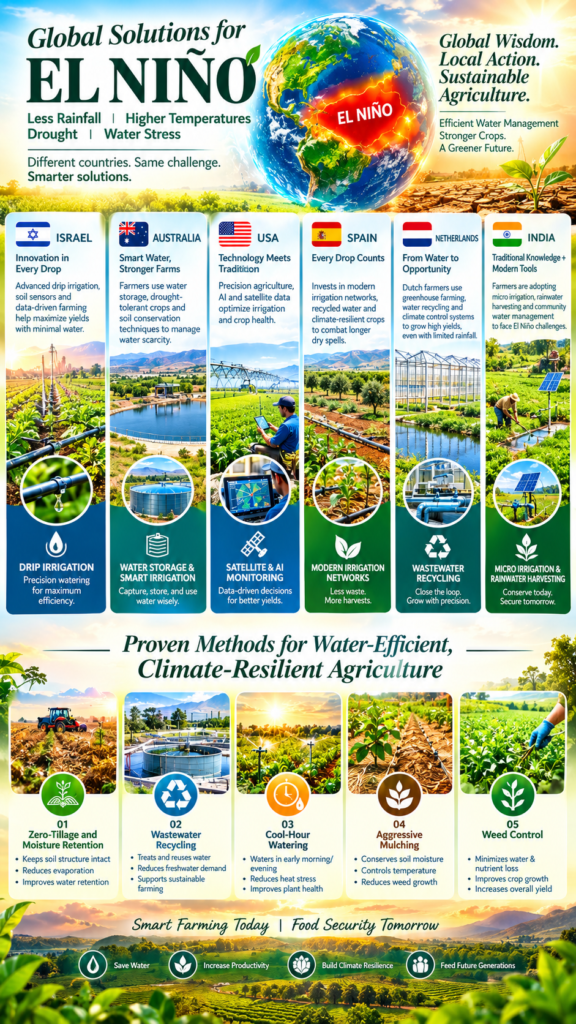
The agricultural sector finds itself on the front lines of an escalating climate crisis. As El Niño cycles continue to trigger severe heatwaves and critical rainfall deficiencies across the globe, traditional farming methods are being pushed to their absolute limits. The threat to global food security is no longer a distant projection—it is an immediate reality.
However, farmers and policymakers are not standing still. Around the world, a handful of nations have emerged as pioneers in climate-smart agriculture. By examining the strategies of Israel, Australia, India, and Vietnam, we can map out a global blueprint for farming through severe heat and drought.
1. Israel: Perfecting Precision Water Management
In Israel, aridity is not a seasonal crisis; it is a permanent condition. Out of necessity, the nation has built the world’s most sophisticated water infrastructure, providing invaluable tools for countries facing temporary El Niño droughts.
- Precision Drip Irrigation: Pioneered nationally, this technology delivers water and liquid nutrients directly to the root zone of the plant. By bypassing the surrounding soil, it reduces evaporation and water waste by up to 90% compared to traditional flood irrigation.
- The Circular Water Economy: Israel treats and recycles nearly 90% of its domestic wastewater, repurposing it exclusively for agricultural use. This creates a reliable, weather-independent water supply that keeps farms insulated from rainfall deficits.
- Desalination Integration: A significant portion of the country’s agricultural water is supplemented by desalinated seawater, proving that crop yields can be entirely uncoupled from traditional weather patterns.
2. Australia: Mastering Large-Scale Dryland Policy
Australia is routinely battered by intense El Niño phases that trigger devastating multi-year droughts. To survive, the country has paired cutting-edge conservation techniques with market-driven policy.
- Market-Based Water Trading: Australia uses a highly regulated water-market system where water entitlements can be bought and sold. During severe scarcity, water naturally flows to high-value, high-efficiency crops, minimizing the broader economic fallout of a drought.
- Zero-Tillage Conservation: Australian dryland farmers are global leaders in no-till agriculture. By leaving the stubble of previous harvests in the ground and avoiding soil disturbance, they trap and retain every milligram of residual soil moisture.
- Predictive Climate Modeling: The Australian Bureau of Meteorology (BOM) provides highly accurate, long-range seasonal outlooks. This data allows commercial farmers to proactively adjust livestock stocking rates and select optimal seed varieties months before the heat sets in.
3. India: Driving Smallholder Climate-Smart Agriculture
With roughly half of its agricultural land dependent entirely on monsoon rains, India faces a massive challenge protecting millions of smallholder farmers during weak El Niño monsoons. The country’s response relies heavily on crop diversification and genetic innovation.
- Drought-Resilient Cultivars: The Indian Council of Agricultural Research (ICAR) has developed and successfully deployed climate-resilient crop strains. A prime example is Sahbhagi Dhan, a drought-tolerant rice variety that yields successfully even under severe moisture stress.
- The Millet Revolution: India has aggressively incentivized a shift away from water-intensive crops like paddy rice and sugarcane toward hardy, traditional millets (such as pearl millet/bajra and sorghum). These crops require a fraction of the water and easily withstand high temperatures.
- District-Specific Contingency Plans: The government relies on localized response frameworks, pushing out real-time weather alerts and providing subsidized, short-duration seeds to farmers when traditional monsoon timelines fail.
4. Vietnam: Micro-Climate Engineering in the Tropics
As a major global rice and fruit exporter, Vietnam is highly vulnerable to Pacific Ocean warming. Vietnamese agriculture excels at rapid, tactical adaptations on the ground.
- Micro-Climate Shading: To combat intense solar radiation, farmers widely employ protective mesh nets and canopy shading. This simple yet effective engineering reduces direct sun exposure on high-value crops, drastically cutting soil moisture evaporation rates.
- Strict Crop Scheduling: Local authorities actively adjust regional agricultural calendars, shifting planting dates to avoid peak El Niño heat waves and managing reservoir allocations with strict discipline.
The Path Forward: A Unified Strategy
There is no single “silver bullet” for surviving an El Niño event. The ultimate solution lies in combining the strengths of these diverse nations:
- Adopt Israel’s efficiency to secure the water we have.
- Utilize Australia’s data models to predict and plan for the worst.
- Embrace India’s crop diversification to reduce resource reliance.
- Deploy Vietnam’s physical protections to shield crops from direct heat.
As climate volatility becomes the new normal, integrating these global blueprints is no longer just an innovative choice—it is the baseline for the future of sustainable farming.