
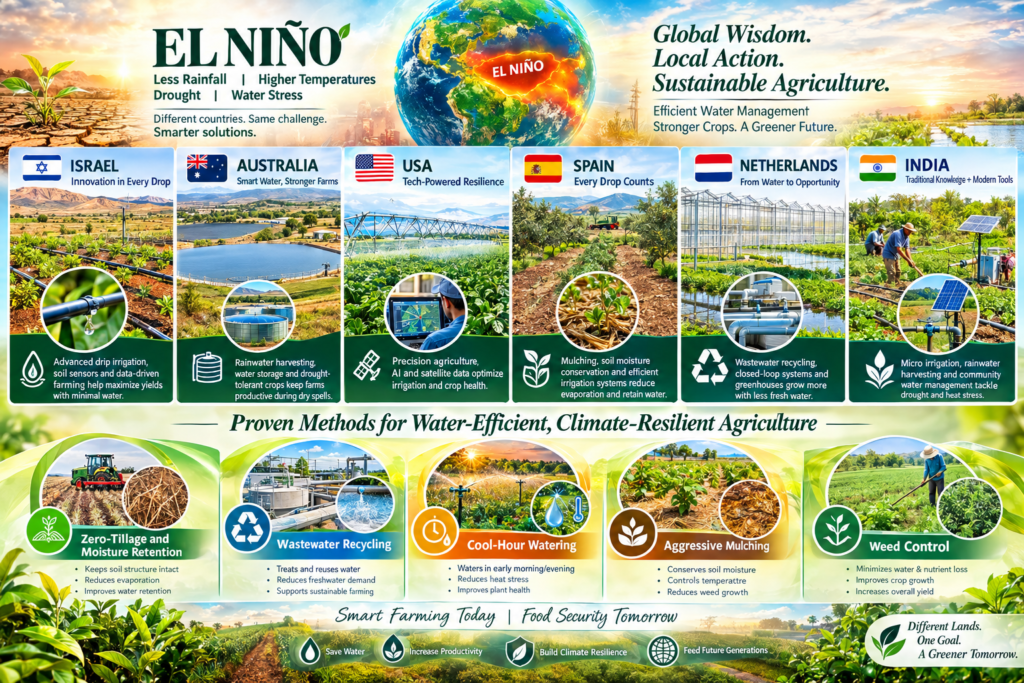
How farmers can protect soil moisture, manage water efficiently and maintain healthier crops during rainfall deficiency and extreme heat
Agriculture depends on one resource above almost everything else: water.
But changing rainfall patterns, rising temperatures, prolonged dry spells and recurring climate extremes are making agricultural water management increasingly important. During an El Niño event, some regions can experience below-normal rainfall and higher agricultural drought risk, while other regions may experience excessive rainfall or flooding. The effects are not uniform across the world.
According to the Food and Agriculture Organization of the United Nations (FAO), a new El Niño phase was expected to emerge in 2026, with agricultural drought risks identified in several major farming regions. FAO emphasizes early action such as water preparation, drought-tolerant crops, improved planting decisions and localized climate information.
For farmers, the lesson is clear:
Successful agriculture in a hotter and more unpredictable climate requires more than simply adding irrigation. It requires managing every drop of water efficiently.
Why El Niño Matters to Agriculture
El Niño is a natural climate phenomenon associated with unusually warm surface waters in parts of the central and eastern Pacific Ocean. This warming can disrupt atmospheric circulation and rainfall patterns around the world.
Its agricultural effects depend on location, season and event intensity.
In some regions, El Niño can contribute to:
- 🌧️ Reduced rainfall
- ☀️ Longer dry spells
- 🌡️ Higher temperatures
- 💧 Increased crop water demand
- 🌱 Soil-moisture depletion
- 🌾 Lower crop productivity
- 🐄 Reduced pasture availability
- 🔥 Increased drought and wildfire risk
FAO notes that El Niño occurs against a warming climate background, which can amplify heat and drought impacts in vulnerable agricultural systems.
This makes water-use efficiency and soil-moisture conservation essential components of climate-resilient agriculture.
Agriculture’s Water Challenge
Agriculture is the world’s largest user of freshwater withdrawals, accounting for roughly 72% globally, according to FAO. At the same time, climate change is increasing uncertainty around water availability and crop water requirements.
FAO also reports that irrigated agriculture occupies about 23% of global cropland but produces a disproportionately large share of global crop value. However, much irrigated land is located in areas already experiencing high or very high water stress.
The objective therefore should not simply be:
“How can we use more water?”
Instead:
“How can we produce more healthy crops with every unit of water available?”
That shift in thinking leads to smarter irrigation, better soil management, water recycling and improved farm practices.
5 Water-Efficient Farming Practices for Hot and Dry Conditions
1. Zero-Tillage and Moisture Retention
Protect the soil → retain moisture → support the root zone
Repeated intensive tillage can disturb soil structure and leave the soil surface more exposed. Conservation agriculture promotes minimum soil disturbance, permanent soil cover and crop diversification. These practices can improve water and nutrient-use efficiency while reducing erosion.
How it helps
- Preserves soil structure
- Reduces unnecessary soil disturbance
- Helps retain soil moisture
- Reduces erosion
- Supports biological activity
- Improves water-use efficiency
Zero-tillage should not be treated as a universal prescription for every soil and cropping system. Local soil conditions, machinery, weeds and crop requirements need to be considered.
In South Asia’s Indo-Gangetic Plains, FAO reports that farmers use zero-tillage in wheat systems, while alternate wetting and drying in rice can substantially reduce water consumption under appropriate conditions.
The bigger principle
Don’t allow valuable rainfall or irrigation water to disappear before the crop can use it.
2. Wastewater Recycling and Safe Water Reuse
Treat → recycle → reuse → conserve freshwater
During water shortages, agriculture can potentially use properly treated wastewater as a supplementary water resource.
FAO recognizes treated wastewater as one of the non-conventional water resources that can contribute to agricultural water security when appropriate treatment, monitoring and risk management are in place.
However, this does not mean untreated wastewater should be used on crops.
Water quality must be matched to:
- Crop type
- Irrigation method
- Soil conditions
- Public-health requirements
- Local regulations
- Salinity and contaminant risks
FAO specifically stresses that untreated wastewater is inappropriate for agricultural irrigation and that adequate treatment and safe management are essential.
For suitable agricultural and agroforestry applications, treated wastewater can help reduce pressure on freshwater resources while creating a more circular water system.
The bigger principle
Wastewater can become a resource when it is treated, monitored and safely managed.
3. Cool-Hour Watering
Water when evaporation pressure is lower.
Irrigation timing matters, particularly during periods of intense heat.
Watering during cooler periods—commonly early morning or, where appropriate, evening—can help reduce immediate evaporative losses compared with irrigation during the hottest part of the day.
However, timing should be adapted to:
- Crop type
- Irrigation method
- Soil moisture
- Weather conditions
- Disease risk
- Local humidity and wind
Efficient irrigation is about delivering the right quantity of water to the right place at the right time, rather than simply increasing irrigation frequency.
Drip and other resource-efficient irrigation technologies can also help reduce unproductive water losses. FAO identifies improved irrigation technologies, soil-moisture conservation and water harvesting as complementary approaches to drought adaptation.
The bigger principle
Irrigation efficiency is not only about how much water you apply—it is also about when and where you apply it.
4. Aggressive Mulching for Soil-Moisture Conservation
Cover the soil → reduce evaporation → protect the root zone
Mulching is one of the simplest tools available for conserving soil moisture.
Organic materials such as crop residues, straw, grass, leaves and other suitable biomass can form a protective layer over the soil.
FAO identifies surface residues and soil cover as important ways of reducing evaporation and protecting soil moisture. Mulching can also help control weeds and moderate soil-temperature fluctuations.
Potential benefits of appropriate mulching
🌱 Reduced soil evaporation
🌱 Better moisture retention
🌱 Lower soil-temperature fluctuations
🌱 Reduced weed emergence
🌱 Protection against erosion
🌱 Improved soil organic matter when suitable organic materials are used
Research summarized through FAO’s AGRIS platform also identifies mulching as a useful dryland water-conservation practice because it can preserve moisture in the root zone and reduce evaporation.
Important consideration
“More mulch” is not automatically better. The material, thickness, decomposition characteristics, pests, disease conditions and crop requirements should be considered.
The bigger principle
The best irrigation system can still lose water quickly if the soil surface is left exposed to intense heat.
5. Effective Weed Control
Every weed competes for water.
During drought conditions, competition between crops and weeds becomes even more important.
Weeds can consume available soil moisture and nutrients that the intended crop needs for growth.
FAO notes that appropriate weed control can reduce unnecessary water losses associated with weed transpiration, while soil cover can simultaneously help reduce evaporation.
Integrated weed management may include:
- Timely mechanical control
- Mulching
- Cover crops
- Crop rotation
- Appropriate cultivation practices
- Targeted herbicide use where suitable and legally permitted
The objective is not simply to eliminate every plant other than the crop. It is to manage competition effectively while protecting soil health and biodiversity.
The bigger principle
Water saved from unnecessary plant competition is water potentially available to the crop.
The Power of Combining the Practices
The five practices become more powerful when they are integrated.
Consider a drought-prone farm:
Rainfall / stored water
↓
Efficient irrigation
↓
Cool-hour application
↓
Moisture-retaining soil management
↓
Mulch protects the soil surface
↓
Weed control reduces competition
↓
Healthy root zone
↓
Better water productivity
This is the foundation of climate-smart agriculture.
FAO describes climate-smart agricultural approaches as a combination of practices that can improve productivity and resilience while addressing climate risks.
Beyond Irrigation: Build a Complete Farm Water Strategy
A drought-resilient farm should not depend on a single water source or a single technology.
A comprehensive strategy can include:
💧 1. Rainwater Harvesting
Capture rainfall before it becomes runoff.
🏞️ 2. Farm Ponds and Storage
Store water when it is available for later use.
🌱 3. Soil-Moisture Conservation
Use soil cover, appropriate tillage and organic matter management.
🚰 4. Efficient Irrigation
Consider drip, sprinkler or other suitable systems according to crop and site conditions.
🌡️ 5. Irrigation Scheduling
Use crop requirements, soil moisture and weather information rather than applying water on a fixed schedule alone.
🌿 6. Mulching and Weed Management
Reduce unnecessary water losses from the soil and competing vegetation.
♻️ 7. Safe Water Recycling
Where feasible, use appropriately treated and monitored non-conventional water resources.
📡 8. Weather and Crop Monitoring
Early-warning systems and localized information can help farmers make decisions before drought damage becomes severe.
FAO’s 2026 El Niño analysis emphasizes precisely this idea: identifying agricultural drought risk early can help governments, farmers and support systems prepare water, seeds, livestock feed and other resources before losses deepen.
El Niño Is a Climate Challenge—Water Management Is a Farm Strategy
El Niño cannot be controlled by farmers.
Rainfall cannot be commanded.
Temperatures cannot be switched off.
But water can be managed better.
Farmers can improve resilience by protecting soil moisture, harvesting rainfall, using efficient irrigation, controlling weeds, applying suitable mulch, monitoring weather conditions and—where technically and legally appropriate—reusing treated water.
The most resilient agricultural systems are not necessarily those that simply have the largest water supply.
They are systems that capture water, store water, conserve water, deliver water efficiently and protect the soil’s ability to retain water.
Smart Farming Today, Food Security Tomorrow
The future of agriculture will increasingly depend on the ability to produce more reliably under uncertain climatic conditions.
The answer is not one single technology.
It is an integrated approach:
🌧️ Capture Water
💧 Store Water
🚜 Conserve Soil
🌱 Protect Moisture
♻️ Reuse Suitable Water Safely
🚰 Irrigate Efficiently
🌿 Control Weeds
🌾 Build Climate Resilience
El Niño provides a powerful reminder that water security and food security are deeply connected.
For farmers, agroforestry managers and agricultural landowners, the goal should be simple:
Save every possible drop. Protect every inch of productive soil. Help every plant make the most of the water available.
Smart Farming Today | Water-Secure Agriculture Tomorrow | Food Security for Future Generations
Note: Water-management practices should be adapted to local soil, crop, climate, water quality, regulations and farm conditions. Treated wastewater should only be used where treatment, monitoring and applicable safety standards are satisfied.