
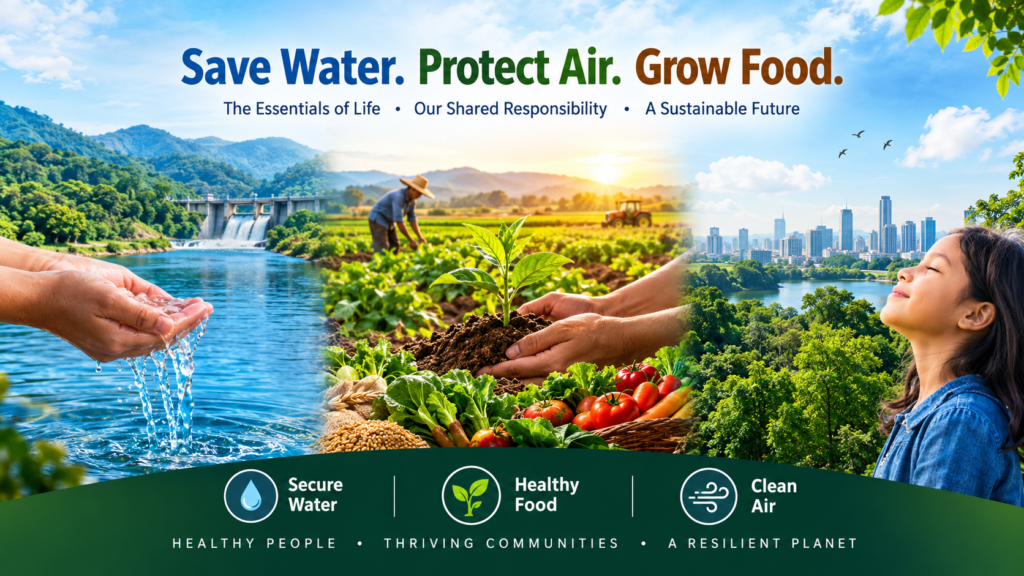
A call to action for scientists, researchers, young innovators, industries, farmers, educators and every citizen of the planet.
Humanity has learned to build machines that fly, computers that think, vehicles that travel at extraordinary speeds, and spacecraft that explore distant worlds. Yet, beneath every technological achievement lies a fundamental truth: no human being can survive without clean air, safe water and nutritious food.
We are advancing rapidly in artificial intelligence, robotics, software, space exploration, nanotechnology, electronics, telecommunications, chemistry and physics. These innovations have transformed our lives and expanded the boundaries of human knowledge. But technological advancement alone cannot sustain civilization if the natural systems that provide our basic necessities are neglected.
The question we must urgently ask ourselves is this:
What is the true value of technological progress if humanity cannot secure the air we breathe, the water we drink and the food we eat?
This is not an argument against technology. It is a call to direct more of our intelligence, investment, research and innovation towards the very foundations of life.
1. The Three Foundations of Human Survival
Photo № 13771862. Photographer Alexander Nikitin
Water — The Foundation of Life
Every household, farm, industry and ecosystem depends on water. Yet groundwater depletion, polluted rivers, inefficient irrigation, deteriorating watersheds and unpredictable rainfall threaten water security in many regions.
We must make water conservation a way of life through rainwater harvesting, aquifer recharge, watershed restoration, wastewater treatment and reuse, efficient irrigation and protection of lakes, rivers and wetlands.
What Is The Climate In Greece? Wind Patterns That Change Everything – Encyclopedia Hellenica
Air — The Breath of Civilization
Clean air is essential for human health and the survival of ecosystems. Air pollution from transport, industrial activity, power generation, waste burning and other sources threatens public health.
We need cleaner energy, effective emission controls, better public transport, clean industrial processes, scientific monitoring and the protection and restoration of healthy ecosystems. Trees and forests are valuable, but they must complement—not replace—direct reductions in pollution.
Bharat Certis AgriScience Ltd | Crop Protection & Agri Solutions
Food — The Foundation of Human Dignity
Food security requires more than producing enough crops. People must also be able to access safe, nutritious and affordable food throughout the year.
Soil degradation, crop diseases, extreme heat, water shortages, supply-chain disruptions and food waste can undermine that security. We need resilient crops, regenerative and conservation-oriented farming practices, scientific pest management, better storage, local food systems and technologies that help farmers produce more sustainably.
Water, air and food are interconnected. Agriculture needs water and healthy soil. Ecosystems help regulate the water cycle, store carbon and support biodiversity. Polluted air and a changing climate can damage crops, forests and human health.
Protecting these three essentials is not a separate sector of development. It is the foundation on which every other sector depends.
2. Technology Must Serve Life, Not Distract Us from It
Imagine a world with supercomputers, autonomous vehicles, advanced robots, space stations and intelligent machines—but with empty reservoirs, infertile farmland and air that is unsafe to breathe.
Would that world represent genuine progress?
Technology is not the enemy of nature. In fact, it may be one of our strongest tools for protecting it. But our definition of innovation must expand beyond convenience, speed, automation and profit to include survival, sustainability and the well-being of future generations.
Artificial intelligence can help predict droughts and identify crop diseases. Satellites can monitor deforestation, reservoirs and agricultural conditions. Sensors can detect water leakage, measure soil moisture and monitor air quality. Biotechnology can support the development of crops suited to particular environmental stresses. Robotics can assist with precision agriculture, while advanced materials can improve filtration, water treatment and energy efficiency.
The challenge is not whether technology can contribute to solving these problems. It is whether we will prioritize, fund and deploy the right solutions at the necessary scale.
We should encourage every field of engineering and science to ask three additional questions:
- Does this innovation help conserve water?
- Does it help protect or restore clean air and healthy ecosystems?
- Does it help produce, preserve or distribute safe and nutritious food sustainably?
Not every invention needs to address all three. But every society should ensure that its innovation ecosystem devotes substantial attention to them.
3. Research Must Prepare Us for El Niño, Droughts and Disasters
Climate variability, extreme heat, floods, droughts, pandemics and other emergencies can disrupt food production, water supplies and public health. El Niño is one example of a climate phenomenon that can alter rainfall and temperature patterns in different regions, increasing drought or flood risks in vulnerable areas. Its effects vary by location and season. World Health Organization+1
In September 2026, the World Meteorological Organization reported that a strong El Niño was developing and warned of increased risks from extreme weather into 2027. This makes preparedness, monitoring and locally appropriate adaptation especially important. World Meteorological Organization
Research should move beyond responding to disasters after they occur. We need to prepare before crops fail, reservoirs run dry or supply chains break down.
Penelitian Unggul Baru Padi Tahan Kekeringan oleh IPB untuk Adaptasi Perubahan Iklim – Inovarian
Climate-resilient agriculture
Develop and test locally suitable drought- and heat-tolerant crop varieties, improve seed systems, diversify crops, conserve soil moisture and refine planting schedules using reliable weather forecasts.
Integrated Watershed Development: Securing Rural India’s Water Future
Water security and drought preparedness
Expand rainwater harvesting, recharge groundwater where geologically appropriate, repair distribution leaks, reuse treated wastewater safely and develop local water budgets that balance human needs with ecosystem requirements.
Clean-air research
Improve pollution monitoring, identify emission sources, develop cleaner industrial and household energy systems, and create effective early-warning systems for dangerous air-quality episodes.
ALMER Almacenadora Mercader | Agronegocios
Food resilience and emergency preparedness
Improve food storage, reduce post-harvest losses, protect seed diversity, strengthen local supply chains and prepare emergency distribution systems for communities affected by disasters.
The Food and Agriculture Organization’s 2025 assessment of land and water resources highlights the pressure that land degradation, water scarcity and climate change place on agricultural production. It also emphasizes the importance of protecting these resources while improving sustainable productivity. FAOHome
Our goal must be to build communities that can withstand environmental shocks—not merely communities that function well when the weather, economy and supply chains cooperate.
4. It Is Time to Redirect Young Minds Towards the Essentials of Life
Young people are often encouraged to pursue careers in artificial intelligence, software development, finance, automobiles, electronics, aerospace and emerging technologies. These fields are important and should continue to grow.
However, we must also inspire a new generation of water scientists, agricultural innovators, soil researchers, climate specialists, food technologists, environmental engineers and ecosystem restoration experts.
We need to make these fields attractive to the brightest minds by offering meaningful careers, research funding, entrepreneurial opportunities, modern laboratories, field experience and recognition for measurable impact.
A student who develops a low-cost method to remove a dangerous contaminant from drinking water can change thousands of lives. A researcher who improves irrigation efficiency without compromising crop yields can help farmers and communities. An agricultural entrepreneur who reduces food waste can make existing harvests go further.
These achievements deserve the same seriousness, ambition and respect as breakthroughs in computing, transportation or space exploration.
Young innovators should be encouraged to combine disciplines:
- AI + Agriculture: early detection of crop diseases, yield forecasting and precision irrigation.
- Engineering + Water: affordable desalination where appropriate, efficient treatment, leak detection and safe reuse.
- Biology + Food: resilient crops, improved nutrition, soil health and sustainable pest management.
- Energy + Environment: cleaner electricity, low-emission technologies and efficient cooling systems.
- Space technology + Earth science: satellite-based monitoring of drought, vegetation, floods and water resources.
- Nanotechnology + Public health: carefully tested filtration and sensing technologies for water quality and pollution.
Research must not end in academic papers or laboratory demonstrations. It must reach farms, villages, towns, industries and households through affordable, reliable and maintainable solutions.
The world needs not only brilliant researchers, but also people who can turn research into everyday practice.
5. Everyone Must Become a Guardian of Water, Air and Food
The responsibility to protect life’s essentials cannot be left to scientists, governments or farmers alone. Every individual, family, business, educational institution and community has a role to play.
Governments must develop effective policies, invest in essential infrastructure, enforce environmental standards and support farmers and researchers. Industries must reduce pollution, use resources efficiently and develop sustainable production systems. Educational institutions must teach practical environmental responsibility alongside academic knowledge.
Farmers need access to appropriate research, reliable weather information, better seeds, sustainable water-management methods and fair markets. Entrepreneurs should see opportunities in solving real problems related to food production, water conservation, clean energy and environmental protection.
And ordinary citizens must translate awareness into everyday habits.
A Practical Mission for Every Citizen
Save every possible drop of water.
Repair leaks, harvest rainwater, avoid unnecessary wastage, protect local water bodies and use water according to actual need.
Protect the air we breathe.
Avoid burning waste, reduce unnecessary fuel consumption, support cleaner energy and transport, and protect existing trees and natural ecosystems.
Respect the soil and support food production.
Reduce food waste, support responsible farming, protect fertile land and encourage local food-growing initiatives wherever practical.
Consume responsibly.
Buy what is needed, reuse and repair where possible, manage waste properly and avoid treating endless consumption as the measure of success.
Educate the next generation.
Encourage children and young adults to understand water cycles, soil health, biodiversity, nutrition, agriculture and climate resilience through hands-on learning.
These actions complement larger investments in infrastructure, scientific research and public policy. Individual responsibility is important, but it must not become an excuse for governments and industries to avoid their own obligations.
The Food and Agriculture Organization reports that substantial quantities of food are lost before reaching retail, while additional food is wasted in shops, food services and homes. Reducing these losses can improve food availability while conserving the land, water and energy used in production. FAOHome+1
Producing more food matters. Ensuring that the food we already produce reaches people also matters.
6. Put Survival Before Luxury, Without Rejecting Progress
Modern civilization has developed an enormous appetite for consumer products, entertainment, luxury goods and convenience. These things can improve quality of life, create livelihoods and contribute to economic development.
The problem begins when consumption takes priority over essential needs, when food is wasted while people go hungry, when water is squandered while communities face shortages, and when economic activity damages the environment on which it depends.
We must reconsider our priorities.
Before spending on another unnecessary purchase, we can ask whether the money, time or resources could be used more meaningfully. Before building another facility that consumes scarce resources, we should assess its environmental impact. Before celebrating a new technology, we should examine its full resource requirements and long-term consequences.
This is not a call to abandon automobiles, electronics, software, luxury products or modern lifestyles. It is a call to build a civilization in which prosperity is supported by secure basic necessities rather than pursued at their expense.
A society cannot be considered truly prosperous if its people have wealth but lack safe drinking water, nutritious food or breathable air.
7. From Awareness to Action: A Global Research Mission
We need a coordinated mission that brings together universities, research institutions, startups, established industries, farmers, environmental organizations and public authorities.
The following priorities deserve sustained attention:
| Priority | Research and implementation goals |
|---|---|
| Water security | Rainwater harvesting, groundwater recharge, safe reuse, leak detection and affordable treatment |
| Food security | Climate-resilient crops, healthy soils, precision farming, storage and food-waste reduction |
| Clean air | Pollution monitoring, cleaner energy, emission reduction and healthier urban planning |
| Disaster resilience | Early-warning systems, emergency reserves, drought planning and resilient supply chains |
| Accessible innovation | Low-cost, scalable technologies that work for rural communities and low-income households |
| Education | Practical environmental literacy and opportunities for young people to conduct field-based research |
These priorities align with the United Nations Sustainable Development Goals, particularly Goal 2 on Zero Hunger, Goal 3 on Good Health and Well-being, Goal 6 on Clean Water and Sanitation, Goal 12 on Responsible Consumption and Production, and Goal 13 on Climate Action. Sustainable Development+1
The objective should be measurable progress, not merely impressive announcements. Research must be evaluated by its reliability, affordability, environmental effects and real-world benefits.
We must also recognize that the solutions will differ across regions. A drought-prone farming district needs different interventions from a flood-prone river basin or a heavily polluted industrial city. Local science, community participation and long-term monitoring are essential.
Conclusion: The Future of Humanity Begins with the Essentials
Human civilization stands at a remarkable point in history. We can communicate across continents instantly, analyse enormous amounts of data, explore space and develop technologies that previous generations could scarcely imagine.
But our achievements must never make us forget the natural foundations that sustain every human life.
Water, air and food are not ordinary commodities. They are the conditions that make every ambition, invention, career, business and human relationship possible.
We cannot manufacture a substitute for the entire living system of our planet. Technology can purify water, but it cannot make water resources limitless. Science can improve food production, but it cannot make fertile land and healthy ecosystems irrelevant. Engineering can reduce air pollution, but it cannot eliminate our dependence on a functioning atmosphere.
The time has come to make the protection of life’s essentials one of humanity’s highest collective priorities.
Let the next generation compete not only to build the fastest vehicles, the most powerful computers or the most advanced spacecraft, but also to develop the most water-efficient communities, the most resilient food systems, the cleanest industrial processes and the most effective ways to restore our natural environment.
Let schools teach children to grow food as well as use technology. Let universities reward innovations that solve real environmental problems. Let industries make sustainability central to their operations. Let governments protect natural resources as essential public assets. Let every citizen understand that conserving water, preventing pollution and reducing food waste are acts of responsibility towards humanity.
We should not wait for a catastrophic shortage to teach us the value of what we have neglected. Nor should we assume that a single disaster will inevitably wipe out massive populations. The real warning is that unmanaged risks can cause immense suffering—and that preparation, research, cooperation and responsible action can reduce those risks.
Our greatest achievement will not simply be how far we travel into space or how intelligent our machines become. It will be whether future generations inherit a planet where they can breathe safely, drink clean water, eat nutritious food and live with dignity.
First, secure the essentials of life. Then, let innovation elevate the quality of life.
Save Water. Protect Air. Grow Food. Restore Nature. Sustain Humanity.