
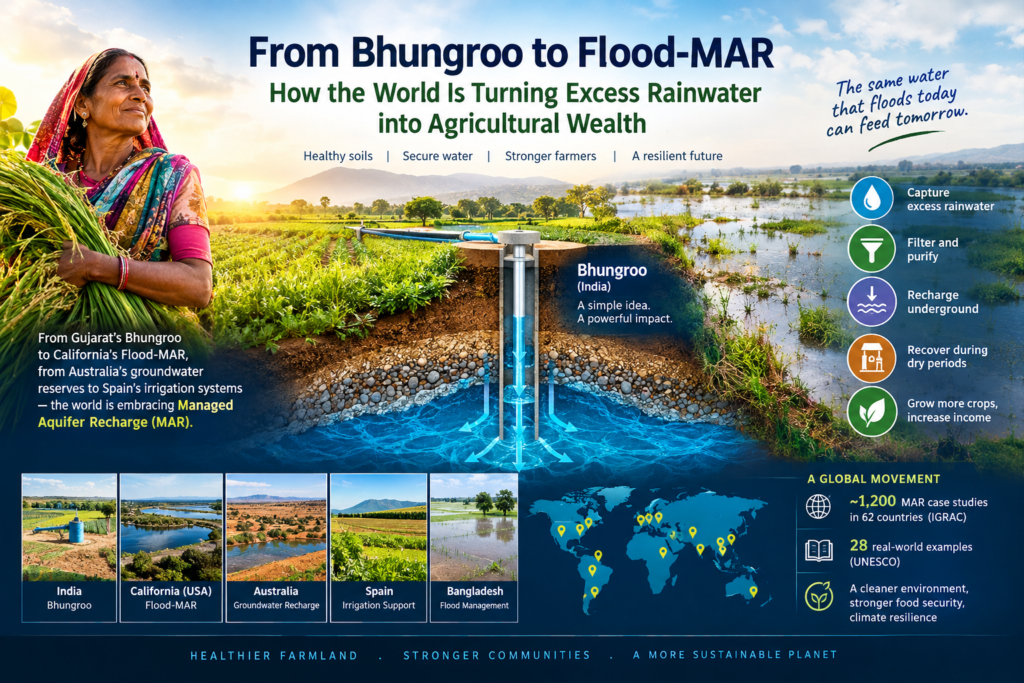
From Gujarat’s ingenious Bhungroo system to California’s Flood-MAR and Australia’s underground water reserves, a global movement is changing the way farmland stores water
What if the rain that destroys a crop today could become the water that saves the same farm tomorrow?
For millions of farmers around the world, water creates a strange paradox.
During the rainy season, too much water can flood fields, destroy crops, wash away nutrients and increase soil salinity. A few months later, the same farmland may face severe water scarcity.
The traditional response has often been to build more surface reservoirs, dig deeper borewells or depend on increasingly unpredictable rainfall.
But a different idea is gaining attention across the world:
Store water underground when it is abundant and recover it when agriculture needs it.
In Gujarat, India, this idea has taken a remarkable form called Bhungroo. In other parts of the world, similar principles are being implemented under names such as Managed Aquifer Recharge (MAR), Agricultural MAR and Flood-MAR.
Together, these approaches point toward a new possibility for farmland:
The land beneath our feet can become part of our water-storage infrastructure.
The Gujarat Story: When Flooding and Drought Exist on the Same Farm
Around the turn of the century, farmers in parts of Gujarat were struggling with two apparently opposite problems.
Heavy and erratic rainfall could leave agricultural fields waterlogged. At the same time, the dry season brought severe water shortages.
In some areas, salinity further reduced agricultural productivity.
It was in this environment that social entrepreneur and innovator Biplab Ketan Paul, along with the team behind Naireeta Services, developed and promoted the Bhungroo water-management system.
The fundamental idea was remarkably simple:
Instead of allowing excess rainwater to remain on the surface and damage farmland, capture it, filter it and store it underground for later agricultural use.
The United Nations Framework Convention on Climate Change describes Bhungroo as a system that injects and stores excess rainfall underground and later lifts the stored water during dry periods. According to UNFCCC, some systems can store up to 40 million litres of rainwater and supply water for as long as seven months.
The technology has also been recognised internationally, including through the 2017 Buckminster Fuller Challenge.
What Exactly Is Bhungroo?
The Gujarati word Bhungroo refers to a hollow pipe.
The system essentially uses a specially designed filtration and underground injection arrangement to move excess surface water into suitable underground formations.
A simplified sequence is:
Heavy rainfall → water collection → filtration → underground injection → subsurface storage → recovery during dry periods → irrigation
Instead of trying to keep enormous quantities of water in an open reservoir, the system uses the subsurface as a storage environment.
The reported capacity can vary considerably depending on geological conditions and design. Some documented Bhungroo systems have capacities ranging from hundreds of thousands to tens of millions of litres.
One important benefit is that waterlogging can be reduced during the wet season while stored water becomes available during the dry season.
That means the same infrastructure can potentially address both excess water and water scarcity.
From Waterlogged Land to Productive Farmland
The agricultural impact is perhaps the most important part of the story.
When water remains standing in agricultural fields for prolonged periods:
- crops can suffocate or rot;
- soil structure can deteriorate;
- salinity can increase;
- nutrients can be affected;
- farmers may lose an entire season.
Once excess water is removed from the root zone and managed properly, farmers can potentially cultivate during periods that were previously difficult.
The stored water can then support irrigation during the dry season.
Studies and field reports associated with Bhungroo have documented increased cropping opportunities, improved farm productivity and stronger economic outcomes for participating farmers. UNFCCC reports that the initiative has supported more than 18,000 marginal farmers and their dependent families in India.
Other documentation describes the technology as enabling farmers to move from a single seasonal crop toward multiple cropping opportunities.
The Human Story Behind the Technology
Bhungroo is not only a water story.
It is also a women’s empowerment story.
Naireeta Services developed a model in which women played central roles in selecting beneficiaries, managing systems and participating in agricultural decision-making.
UNFCCC describes Bhungroo as a women-driven process and reports that the technology has helped women gain greater economic participation and influence in their communities.
Earlier reporting on the initiative documented thousands of Bhungroo installations and the involvement of close to 20,000 women.
This is particularly significant because water scarcity disproportionately affects rural women in many parts of the developing world.
When water becomes available closer to the farm and household, the economic consequences can extend far beyond irrigation.
But Bhungroo Is Only One Part of a Much Bigger Global Story
This is where the story becomes much more interesting.
Bhungroo should not be viewed as an isolated Indian invention representing the world’s only approach to underground water storage.
Across continents, scientists, governments, farmers and water agencies are implementing a broader concept called:
Managed Aquifer Recharge — MAR
MAR means deliberately putting suitable water into an aquifer for storage, recovery, environmental benefit or groundwater restoration.
The International Groundwater Resources Assessment Centre (IGRAC) and researchers have compiled a global inventory containing approximately 1,200 MAR case studies across 62 countries.
UNESCO has also documented 28 real-world MAR examples from around the world, ranging from local community projects to large regional schemes. These projects demonstrate applications including increasing groundwater storage, improving water security, protecting water quality and supporting resilience against drought and emergencies.
In other words:
The world is increasingly looking underground for water security.
California: Turning Floodwater into a Drought Reserve
One of the strongest modern examples comes from California.
California has experienced both severe drought and increasingly intense rainfall events.
Its response includes Flood-MAR — Flood Managed Aquifer Recharge.
The principle is strikingly similar to the underlying philosophy of Bhungroo.
During periods of high rainfall, snowmelt or flooding, water that would otherwise create flood risk can be redirected toward suitable agricultural lands and recharge areas.
The water then infiltrates into the ground and replenishes aquifers.
California’s Department of Water Resources describes Flood-MAR as a strategy that can simultaneously provide:
- flood-risk reduction;
- groundwater replenishment;
- drought preparedness;
- water-supply benefits;
- ecosystem benefits;
- greater climate resilience.
In some projects, agricultural land itself becomes part of the recharge infrastructure.
This is a major change in thinking.
The farm is no longer viewed only as a place that consumes water.
The farm can also become a place where water is temporarily stored underground.
California’s Department of Water Resources has specifically supported projects that divert high flows onto agricultural lands to recharge depleted aquifers.
Why California’s Model Matters to Farmers
Imagine a farm during an exceptionally wet winter.
Instead of considering floodwater only as a threat, a properly assessed farm could potentially become part of a wider groundwater-recharge network.
During wet periods:
Floodwater → agricultural land → soil infiltration → aquifer
During dry periods:
Aquifer → groundwater well → irrigation → crops
The same landscape therefore participates in two different functions:
flood management and water storage.
California’s experience shows why this concept is becoming increasingly important as climate patterns become more unpredictable.
Australia: Building a Water Reserve Beneath the Ground
Australia faces another familiar agricultural challenge: drought.
Its water authorities are therefore investigating Managed Aquifer Recharge as a way to improve water security.
The Australian Government’s National Water Grid program has supported studies examining MAR opportunities for agriculture.
In New South Wales, a statewide assessment has mapped potential locations where MAR could improve water security and drought resilience.
The Australian government describes one major advantage clearly:
Water stored underground does not evaporate like water stored in a surface dam.
The NSW assessment specifically identifies agricultural benefits, climate-change resilience, drought resilience and water security as potential outcomes.
For countries facing high evaporation, underground storage can therefore offer an important strategic advantage.
Spain: Farmers Turn to MAR to Protect Irrigation
Spain provides another powerful example.
The Los Arenales aquifer supports an agricultural region where groundwater has historically been heavily used for irrigation.
Over time, groundwater levels declined significantly.
Farmers and water managers responded by developing Managed Aquifer Recharge systems.
Research published in Groundwater for Sustainable Development found that MAR supplied approximately 25% of local agricultural groundwater demand and was associated with rising groundwater levels of around 0.4 metres per year in the Los Arenales groundwater body.
The significance is enormous.
MAR was not merely being used to protect groundwater as an environmental resource.
It was being used to help maintain agricultural irrigation.
That creates an important lesson for farmland owners:
Water management can be an agricultural productivity strategy.
India: From Traditional Water Harvesting to Scientific Groundwater Recharge
India has a long history of traditional water-management systems.
Stepwells, tanks, ponds, check dams, farm ponds, percolation structures and watershed systems have all played roles in capturing rainfall.
Modern groundwater-recharge programmes are now combining traditional knowledge with hydrogeological science.
Bhungroo represents one distinctive example.
Other Indian approaches include:
- recharge wells;
- check dams;
- percolation tanks;
- recharge shafts;
- infiltration structures;
- watershed development;
- aquifer-recharge projects.
The important change is moving from simply harvesting rainwater to understanding where that water should go, how much the aquifer can accept, how groundwater moves underground and how the resource can subsequently be monitored and used.
The Middle East and Africa: Underground Storage in Water-Stressed Regions
The logic becomes even more compelling in arid and semi-arid regions.
Countries across the Middle East and Africa face intense pressure on freshwater resources.
In such environments, water storage has traditionally focused heavily on dams and reservoirs.
But underground storage offers another possibility.
Managed recharge systems can potentially capture seasonal flows and replenish groundwater in suitable geological formations.
UNESCO’s international MAR case studies document examples across different climatic and geographic settings, demonstrating that managed aquifer recharge is not limited to one type of landscape or one continent.
The exact technology varies from place to place.
Some projects use infiltration basins.
Others use recharge wells.
Some use river or floodwater.
Others use stormwater or treated water.
But the fundamental principle remains:
Put suitable water underground when it is available, and preserve it for when it is needed.
Bangladesh: When the Problem Is Too Much Water
Bangladesh demonstrates why this technology is particularly interesting.
Unlike drought-dominated regions, parts of Bangladesh face serious flooding and waterlogging.
Bhungroo itself has been introduced in contexts outside India, including Bangladesh, precisely because the technology can address the opposite side of the water crisis: too much water at the wrong time.
This is an important lesson for climate adaptation.
A technology does not necessarily have to be designed exclusively for drought or exclusively for floods.
The most valuable systems may be those capable of managing both extremes.
The Global Pattern Is Becoming Clear
Across different countries, the terminology may change.
In Gujarat:
Bhungroo
In California:
Flood-MAR
In Australia:
Managed Aquifer Recharge
In Europe:
MAR for groundwater and irrigation
In other regions:
Artificial groundwater recharge, aquifer storage and recovery, infiltration systems or groundwater replenishment
The engineering may differ.
The geology may differ.
The rainfall may differ.
But the fundamental strategy is remarkably similar.
Capture → Recharge → Store → Recover → Irrigate
That is becoming one of the important ideas in modern water management.
Why Underground Water Storage Can Be Powerful
Surface reservoirs have obvious advantages, but they also face limitations.
Stored surface water can experience:
- evaporation;
- land requirements;
- sedimentation;
- ecological impacts;
- infrastructure costs.
Underground storage can offer different advantages where geological conditions are suitable.
Water can potentially be stored below the surface with relatively little land occupation, while avoiding direct exposure to evaporation.
Australia specifically identifies reduced evaporation as one of the potential advantages of underground storage.
However, underground recharge is not automatically suitable everywhere.
Successful MAR requires careful assessment of:
- aquifer characteristics;
- soil and geological layers;
- groundwater quality;
- recharge capacity;
- existing groundwater levels;
- contamination risks;
- water chemistry;
- extraction rights;
- environmental regulations;
- monitoring requirements.
California’s guidance also emphasises monitoring because recharge can, in some circumstances, mobilise contaminants and affect groundwater quality.
So the lesson is not:
“Every farm should simply drill a recharge pipe.”
The lesson is:
Every farm should understand its water system before deciding how to manage it.
The Future Farmland Checklist
For anyone purchasing or developing agricultural land, the traditional questions have usually been:
How many acres?
What is the soil?
What is the road access?
What crops can be grown?
In a climate-stressed future, another question needs to become equally important:
What is the farm’s water-security strategy?
Before acquiring agricultural land, investors and farmers should examine:
Rainfall
How much rain does the region receive, and how variable is it?
Drainage
Where does rainwater go during intense rainfall?
Waterlogging
Does the land remain submerged after heavy rain?
Soil
Can the soil absorb and retain water effectively?
Groundwater
What is the depth and quality of groundwater?
Aquifer
What type of underground formation exists beneath the land?
Irrigation
What reliable sources of irrigation are available?
Recharge
Can rainwater be safely recharged into the local aquifer?
Storage
Can the farm store water through ponds, tanks or underground systems?
Crops
Which crops match the area’s water availability?
Climate resilience
Can the farm remain productive through prolonged dry periods?
These questions can fundamentally change how agricultural land is evaluated.
Farmland Is More Than an Acreage Number
Two farms may each contain 10 acres.
But they may have completely different productive potential.
Farm A may have:
- poor drainage;
- uncertain groundwater;
- severe waterlogging;
- no irrigation reserve;
- declining soil quality.
Farm B may have:
- good natural drainage;
- reliable rainfall;
- groundwater access;
- rainwater harvesting;
- scientifically managed irrigation;
- groundwater-recharge potential;
- diversified crops.
Both farms have 10 acres.
But they are not necessarily equal agricultural assets.
This is why the future of farmland valuation may increasingly involve water security, climate resilience and productive infrastructure, rather than acreage alone.
From Farmland to Water-Resilient Farmland
The global examples suggest a broader shift.
Traditional agricultural thinking often follows this cycle:
Rain → runoff → flood → water shortage → borewell → groundwater depletion
The emerging model attempts to create a different cycle:
Rain → capture → recharge → underground storage → controlled recovery → irrigation → crops → income
The second model is more circular.
Instead of treating rainfall as something that must simply be drained away, it treats rainfall as a resource that can potentially be stored and reused.
Can This Create Three-Crop Farmland?
In suitable locations, better water management can increase the number of productive days available to farmers.
Bhungroo examples from Gujarat have demonstrated how controlling waterlogging while retaining water for the dry season can support multiple cropping opportunities.
But the concept should not be interpreted as a guarantee that every farm can produce three crops.
Crop cycles depend on:
- climate;
- soil;
- irrigation;
- crop selection;
- temperature;
- sunlight;
- market conditions;
- farm management.
Water security is one important foundation—not the only one.
The Bigger Opportunity: Climate-Resilient Agriculture
Climate change is making water management more complicated.
Some regions are experiencing:
longer dry periods + more intense rainfall events
That means the old assumption of relatively predictable rainfall is becoming less reliable.
The future challenge may therefore not simply be:
“How do we get more water?”
It may be:
“How do we capture the water when we have too much of it, store it safely, and use it when we have too little?”
That is precisely where technologies such as Bhungroo, MAR and Flood-MAR become relevant.
From Gujarat to the World
The story that began with farmers struggling against drought, waterlogging and salinity in Gujarat now fits into a much larger global conversation.
A global inventory has documented around 1,200 managed aquifer recharge cases in 62 countries.
UNESCO’s documented examples show that MAR is being used to improve water security, increase groundwater storage, support food production, protect ecosystems and strengthen resilience to drought and emergencies.
California is experimenting with using agricultural landscapes to recharge aquifers during floods.
Australia is evaluating underground storage as a drought reserve.
Spain has demonstrated how MAR can support irrigation.
India continues to develop groundwater-recharge and rainwater-harvesting systems.
And Bhungroo offers a particularly compelling example of how a relatively small-scale technology can combine water management, agricultural productivity, climate resilience and women’s empowerment.
The New Definition of Productive Farmland
Perhaps the most important lesson is this:
Productive farmland is not simply land that can grow a crop today.
It is land that has the potential to remain productive tomorrow.
That means thinking about:
Soil + Water + Drainage + Irrigation + Recharge + Crops + Climate + Management
When these elements work together, farmland becomes more resilient.
And resilience may become one of the most valuable agricultural assets of the future.
The Golden Lesson from Bhungroo
The genius of the Bhungroo idea is not simply the pipe.
It is the change in mindset.
Instead of seeing floodwater as a problem and drought as a separate problem, it connects them.
The water that is a problem today can become the solution tomorrow.
That principle is now appearing in different forms around the world.
From Gujarat’s Bhungroo to California’s Flood-MAR, from Australia’s groundwater-recharge planning to Spain’s irrigation-supporting MAR systems, the message is becoming increasingly clear:
The future of farming may depend as much on how intelligently we store water as on how much rain we receive.
And beneath millions of acres of farmland lies a potentially enormous, largely invisible asset:
The underground reservoir.
When scientifically assessed, responsibly managed and protected from over-extraction, that hidden water-storage capacity can become an important component of food security, farm resilience and long-term agricultural wealth.
The future farm may not simply harvest crops.
It may harvest rain, store water underground, protect the soil, grow food and build resilience—all on the same piece of land.
Sources & Further Reading
- UNFCCC — Bhungroo, India: Documentation of the Bhungroo water-management system and its climate-resilience and agricultural applications.
- NITI Aayog / Government of India — Bhungroo Ground Water Injection Well: Documentation of the Gujarat intervention and underground rainwater storage approach.
- Buckminster Fuller Institute — Bhungroo: Recognition of Bhungroo as the 2017 Buckminster Fuller Challenge winner.
- IGRAC — Global MAR Inventory: Approximately 1,200 MAR case studies across 62 countries.
- UNESCO — Managing Aquifer Recharge: 28 documented real-world MAR examples from around the world.
- California Department of Water Resources — Groundwater Recharge / Flood-MAR: California’s approach to capturing high flows and recharging aquifers.
- Australian Government — Managed Aquifer Recharge Opportunities for Agriculture: Research into MAR for agricultural and drought resilience in Australia.
- Groundwater for Sustainable Development — Los Arenales, Spain: Research documenting MAR’s contribution to agricultural groundwater demand and groundwater recovery.
Original Bhungroo story source: Eenadu Telugu News Paper, as provided for this article.