
External Affairs Minister S. Jaishankar’s recent warning about a possible major global food crisis in the coming months has brought a critical issue into focus: how prepared is India if international food, fertiliser, energy and shipping systems come under simultaneous pressure?
Speaking at an Asia Society event in New York on September 28, 2026, Jaishankar linked the risk to disruptions caused by the Ukraine and Iran-Gulf conflicts, fertiliser shortages, difficulties affecting major grain exporters and potential climate disruption from El Niño.
This warning should not be interpreted as a prediction that India will necessarily face a food shortage. India currently has substantial foodgrain reserves and has already implemented several contingency mechanisms. But it highlights the importance of building resilience before a crisis reaches the farm, market and household level.
Why India needs a contingency plan
A modern food crisis does not necessarily begin with empty warehouses.
It can start with:
War → disrupted shipping → higher energy prices → expensive fertilisers → lower farm profitability → reduced fertiliser application → lower yields → higher food prices → pressure on household budgets.
Climate variability can amplify the problem.
A combination of poor rainfall, high temperatures, water stress and fertiliser shortages could create a much larger agricultural shock than any one factor alone.
The risk is particularly important for India because agriculture depends heavily on monsoon conditions, while some agricultural inputs and edible oils remain connected to international markets.
India’s First Line of Defence: Foodgrain Reserves
India already has an important buffer against food shortages.
As of 28 May 2026, government-held stocks included approximately:
- 513 lakh metric tonnes of wheat
- 397 lakh metric tonnes of rice
- Around 298 lakh metric tonnes of procured paddy awaiting milling
The Government stated that overall foodgrain stocks were substantially above prescribed buffer norms at that point.
India also maintains strategic reserves specifically designed to provide additional protection during situations such as abnormal production shortfalls or natural calamities.
This means India’s contingency strategy should not be limited to producing more food. It should cover the entire food system.
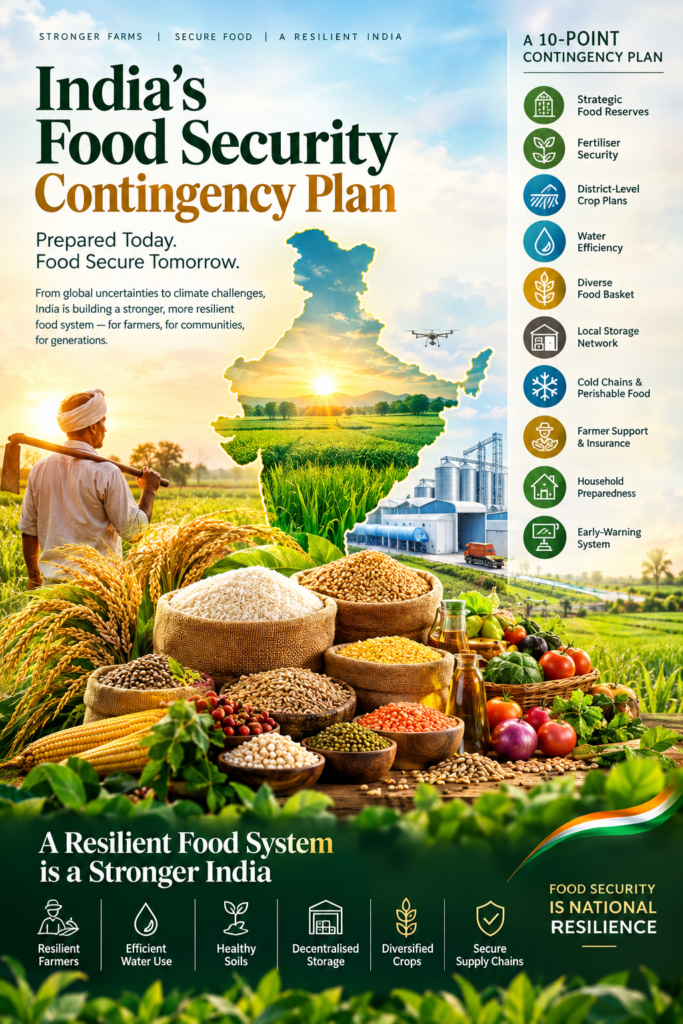
A 10-Point Food Security Contingency Plan for India
1. Build a Strategic Food Reserve
India should continuously maintain adequate reserves of:
- Rice
- Wheat
- Pulses
- Millets
- Maize
- Sugar
- Edible oils
Rice and wheat already form the backbone of India’s public food-security system.
However, a future food shock could affect protein, edible oils and animal-feed markets as much as cereals.
Therefore, strategic planning should increasingly consider a diversified food basket rather than cereals alone.
2. Strengthen Domestic Fertiliser Security
One of the biggest concerns in the current global scenario is fertiliser availability.
India should maintain contingency inventories and diversified supply arrangements for:
- Urea
- DAP
- MOP
- NPK fertilisers
- Micronutrients
- Biofertilisers
The objective should be simple:
No major disruption in fertiliser availability during the critical sowing window.
India should simultaneously encourage efficient fertiliser application through soil testing, precision agriculture, integrated nutrient management and organic sources.
3. Prepare District-Level Crop Contingency Plans
A national agricultural strategy cannot be identical for every district.
A drought-prone district requires a different response from a flood-prone district.
Contingency plans should therefore specify:
If rainfall is delayed →
Short-duration crops.
If rainfall is deficient →
Millets, pulses and other lower-water crops.
If rainfall stops after sowing →
Moisture conservation and protective irrigation.
If excessive rainfall occurs →
Drainage, flood-tolerant varieties and rapid crop replacement.
India has already moved in this direction. In June 2026, the Agriculture Ministry reported contingency planning for vulnerable districts, including a focus on short-duration and lower-water crops amid El Niño concerns.
4. Make Every Drop of Water More Productive
Food security is ultimately linked to water security.
India’s contingency strategy should accelerate:
- Drip irrigation
- Sprinkler irrigation
- Farm ponds
- Check dams
- Rainwater harvesting
- Watershed development
- Mulching
- Soil-moisture conservation
- Wastewater reuse where safely appropriate
- Solar-powered irrigation
The objective should move from simply “more irrigation” to:
More crop output from every unit of water.
This becomes particularly important during hot and dry conditions.
5. Diversify India’s Food Basket
India’s food-security system has historically depended heavily on rice and wheat.
Climate and geopolitical uncertainty make diversification increasingly valuable.
Greater production and consumption of:
Millets + pulses + maize + oilseeds + traditional crops
can reduce pressure on water, fertiliser and imported commodities.
Pulses deserve particular attention because India has been pursuing greater domestic self-reliance in crops such as tur, urad and moong.
6. Create a Stronger Local Food-Storage Network
Food security is not only about how much grain exists.
It is also about where the grain is stored.
A decentralised storage network can reduce:
- Transportation bottlenecks
- Post-harvest losses
- Regional supply disruptions
- Dependence on long-distance movement during emergencies
India’s Decentralised Grain Storage Plan is already expanding through PACS.
As of July 2026, construction had been completed in 313 PACS, creating more than 1.80 lakh metric tonnes of storage capacity.
The next step should be integrating local storage with:
PACS + farmers + FPOs + mandis + processors + local administrations.
7. Strengthen Cold Chains and Perishable-Food Security
A food crisis isn’t only about rice and wheat.
India also needs contingency plans for:
- Vegetables
- Fruits
- Milk
- Eggs
- Meat
- Fish
- Potatoes
- Onions
- Tomatoes
Cold storage, pack houses, refrigerated transportation and local processing can prevent temporary supply disruptions from becoming major price shocks.
Food processing can also convert seasonal agricultural surpluses into longer-lasting stocks.
8. Protect Farmers From the Economic Shock
A food crisis can become worse if farmers cannot afford to plant the next crop.
Therefore, contingency planning should include:
- Timely credit
- Crop insurance
- Emergency input support
- Seed reserves
- Fertiliser availability
- Weather advisories
- Market information
- Rapid compensation following severe crop losses
The Government reported a national seed reserve of approximately 1.75 lakh quintals in its 2026 Kharif preparedness measures, along with expanded crop-insurance efforts.
The principle is:
Protect the farmer today to protect the food supply tomorrow.
9. Build Household-Level Food Resilience
Food security should not depend entirely on government warehouses.
Households can also adopt sensible preparedness measures without panic buying.
A practical household contingency reserve could include regularly consumed, shelf-stable foods such as:
- Rice
- Wheat/atta
- Pulses
- Millets
- Cooking oil
- Salt
- Sugar
- Basic spices
- Packaged drinking-water arrangements where necessary
The goal is normal household inventory management, not hoarding.
Panic buying can actually worsen temporary shortages and increase prices.
10. Develop an India Food Security Early-Warning System
India needs an integrated dashboard tracking:
🌾 Agriculture
Crop acreage, sowing, yields and crop health.
🌧️ Weather
Monsoon, drought, floods and extreme temperatures.
💧 Water
Reservoir levels, groundwater and irrigation availability.
🧪 Fertilisers
Domestic production, imports, inventories and prices.
🚢 Logistics
Ports, shipping routes and freight costs.
🌍 Global markets
Wheat, rice, maize, edible oil and fertiliser prices.
🏪 Domestic markets
Wholesale and retail food prices.
Such a system would allow authorities to intervene before shortages become visible to consumers.
The Three-Level Contingency Model
India’s preparedness can be organised into three levels.
🟢 LEVEL 1 — Normal Conditions
Maintain:
- Adequate buffer stocks
- Seed reserves
- Fertiliser inventories
- Water conservation
- Crop diversification
- Decentralised storage
🟡 LEVEL 2 — Supply Disruption
If international prices or supplies become severely disrupted:
- Release strategic stocks where necessary
- Diversify imports
- Support domestic production
- Increase market monitoring
- Protect vulnerable consumers
- Prioritise fertiliser distribution
- Accelerate alternative cropping strategies
🔴 LEVEL 3 — Major Food Shock
If multiple crises occur simultaneously:
War + fertiliser shortage + poor monsoon + shipping disruption
then India would need coordinated action involving:
Central Government + State Governments + FCI + agriculture departments + cooperatives + FPOs + private logistics + retailers + local administrations.
Food distribution should prioritise vulnerable populations and essential food commodities.
What Farmers Can Do Now
The most important response does not necessarily require waiting for a crisis.
Farmers can strengthen resilience through:
1. Water conservation
Store rainwater and improve irrigation efficiency.
2. Crop diversification
Avoid excessive dependence on a single crop wherever agronomically suitable.
3. Soil health
Use soil testing and balanced nutrient management.
4. Organic matter
Compost, farmyard manure and other suitable soil-building practices can improve soil structure and water retention.
5. Mulching
Reduce evaporation and protect soil moisture.
6. Climate-resilient varieties
Select varieties appropriate for local weather and water conditions.
7. Local storage
Reduce post-harvest losses through proper storage.
8. Weather-based decisions
Use reliable weather forecasts and agricultural advisories before sowing and irrigation decisions.
India Is Not Starting From Zero
The important point is that India already possesses several components of a food-security contingency system.
The country has:
✔ Strategic foodgrain reserves
✔ Public distribution infrastructure
✔ Government procurement
✔ Crop insurance
✔ Seed reserves
✔ District-level contingency planning
✔ Fertiliser distribution systems
✔ Decentralised storage initiatives
✔ Agricultural research institutions
✔ Farmer credit mechanisms
India’s 2025–26 third advance estimate placed foodgrain production at approximately 376.56 million tonnes, a record level according to the Agriculture Ministry.
Therefore, the current challenge is less about reacting to a crisis after it arrives and more about making the existing system resilient to simultaneous global shocks.
The Bigger Lesson: Food Security Is National Resilience
The warning highlighted by Jaishankar connects four systems that are often discussed separately:
ENERGY → FERTILISER → AGRICULTURE → FOOD
A disruption in one can affect the others.
For India, the long-term answer is therefore not simply to accumulate more grain.
It is to build a resilient agricultural ecosystem based on:
More domestic capacity + diversified supply chains + efficient water use + healthy soils + decentralised storage + climate-resilient agriculture + strategic reserves.
The objective should be to ensure that even when the world faces geopolitical conflict, disrupted shipping, fertiliser shortages or extreme climate conditions, Indian farms can continue producing and Indian households can continue accessing affordable food.
Conclusion
The recent warning about a possible global food crisis should be viewed as a risk signal, not an inevitable outcome. Current Indian government data indicate substantial foodgrain stocks and multiple preparedness mechanisms, while the global situation described by Jaishankar highlights why those safeguards need continual strengthening.
India’s strongest contingency plan is ultimately a combination of food reserves, resilient farmers, efficient water management, diversified crops, secure inputs, decentralised storage and reliable supply chains.
Food security is not created when a crisis begins.
It is built years before the crisis arrives.