
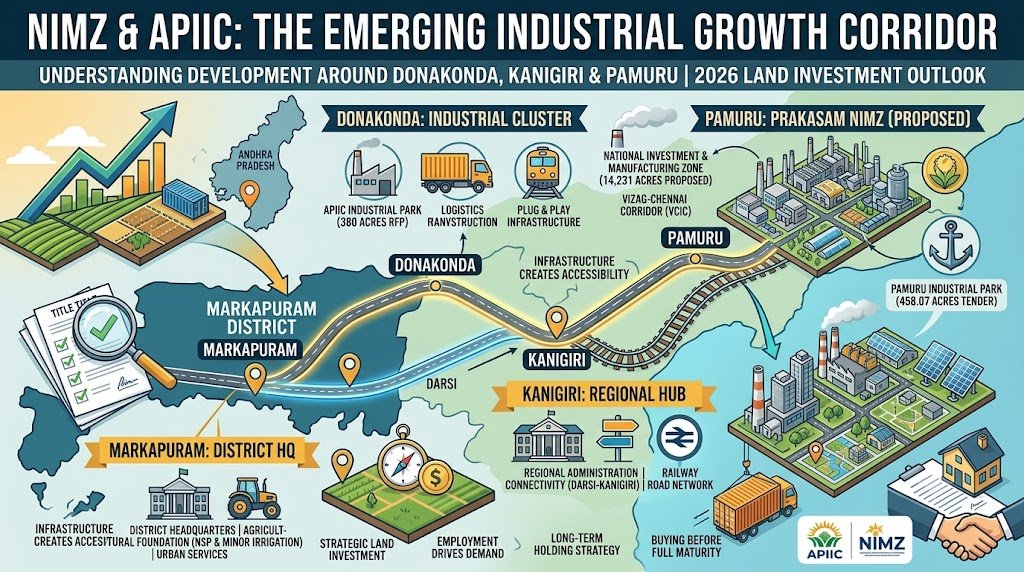
Why the Markapuram District Region Deserves Attention from Land Investors in 2026
When evaluating land for long-term investment, one of the most important questions is not simply “What is the land price today?”
A more strategic question is:
“What economic infrastructure could surround this land over the next 5–15 years?”
This is where the Donakonda–Kanigiri–Pamuru region of Andhra Pradesh deserves closer attention.
The newly formed Markapuram District includes the Kanigiri and Markapuram revenue divisions, with Kanigiri and Pamuru among its mandals. The district administration describes the creation of the district as an effort to address the development needs of the western parts of the former Prakasam district and promote more equitable regional development.
At the same time, official APIIC documents identify significant industrial-development proposals around Donakonda and Pamuru, including a proposed Prakasam National Investment and Manufacturing Zone (NIMZ) and a proposed 380-acre industrial park at Donakonda.
For land investors, this creates an important theme:
Land that is agricultural or predominantly rural today can sit within a region undergoing gradual industrial, infrastructure and economic transformation.
That does not mean every parcel will appreciate or that every announced project will be completed exactly as proposed. But it does mean that the region’s development pipeline deserves serious attention before making a land-buying decision.
Donakonda–Kanigiri–Pamuru: The Bigger Development Picture
The emerging regional story is not based on one project.
It is a combination of:
NIMZ + Industrial Parks + Rail Connectivity + Road Connectivity + Manufacturing + Logistics + Agriculture + Urbanisation
These factors can create a broader economic ecosystem around the region.
A simplified development map can be viewed as:
MARKAPURAM
Regional administration, agriculture, services and surrounding rural markets
↓
KANIGIRI
Regional town + road connectivity + surrounding agricultural markets
↓
PAMURU
Proposed NIMZ + industrial-development potential + agricultural land
↓
DONAKONDA
Industrial cluster + proposed large industrial park + logistics/connectivity potential
The significance of this network is that investors do not necessarily need to look only at land immediately inside an industrial park.
They can also examine land in the surrounding economic catchment, subject to title, access, zoning, land-use regulations and actual project progress.
1. What Is NIMZ and Why Does It Matter for Land Investors?
NIMZ stands for National Investment and Manufacturing Zone.
The concept comes from India’s National Manufacturing Policy and is intended to create integrated industrial townships with modern infrastructure, planned land use, social infrastructure, skill development and manufacturing facilities.
APIIC states that Andhra Pradesh proposed NIMZs in Chittoor and Prakasam districts and that in-principle approval had been accorded by the Government of India, while the detailed reports and final application were submitted for further approval.
For the Prakasam NIMZ, APIIC identifies:
- Location: Pamuru and Pedacherlapalli mandals
- Industrial corridor: Vizag–Chennai Industrial Corridor (VCIC)
- Proposed extent: approximately 14,231 acres
- Estimated external and internal infrastructure cost: approximately ₹10,859 crore
- APIIC’s page also lists projected economic benefits including investment, employment and exports.
These figures should be understood as officially stated proposal-level figures, not as completed development or guaranteed economic outcomes.
Nevertheless, the scale of the proposal is significant enough to make Pamuru and its surrounding region important locations to monitor for long-term land and infrastructure development.
2. Why Pamuru Could Become an Important Industrial Location
Pamuru is particularly interesting because the proposed Prakasam NIMZ is located within Pamuru and Pedacherlapalli mandals.
This places the area within a much larger industrial-development framework rather than making it simply a rural agricultural market.
Industrial zones can generate demand beyond the industrial boundary itself.
A functioning industrial ecosystem can require:
- Manufacturing facilities
- Warehouses
- Logistics
- Transport services
- Worker accommodation
- Housing
- Retail
- Restaurants
- Healthcare
- Education
- Financial services
- Repair and maintenance services
- Agricultural supply chains
Therefore, when studying land for sale near Pamuru, investors should examine not only today’s land price but also:
What infrastructure exists today?
What projects are officially proposed?
How accessible is the land?
How close is it to future employment and logistics centres?
What is the legal land-use status?
These questions can be much more valuable than simply comparing today’s price per acre.
3. Donakonda: A Major Industrial Development Theme
Donakonda is one of the most important industrial-development locations in this regional story.
APIIC’s 2025 Expression of Interest describes the Donakonda Industrial Cluster as strategically significant for Andhra Pradesh’s industrialisation and states that the proposed industrial node is aligned with the broader National Industrial Corridor Development Programme (NICDP) framework.
APIIC’s document highlights the potential for stronger inter-regional connectivity through:
- Roads
- Railways
- Logistics networks
- Connections to ports
The document also presents Donakonda as an integrated industrial ecosystem with proposed industrial, residential and commercial uses along with green spaces.
For land investors, this is important because industrial development is rarely isolated.
A major industrial node can potentially influence surrounding land demand through:
Jobs → Population → Housing → Services → Transport → Commerce → Land Demand
That is the broader development cycle investors should watch.
4. A 380-Acre Industrial Park Is Already in the APIIC Development Pipeline
One of the strongest reasons to examine Donakonda today is that the industrial-development discussion is not limited to a conceptual vision.
APIIC issued an RFP for development, operation and maintenance of a 380-acre industrial park at the Donakonda Industrial Cluster in Prakasam District through a development agreement/PPP structure.
APIIC’s documentation states that the proposed project is intended to cater to industrial entrepreneurs in the region.
The RFP calls for a developer capable of:
- Designing the project
- Financing it
- Constructing the industrial park
- Operating and maintaining it
- Marketing the park
- Supporting capacity utilisation
APIIC also states that the project can avail incentives under the Andhra Pradesh Policy for Establishment of Private Industrial Parks with “Plug & Play” Industrial Infrastructure (4.0), 2024–29.
The APIIC tender records also show that the 380-acre Donakonda industrial-park RFP has subsequently appeared as a second-call tender, demonstrating that the proposal has continued through the procurement process rather than remaining only a high-level concept.
This distinction matters.
There is a difference between:
“A government may develop an industrial park someday”
and
“A government industrial infrastructure agency has issued a formal RFP for a defined industrial park.”
Investors should understand that distinction when researching land.
5. Pamuru Also Has an Industrial Park Development Track
The industrial-development story around Pamuru is broader than the NIMZ proposal.
APIIC’s tender listings also include a proposed 458.07-acre industrial park at Pamuru Industrial Cluster, Prakasam District, through a development-agreement process.
This adds another layer to the regional development map:
Prakasam NIMZ
14,231 acres proposed
Pamuru Industrial Cluster
458.07 acres listed in APIIC’s industrial-park tender pipeline
Donakonda Industrial Park
380 acres proposed through APIIC’s PPP/development process
These are separate projects and should not be added together as if they constitute one contiguous industrial zone.
But together they demonstrate why Pamuru–Donakonda is becoming an important area for industrial-development research.
6. APIIC’s Role Makes the Story More Significant
APIIC — Andhra Pradesh Industrial Infrastructure Corporation Limited — is a Government of Andhra Pradesh undertaking responsible for industrial infrastructure development.
APIIC states that it has developed more than 300 industrial parks covering approximately 1,21,655 acres, including allotted area, and also develops sector-focused parks and other industrial infrastructure.
This matters when analysing a proposed industrial location.
Industrial infrastructure requires more than factories.
It can involve:
- Roads
- Internal infrastructure
- Power
- Water
- Industrial plots
- Warehousing
- Common facilities
- Commercial services
- Logistics
- Environmental infrastructure
APIIC’s industrial-park information states that its industrial areas are developed with features such as approved layouts, internal roads, water supply and power supply.
Therefore, an APIIC-backed industrial-development pipeline can be an important location signal for land researchers.
It is not a guarantee of nearby land appreciation, but it is a meaningful factor to investigate.
7. Andhra Pradesh Is Building a Broader Industrial-Park Ecosystem
The Donakonda and Pamuru proposals should also be viewed within Andhra Pradesh’s broader industrial-policy framework.
APIIC currently highlights policies covering:
- New Industrial Development
- Private Industrial Parks
- MSME development
- Food processing
- Electronics manufacturing
- Sustainable electric mobility
- IT and GCCs
- Data centres
- Semiconductors
- Clean energy
- Tourism
- Space technology
- Other emerging sectors
APIIC’s Plug & Play Industrial Infrastructure Policy also describes an initiative for 175 MSME industrial parks, one in each Assembly constituency, alongside private and PPP-based industrial-park models.
The objective is broader than developing individual factories.
The policy framework is designed to encourage:
Industrial land + infrastructure + private investment + employment + regional development
This broader policy environment is relevant when analysing the long-term land market.
8. Railway Connectivity Adds Another Potential Growth Driver
Industrial growth needs transportation.
That makes railway connectivity particularly important.
South Central Railway states that the Nadikudi–Srikalahasti new railway line project was sanctioned for approximately 309 km and is being executed in phases.
The official railway release identifies:
- Darsi–Kanigiri: 52 km
- Kanigiri–Pamuru: 35 km
- Pamuru–Obulayyapalle–Venkatapuram: 90 km
among the project phases.
South Central Railway says the project is intended to expand rail connectivity into interior areas of Guntur, Prakasam and Nellore and also provide an alternative route to the existing coastal railway line.
The railway authority has also stated that the project can facilitate freight transport through the mineral-rich belt while providing scope for passenger traffic.
For land investors, this creates another important question:
Could future rail connectivity increase the economic accessibility of selected locations?
Potentially, yes — but the answer must be evaluated parcel by parcel based on actual alignments, stations, access roads and project implementation.
9. Markapuram District Creates a Larger Regional Framework
The creation of Markapuram District is another important part of the regional story.
The official district website states that the district was formed to address the development needs of western parts of the former Prakasam District and promote more equitable development.
The district currently has:
- 2 revenue divisions
- 21 mandals
- 3 municipalities
- 1 nagar panchayat
- 406 gram panchayats
- 450 inhabited revenue villages
The two revenue divisions are Kanigiri and Markapuram.
The official mandal list includes both Kanigiri and Pamuru, along with Markapuram and other regional mandals.
This creates a useful administrative and economic framework for analysing the western Prakasam region.
10. Agriculture Gives the Region a Second Economic Foundation
The industrial story should not overshadow the agricultural foundation of the region.
The Markapuram District administration identifies agriculture as an important activity and lists major and medium irrigation sources including:
- Nagarjuna Sagar Project
- Cumbum Tank
- Mopadu Reservoir
- 546 minor irrigation tanks
The district states that these minor irrigation tanks have an ayacut of approximately 80,735 acres.
This is relevant because land in the region does not depend exclusively on industrial development.
Agriculture, horticulture, plantations and agroforestry can remain important long-term land uses.
That creates an interesting combination:
Industrial Growth Potential
Donakonda + Pamuru + APIIC + NIMZ
Infrastructure Growth Potential
Roads + railways + logistics
Agricultural Foundation
Farmland + horticulture + plantations + irrigation
Regional Urbanisation
Markapuram + Kanigiri + surrounding towns and villages
This combination is one reason land investors may want to study the region before waiting for every development project to become operational.
11. Why Land Investors Often Look Before Infrastructure Is Fully Developed
There is a fundamental relationship between infrastructure and land markets.
In many emerging regions, land prices can change as a location moves through different stages:
Stage 1 — Agricultural / Rural Market
Lower-density development and predominantly agricultural land use.
Stage 2 — Infrastructure Announcement
Roads, railways, industrial parks or investment proposals begin attracting attention.
Stage 3 — Land & Infrastructure Development
Industrial parks, roads, utilities and supporting infrastructure begin taking shape.
Stage 4 — Employment & Commercial Activity
Businesses, workers and supporting services begin increasing.
Stage 5 — Mature Economic Corridor
Residential, commercial, logistics and industrial demand become more established.
For a long-term investor, entering during an earlier stage can provide more time for a location’s economic story to develop.
However, earlier-stage investment also carries greater uncertainty.
That is why document verification and project-status verification are essential.
12. Why “Buy Today” Can Be a Strategic Question — Not a Price Prediction
The argument for considering land today should not be:
“Prices will definitely double.”
That cannot be responsibly guaranteed.
A stronger investment argument is:
“If the documented infrastructure and industrial-development pipeline progresses, owning legally sound land in the right location before the area fully matures may provide exposure to future demand.”
This is a fundamentally different proposition.
The investor is buying based on:
- Location
- Infrastructure
- Development pipeline
- Accessibility
- Land fundamentals
- Holding period
- Legal quality
- Potential future demand
rather than simply betting on a short-term price movement.
13. The Importance of Buying the RIGHT Land
Not every property around Donakonda, Kanigiri or Pamuru will benefit equally from regional development.
Two properties can be only a few kilometres apart and still have completely different investment characteristics.
Before buying, investigate:
Legal Title
Is ownership clear?
Survey Number
Does the physical property match the registered records?
Encumbrance
Are there mortgages, claims, disputes or attachments?
Road Access
Is access legally documented and physically usable?
Land Classification
Is it agricultural land? What uses are legally permitted?
Water
What is the actual water source?
Electricity
Is power available or realistically accessible?
Zoning
Could nearby industrial development affect the parcel?
Acquisition Risk
Does any officially notified infrastructure alignment affect the property?
Distance
How close is the property to actual infrastructure rather than a marketing map?
Development Status
Is the nearby project proposed, tendered, under construction or operational?
These distinctions can materially affect the investment thesis.
14. Proposed vs. Tendered vs. Under Construction: Know the Difference
This is one of the most important lessons for land investors.
A project can exist at several stages:
| Project Stage | What It Means |
|---|---|
| Concept | Initial development idea |
| Proposal | Government/agency proposal |
| In-Principle Approval | Initial approval, subject to further processes |
| DPR / Planning | Detailed planning stage |
| Tender / RFP | Developer procurement process |
| Award | Developer/contractor selected |
| Construction | Physical implementation underway |
| Operational | Infrastructure functioning |
For example, APIIC’s Prakasam NIMZ page describes the NIMZ as having in-principle approval, while stating that the final application was submitted for final approval.
The Donakonda industrial park, on the other hand, has progressed to APIIC’s RFP/tender process.
These are not the same project stage.
A smart land buyer should always ask:
“What is the official status today?”
15. Donakonda–Pamuru–Kanigiri: Why the Geography Matters
The most interesting feature of the region is the possibility of multiple growth nodes influencing one another.
Consider the regional structure:
Donakonda
Industrial development + proposed large industrial park
↓
Pamuru
Proposed NIMZ + industrial cluster
↓
Kanigiri
Regional town + railway connectivity proposal + road network
↓
Markapuram
District headquarters + regional services + agricultural economy
This creates a wider economic catchment rather than a single isolated development point.
For land investors, this means the research should not stop at:
“How much is one acre in Donakonda?”
Instead, ask:
“Which locations within the broader corridor have the strongest combination of access, legal clarity, infrastructure proximity, land-use suitability and long-term demand potential?”
16. Why Early Land Research Can Matter
Infrastructure-led growth generally takes time.
Industrial parks require:
- Land assembly
- Planning
- Approvals
- Infrastructure
- Developers
- Investors
- Manufacturing units
- Employment
- Supporting businesses
The same applies to railway and road projects.
This creates a potential advantage for long-term land investors who research locations before the entire development cycle is complete.
But there is also a trade-off:
Earlier entry = potentially more time for development to mature + greater uncertainty.
Later entry = more visible development + potentially less uncertainty, but potentially higher acquisition costs.
There is no universal right answer.
The key is matching the property and purchase price to the investor’s risk tolerance and holding period.
17. What Could Create Future Land Demand?
If the industrial-development pipeline progresses, several secondary demand channels could emerge.
1. Industrial Employment
Factories and industrial businesses can create direct and indirect employment.
2. Housing Demand
Workers, managers and supporting professionals require housing.
3. Commercial Development
Retail, restaurants, banking, offices and services can follow employment.
4. Logistics
Manufacturing requires transportation and storage.
5. Warehousing
Industrial clusters can increase demand for warehousing and distribution.
6. Education
Growing populations can increase demand for schools, training centres and skill-development institutions.
7. Healthcare
Economic activity can create demand for hospitals, clinics and pharmacies.
8. Farm-to-Market Activity
Agricultural production can benefit from better transportation and larger consumer markets.
9. Residential Expansion
Growing towns can expand toward surrounding villages and accessible land parcels.
These are potential economic effects, not guaranteed outcomes for every nearby property.
18. A Land Investor’s 10-Point Checklist for Donakonda–Kanigiri–Pamuru
Before purchasing land in the region, check:
1. Location
Exact village, mandal and district.
2. Road Access
Current and legally recorded access.
3. Industrial Proximity
Distance from officially documented industrial projects.
4. Railway Connectivity
Actual alignment and station/access information.
5. NIMZ Status
Check current official status rather than relying on brochures.
6. Land Documents
Title deed, parent documents, EC, 1-B, Adangal and applicable records.
7. Land Classification
Confirm current classification and permissible use.
8. Water & Electricity
Verify actual availability.
9. Physical Survey
Inspect boundaries and survey stones.
10. Price Benchmarking
Compare with relevant local transactions and comparable properties.
19. Why the Next Few Years Could Be Important for This Region
The combination of official development proposals makes the 2026–2030 period worth monitoring closely.
The region currently has several development themes operating simultaneously:
NIMZ
Prakasam NIMZ proposed around Pamuru and Pedacherlapalli.
Industrial Park
380-acre Donakonda industrial park in APIIC’s development/procurement pipeline.
Pamuru Industrial Development
APIIC tender listings include a 458.07-acre industrial park at Pamuru.
Railway
Darsi–Kanigiri and Kanigiri–Pamuru are phases of the Nadikudi–Srikalahasti railway project.
Industrial Policy
Andhra Pradesh has an active policy framework supporting industrial parks and private/PPP industrial infrastructure.
New District Framework
Markapuram District now provides a dedicated administrative structure covering the Kanigiri and Markapuram divisions.
Taken together, these developments create a compelling research case for land investors who are willing to take a long-term view.
20. The Investment Logic: Buy the Land Before the Story Is Fully Priced In
The core land-investment principle behind emerging corridors is simple:
Infrastructure creates accessibility.
Accessibility attracts economic activity.
Economic activity creates demand.
Demand can influence land values.
The challenge is identifying locations where the first three stages have credible evidence before assuming the fourth.
The Donakonda–Pamuru–Kanigiri region now has several officially documented infrastructure and industrial-development signals.
That does not guarantee appreciation.
But it provides a reason to conduct serious land research today rather than waiting until every project is operational.
For a buyer with a long investment horizon, the question is therefore not merely:
“What is the rate today?”
It can also be:
“What could this location look like after the region’s infrastructure and industrial ecosystem matures?”
21. Why Land Ownership Can Be a Long-Term Strategy
Land is fundamentally different from short-term speculative assets.
A well-selected parcel can potentially offer multiple future possibilities depending on applicable regulations:
- Agricultural use
- Plantation
- Farm development
- Long-term holding
- Resale
- Future permitted development
- Potential use linked to changing regional demand
The key is not simply owning land.
The key is owning the right land, at the right location, with clean documentation and a realistic purchase price.
That is why land selection matters more than simply buying because a project announcement sounds attractive.
22. Should Investors Wait or Start Researching Now?
For someone considering land investment near Donakonda, Kanigiri, Pamuru or Markapuram, waiting until every infrastructure project is completed may mean entering a more mature market.
On the other hand, buying solely because of a future-project announcement can expose an investor to unnecessary risk.
A practical middle path is:
Research Today
Identify locations with documented infrastructure plans.
Verify Today
Check title, survey, access, zoning and land-use status.
Compare Today
Study multiple parcels and actual local price benchmarks.
Visit Today
Physically inspect the property and surrounding infrastructure.
Decide Based on Fundamentals
Buy only when the property makes sense at its current price and for the intended holding period.
This approach allows investors to act early without acting blindly.
23. The Opportunity Is in the Corridor — But the Asset Is the Individual Property
This is perhaps the most important point in the entire article.
A growth corridor can create opportunities.
But a growth corridor does not automatically make every property a good investment.
The individual land parcel remains the asset.
Therefore:
Strong corridor + poor title = poor investment proposition
Strong corridor + poor access = limited utility
Strong corridor + unsuitable land use = potential problem
Strong corridor + inflated purchase price = reduced investment margin
But:
Strong corridor + clear title + suitable land + good access + sensible price + long holding period = a fundamentally different investment proposition
That is the framework serious land investors should use.
Conclusion: Why Donakonda, Kanigiri & Pamuru Deserve Attention in 2026
The Donakonda–Kanigiri–Pamuru region of Markapuram District is entering an important phase of infrastructure and industrial-development attention.
The documented development picture includes the proposed 14,231-acre Prakasam NIMZ around Pamuru and Pedacherlapalli, the 380-acre Donakonda industrial park proposal, the 458.07-acre Pamuru industrial-park tender listing, railway-development phases involving Kanigiri and Pamuru, and a broader Andhra Pradesh policy environment supporting industrial parks and manufacturing infrastructure.
For a long-term land investor, this creates an important window for research.
The objective should not be to chase a guaranteed return.
Instead, it is to identify legally sound land in strategically positioned locations before the region reaches full infrastructure maturity.
If industrialisation, railway connectivity, logistics and supporting urban activity progress as planned, selected locations could experience stronger demand over time. Future appreciation is possible, but it is not guaranteed, and the timing and scale of any appreciation will depend on actual project execution, market conditions and the specific property.
The strategic question for 2026 is therefore:
Will you wait until the development is fully visible, or will you research the right land while the corridor is still evolving?
For investors considering a long-term holding period, now is the time to research, compare, verify and identify suitable land opportunities around Donakonda, Kanigiri, Pamuru and the wider Markapuram District region.
Buy only after proper legal, technical and financial due diligence — but don’t ignore the opportunity simply because the full transformation has not happened yet.
Frequently Asked Questions
Is Donakonda becoming an industrial hub?
Donakonda is part of an official industrial-development pipeline. APIIC has described the Donakonda Industrial Cluster as strategically significant and has proposed a large industrial park there. A 380-acre industrial park has been taken through APIIC’s RFP/procurement process.
Where is the Prakasam NIMZ located?
APIIC identifies the proposed Prakasam NIMZ within Pamuru and Pedacherlapalli mandals of Prakasam District and associates it with the Vizag–Chennai Industrial Corridor.
How large is the proposed Prakasam NIMZ?
APIIC lists the proposed extent at approximately 14,231 acres.
Is there railway development around Kanigiri and Pamuru?
Yes. South Central Railway’s Nadikudi–Srikalahasti project includes a 52-km Darsi–Kanigiri phase and a 35-km Kanigiri–Pamuru phase, among other sections.
Is Pamuru also part of APIIC’s industrial-development pipeline?
APIIC’s tender listings include a proposed 458.07-acre industrial park at Pamuru Industrial Cluster.
Does industrial development guarantee land appreciation?
No. Industrial development can be a potential demand driver, but land prices depend on numerous factors including project execution, exact location, title, access, land use, supply and demand, financing conditions and broader economic conditions.
Is buying farmland near an industrial corridor automatically a good investment?
No. The individual property’s title, survey boundaries, road access, water, land classification, zoning, price and proximity to actual infrastructure must be independently verified.
SEO Optimization Package
SEO Title
NIMZ & APIIC: Donakonda–Kanigiri–Pamuru Land Investment 2026
Alternative SEO Title
Donakonda NIMZ & APIIC Development | Why Kanigiri–Pamuru Land Matters in 2026
Recommended H1
NIMZ & APIIC: Understanding Industrial Development Around Donakonda, Kanigiri & Pamuru
Meta Description
Explore NIMZ and APIIC industrial development around Donakonda, Kanigiri and Pamuru in 2026, and understand the potential impact on long-term land investment.
SEO URL Slug
/nimz-apiic-donakonda-kanigiri-pamuru-land-investment-2026
Primary Keyword
NIMZ Donakonda Kanigiri Pamuru land investment
High-Intent Secondary Keywords
- Donakonda land investment 2026
- Donakonda industrial hub
- Donakonda industrial park
- Donakonda industrial development
- Donakonda NIMZ
- Pamuru NIMZ
- Prakasam NIMZ
- Pamuru land investment
- Pamuru industrial park
- Pamuru land for sale
- Kanigiri land investment
- Kanigiri land for sale
- Kanigiri farmland investment
- Markapuram land investment
- Markapuram District land investment
- farmland near Donakonda
- farmland near Pamuru
- agricultural land near Kanigiri
- farmland near Kanigiri
- agricultural land investment Andhra Pradesh
- land investment in Prakasam District
- industrial corridor Andhra Pradesh
- Andhra Pradesh NIMZ
- APIIC industrial parks
- APIIC land investment
- Donakonda growth corridor
- Kanigiri Pamuru growth corridor
- Markapuram growth corridor
- long-term land investment Andhra Pradesh
Long-Tail SEO Keywords
- best areas for land investment near Donakonda
- land investment opportunities near Pamuru 2026
- farmland for sale near Kanigiri Andhra Pradesh
- agricultural land investment near Pamuru NIMZ
- Donakonda industrial development and land prices
- Prakasam NIMZ land investment opportunities
- Kanigiri Pamuru railway project land investment
- land near Donakonda industrial park
- future growth areas in Markapuram District
- long-term farmland investment near Markapuram
- industrial development near Kanigiri and Pamuru
- land investment near Donakonda industrial corridor
Suggested Image Alt Text
Donakonda Kanigiri Pamuru NIMZ and APIIC industrial development land investment corridor 2026
Suggested Image Title
Donakonda–Kanigiri–Pamuru NIMZ & APIIC Industrial Growth Corridor 2026
Suggested Image Caption
NIMZ, APIIC industrial parks, railway connectivity and infrastructure development are creating a new long-term growth narrative around Donakonda, Kanigiri and Pamuru.
Suggested Internal Links
- Why Kanigiri–Markapuram Is Attracting Land Investors in 2026
- Markapuram–Kanigiri–Pamur: Mapping the Emerging Growth Corridor
- 10 Things to Check Before Buying Farmland in Andhra Pradesh
- How Infrastructure Development Can Influence Land Demand
- Donakonda Industrial Hub: Development, Connectivity & Investment Potential
- Agricultural Land Investment in Andhra Pradesh: Complete Buyer Guide
- Farmland vs. Residential Plots: Which Land Asset Fits a Long-Term Strategy?